
For most urban professionals, abandoning traditional car ownership in favor of a flexible « mobility portfolio » drastically reduces costs and increases lifestyle freedom.
- Owning a car in a dense city isn’t just a car payment; it’s a financial liability burdened by depreciation, parking, and insurance that can easily exceed $800/month before you even drive.
- A « portfolio » approach, combining car subscriptions for occasional use with micromobility (scooters, e-bikes) for daily commutes, optimizes spending and minimizes wasted assets.
Recommendation: Instead of asking « buy or subscribe? », calculate your personal ‘Mobility ROI’ by auditing your true travel needs and allocating your transport budget across a mix of agile services.
For the modern urban professional, the question of car ownership feels like a financial trap. You’re told it’s a rite of passage, an asset, a symbol of freedom. Yet, the reality is often a cascade of unexpected costs, parking anxiety, and the nagging feeling that your most expensive possession sits idle 95% of the time. The conventional debate pits buying against leasing, a tired argument that misses the fundamental shift happening in urban transport.
Most analyses focus on monthly payments, but they ignore the colossal hidden liabilities of city car ownership. We’re not just talking about fuel and insurance; we’re talking about the silent wealth erosion from depreciation and the astronomical cost of simply storing the vehicle. This forces a compromise: you either drain your finances for a convenience you rarely use or sacrifice flexibility entirely.
But what if the entire question is wrong? The true key to financial and lifestyle optimization isn’t choosing how to acquire a car, but strategically designing a personal mobility portfolio. This article reframes the decision away from a single-asset choice and towards a diversified investment strategy. You will learn to think like a CFO for your own transportation, allocating your budget across different « asset classes »—from agile car subscriptions and e-bikes to public transit and pay-per-use scooters—to maximize your personal Mobility ROI. This is not about getting rid of cars; it’s about mastering them on your own terms.
This comprehensive analysis will guide you through the real-world costs and benefits of each option, helping you build a transportation strategy that is cheaper, more flexible, and perfectly adapted to a dynamic city life.
Summary: The modern playbook for urban mobility
- Why Parking and Insurance Make Owning a Car in the City Cost $800/Month?
- How to Combine Scooters and Trains for the Fastest Commute?
- Car Subscription vs. Lease: Which Offers Better Flexibility for Digital Nomads?
- The « Unlock Fee » Trap That Doubles Your Monthly Scooter Budget
- When to Sell Your Car: Signs You Are Ready for a Car-Free Lifestyle?
- Why the Shift to Usership Models Could Save Your Company 20% in OpEx?
- E-Bike vs. Diesel Van: How Much Do You Save on Maintenance and Fuel?
- How to Adapt Your Fleet Strategy to Emerging Mobility Trends Without Losing Capital?
Why Parking and Insurance Make Owning a Car in the City Cost $800/Month?
The sticker price of a car is just the entry fee. For an urban dweller, the true cost of ownership is a relentless drain composed of « hidden liabilities » that are rarely factored into a purchase decision. The two biggest culprits are parking and insurance. In dense metropolitan areas, a dedicated parking spot isn’t a luxury; it’s a mandatory, high-cost utility. For instance, an analysis of New York City car ownership costs reveals that monthly parking fees can range from $500 to a staggering $1,200.
This single expense can often eclipse the car payment itself. Add to this the inflated insurance premiums typical of urban environments, where higher risks of theft, vandalism, and accidents drive costs up significantly. When you combine these with maintenance, registration, and the silent financial killer—depreciation—the concept of a car as an « asset » quickly unravels. It becomes a depreciating liability that demands constant financial input for minimal utilization.
A car subscription, by contrast, transforms these variable, unpredictable liabilities into a single, predictable operating expense. It’s a fundamental shift from capital ownership to a service-based model, where the provider absorbs the risks of depreciation, maintenance, and insurance. While the subscription fee may seem high initially, a true cost-benefit analysis often reveals a different story, especially when you are not shouldering the burden of asset depreciation.
This table breaks down the typical monthly expenses, illustrating how the all-inclusive nature of a subscription can be competitive with, and often more transparent than, traditional ownership once all hidden costs are accounted for.
| Cost Component | Traditional Ownership (Monthly) | Car Subscription (Monthly) |
|---|---|---|
| Vehicle Payment/Fee | $400-600 | Included in subscription |
| Insurance | $150-250 | Included |
| Parking (Urban) | $300-600 | Not included |
| Maintenance | $50-100 | Included |
| Registration/Taxes | $20-50 | Included |
| Roadside Assistance | $10-20 | Included |
| Tire Replacement | $15-30 (amortized) | Included |
| Depreciation | $200-400 | N/A (no ownership) |
| Typical Total | $800-1,200+ | $600-1,200 (all-inclusive) |
Therefore, evaluating car ownership in the city requires moving beyond the monthly payment and conducting a full audit of the Total Cost of Ownership (TCO), where parking and insurance often reveal the unsustainable economics of the traditional model.
How to Combine Scooters and Trains for the Fastest Commute?
The most efficient urban commute is rarely a single-mode journey. It’s a symphony of interconnected services, a concept known as multi-modal transportation. For many professionals, the winning combination is the « last-mile » agility of an e-scooter paired with the long-haul efficiency of a train. This hybrid approach allows you to bypass traffic for the short segments from your home to the station and from the station to your office, while leveraging the speed and reliability of public rail for the main leg of the journey. The key to success is seamless integration and real-time planning.
This isn’t about luck; it’s about a systematic strategy. The first step is to arm yourself with a multi-modal aggregator app like Citymapper or Transit. These platforms are essential tools in your mobility portfolio, integrating live data from public transit, scooter providers, and bike-shares into a single, coherent interface. They allow you to plan your entire route, check vehicle availability, and get accurate time estimates before you even step out the door. This proactive planning turns a potentially chaotic commute into a predictable, optimized process.
The image below visualizes this ideal connection point, where different modes of transport converge to create a fluid and efficient urban transit ecosystem.
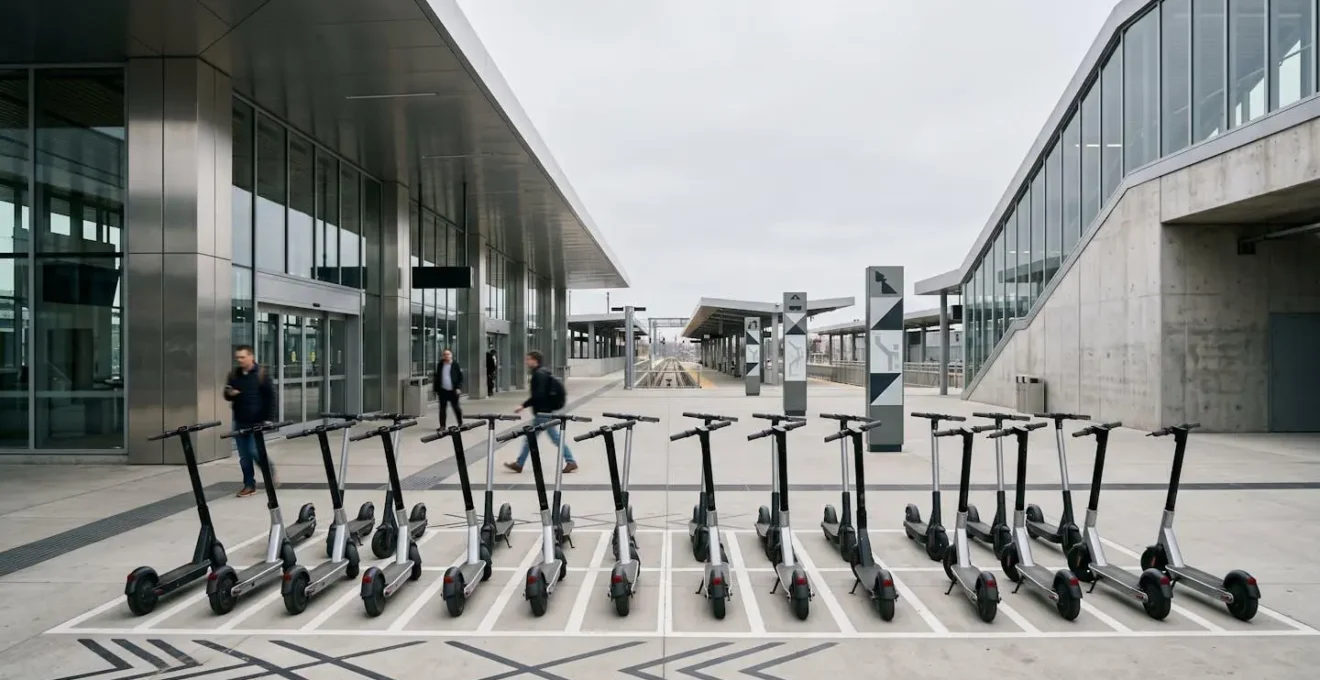
As seen here, the physical design of modern transit hubs increasingly facilitates these connections. However, a successful strategy requires more than just infrastructure. You must build in a time buffer—typically 5-10 minutes—for each « last-mile » scooter segment. This accounts for realities like finding a charged scooter during peak hours, navigating around no-parking zones, or dealing with unexpected weather. A smart commuter always has a backup, such as knowing the walking route or a nearby bus line, to ensure the system is resilient.
By treating scooters and trains as complementary parts of a single system, you transform your daily commute from a source of stress into a competitive advantage, saving both time and money.
Car Subscription vs. Lease: Which Offers Better Flexibility for Digital Nomads?
For a digital nomad or any professional with a mobile lifestyle, flexibility isn’t a perk; it’s a core requirement. Traditional car acquisition models, particularly leasing, are fundamentally at odds with this need. A lease locks you into a specific vehicle for a long-term commitment, typically 24-48 months, with severe financial penalties for early termination. It’s a model built on the assumption of stability and a fixed geographic base, making it a poor fit for anyone whose career or life might require relocating on short notice.
Car subscriptions, on the other hand, are designed around the principle of agile mobility. They offer the utility of a car without the long-term liability of ownership or leasing. As CASI Auto, a leader in the subscription space, explains, the core differentiator is commitment. In their analysis, they highlight the fundamental gap between the two models:
The main difference between flexible leasing and car subscription is the level of commitment required. While flexible leasing offers consumers more flexibility than a standard lease, it still requires a commitment to a specific vehicle for a certain amount of time. Car subscription, on the other hand, offers complete flexibility and convenience without any long-term commitments.
– CASI Auto, The Difference Between Car Subscription and Flexible Leasing
This flexibility manifests in several key ways: short minimum commitment periods (often just 1-3 months), the ability to pause the service, and the option to swap vehicles as your needs change—from a compact city car to an SUV for a weekend trip. This « on-demand » nature is the defining feature for a nomadic professional, turning the car from a fixed asset into an adaptable service.
The following table provides a clear, feature-by-feature comparison, demonstrating why the subscription model’s structure is inherently better suited for a lifestyle defined by change and uncertainty.
| Feature | Car Subscription | Traditional Lease |
|---|---|---|
| Minimum Commitment | 1-3 months | 24-48 months |
| Vehicle Swapping | Yes, within subscription service fleet | No, locked to specific vehicle |
| Pause Option | Yes, most services allow pausing subscription | No, must continue payments or pay early termination fees |
| Geographic Restrictions | Varies by provider; often cross-state allowed, international restricted | State/region restrictions in fine print; early termination for relocation |
| Insurance Flexibility | Included, tied to subscription | Separate policy required, tied to declared residence |
| Early Exit Cost | Typically 30-day notice, no penalty | High termination fees (often thousands) |
| Monthly Cost | $600-1,200+ (all-inclusive) | $300-600 (plus separate insurance, maintenance) |
| Domicile Requirements | Flexible, but must be transparent with provider | Strict legal residence requirements for contract validity |
For the digital nomad, the car subscription isn’t just a different payment plan; it’s a strategic tool that aligns their mobility with their fluid lifestyle, eliminating the financial and logistical anchor of a traditional lease.
The « Unlock Fee » Trap That Doubles Your Monthly Scooter Budget
Micromobility services like e-scooters are a brilliant component of an urban mobility portfolio, but they come with a hidden cost structure that can catch casual users by surprise: the unlock fee. While the low per-minute rate is heavily advertised, every single ride begins with a fixed charge, typically around $1. This may seem insignificant, but for the most common use case—short, last-mile trips—this fee can be the dominant part of the total cost. In fact, a detailed analysis of micromobility pricing structures reveals that for trips under 5-7 minutes, the unlock fee can constitute over 50% of the final price.
This creates the « unlock fee trap. » A user making two short trips per day (e.g., to and from the train station) can accumulate $60 per month in unlock fees alone, before accounting for any time-based charges. For a frequent commuter, this quickly transforms what appears to be a cheap, flexible option into a significant monthly expense, sometimes doubling the anticipated budget. The business model is designed to be profitable on these short, high-frequency rides, and the financial burden falls squarely on the user who hasn’t done the math.
The visualization below captures the seemingly simple moment of payment, which masks the complex and often costly fee structure behind each tap.

The solution for any regular user is to move from a pay-as-you-go model to a subscription or monthly pass. Nearly all major providers (Lime, Bird, Spin) offer passes that either eliminate unlock fees entirely or provide a bundle of free unlocks. The break-even point is typically around 10-15 trips per month. If your usage exceeds this threshold, a monthly pass almost always delivers a better Mobility ROI. For example, a user paying $1 per unlock and an average of $3 per ride for 20 trips a month would spend $80. A $59 monthly pass would offer substantial savings. It’s a simple calculation, but one that is crucial for managing the costs within your mobility portfolio.
Ultimately, treating micromobility with the same financial scrutiny as any other transportation expense is key. Analyzing your usage patterns and investing in a monthly pass is the strategic move to escape the unlock fee trap and keep this valuable tool cost-effective.
When to Sell Your Car: Signs You Are Ready for a Car-Free Lifestyle?
Letting go of a car is more than a financial decision; it’s a lifestyle transformation. The thought can be daunting, haunted by « what if » scenarios for emergencies or weekend getaways. However, for many city dwellers, the convenience a car provides is a psychological illusion that doesn’t stand up to a cost-benefit analysis. The key is to objectively determine if you’ve reached your « Mental Break-Even Point, » where the stress, cost, and mental load of ownership consistently outweigh the practical benefits. The transition to a car-free life shouldn’t be a leap of faith but a data-driven conclusion.
One of the most telling metrics is the « Dust and Guilt Index »: how many days per week does your car sit parked, gathering dust while you pay for its existence? If it’s five or more days a week, you’re not paying for transportation; you’re paying for expensive, stationary storage. Another critical sign is the maturity of your local Mobility-as-a-Service (MaaS) ecosystem. If you have reliable access to at least three viable alternatives—like frequent public transit, readily available car-share vehicles, and a safe network for micromobility—the primary argument for private ownership collapses. These services combine to form a safety net that covers nearly all transportation needs.
The final barrier is often the « edge cases »—the rare trips that seem to necessitate a personal vehicle. Before letting these outliers dictate your financial life, price them out. How much would a rental car cost for that one annual road trip? Can that trip to the furniture store be replaced by a delivery service for a fraction of your monthly insurance payment? When you quantify these alternatives, you often find they are far cheaper than the year-round cost of owning. To help you make this critical decision, use the following audit to assess your readiness.
Your readiness checklist for a car-free life
- Calculate Your ‘Dust and Guilt’ Index: For one month, track the number of days your car remains unused. If it consistently exceeds 20 days, you are primarily paying for storage, not transport.
- Map Your MaaS Ecosystem: Verify that you have reliable access within a 10-minute walk to at least three distinct mobility options (e.g., train station, car-share pod, scooter/bike hub). A strong ecosystem is a prerequisite.
- Run a Total Cost Comparison: Sum up your total monthly car costs (payment, insurance, parking, fuel, maintenance). Compare this figure to a projected budget using on-demand services for your actual travel patterns. The difference is your potential monthly savings.
- Conduct a ‘One-Month Trial Separation’: Park your car and commit to using only alternative transport for 30 days. This real-world test is the single best predictor of long-term viability and will reveal any true gaps in your mobility plan.
- Price Your ‘Edge Cases’: List the 3-5 trips per year where a car seems essential (e.g., moving large items, family vacations). Research and price out specific alternatives like rental cars or delivery services to confirm these do not justify year-round ownership costs.
Selling your car is the ultimate act of optimizing your mobility portfolio—liquidating a depreciating, high-maintenance asset to free up capital for more flexible, cost-effective services.
Why the Shift to Usership Models Could Save Your Company 20% in OpEx?
The principles of the mobility portfolio don’t just apply to individuals; they are revolutionizing corporate fleet management. For decades, companies have been locked into a cycle of capital-intensive vehicle acquisition, management, and disposal. This traditional model burdens the balance sheet with depreciating assets and saddles the income statement with unpredictable operating expenses (OpEx) like fuel, maintenance, and insurance. The shift to « usership » over « ownership »—leveraging Mobility-as-a-Service (MaaS)—offers a direct path to significant cost reduction and operational agility.
The core financial benefit comes from converting a large capital expenditure (CapEx) into a predictable, scalable operating expense. Instead of buying a fleet of vans, a company can subscribe to a mobility service, paying a fixed monthly fee that covers vehicle access, insurance, and maintenance. This immediately frees up capital that would have been tied up in assets that are often underutilized. It also smooths out cash flow by eliminating the surprise costs of major repairs or seasonal fluctuations in fuel prices. Comprehensive studies on Mobility-as-a-Service for corporate fleets indicate that this strategic shift leads to reduced costs on vehicle acquisition, maintenance, and fuel.
While a 20% reduction in OpEx is a commonly cited benchmark, the actual savings depend on the company’s specific usage patterns. The greatest gains are found in businesses with variable demand or urban-centric operations. For example, a delivery company that experiences seasonal peaks can scale its fleet up or down through a MaaS provider without having to own and maintain idle vehicles during the off-season. This « right-sizing » of the fleet in real-time is a powerful lever for efficiency that the ownership model simply cannot match. It transforms the corporate fleet from a fixed cost center into a flexible, on-demand resource.
By embracing a usership model, companies can not only achieve significant cost savings but also build a more resilient and adaptable operation, ready to respond to the evolving landscape of urban logistics and employee mobility.
E-Bike vs. Diesel Van: How Much Do You Save on Maintenance and Fuel?
For urban logistics and last-mile delivery, the diesel van has long been the default workhorse. However, a granular look at the Total Cost of Ownership (TCO) reveals it to be an increasingly inefficient and expensive tool for dense city environments. The electric cargo bike, or e-bike, is emerging as a dramatically more cost-effective alternative, with savings that extend far beyond just fuel. The most significant financial advantages lie in maintenance, energy costs, and insurance.
A diesel van is a complex machine with an internal combustion engine, an emissions control system, and numerous moving parts that require regular, costly service. Oil changes, filter replacements, and inevitable repairs to the powertrain create a constant and often unpredictable stream of maintenance expenses. An e-bike, by contrast, has a far simpler mechanical profile. Its maintenance is largely limited to inexpensive consumables like brake pads and chains, with a potential battery replacement after several years. This difference in mechanical complexity translates directly into a massive reduction in service costs and, just as importantly, operational downtime.
The energy cost differential is equally stark. Powering an e-bike costs pennies in residential electricity, while fueling a diesel van involves exposure to volatile global fuel markets. When you factor in the significantly lower insurance premiums and the absence of expensive registration fees for e-bikes, the financial case becomes overwhelming. The following 5-year TCO comparison, based on data points from a recent analysis of vehicle ownership costs, quantifies the staggering difference in long-term expenses.
| Cost Category | E-Bike (5 years, 15,000 miles) | Diesel Van (5 years, 15,000 miles) |
|---|---|---|
| Initial Purchase | $1,500-3,000 | $35,000-50,000 |
| Energy Cost (per 100km) | $0.50-1.00 (residential electricity) | $12-18 (diesel fuel) |
| Total Energy (15,000 miles) | ~$120-240 | ~$2,900-4,300 |
| Maintenance (5 years) | $300-600 (tires, brake pads, chain, battery replacement) | $3,000-6,000 (oil changes, filters, emissions systems, major repairs) |
| Insurance (annual) | $75-150 (if required) | $1,800-2,500 |
| Insurance (5 years) | $375-750 | $9,000-12,500 |
| Registration/Licensing | $0-50 total | $500-1,000 |
| Downtime Cost | Near-zero (quick service, on-site repairs) | $500-2,000 (shop time, business disruption) |
| Total 5-Year Cost | $2,345-4,640 | $51,900-75,800 |
| Cost Savings with E-Bike | $47,160-71,160 (91-94% reduction) | |
A reduction of over 90% in total cost is not an incremental improvement; it is a disruptive economic shift. For urban-focused businesses, integrating e-bikes into their mobility portfolio isn’t just an environmental choice, it’s a profound strategic move to boost profitability.
Key takeaways
- Total Cost is the Only Metric That Matters: Don’t just compare monthly payments. A true analysis must include parking, insurance, maintenance, and depreciation to reveal the full financial burden of car ownership.
- Flexibility Has a High Monetary Value: The ability to pause, swap, or cancel a car subscription is a form of financial insurance against life changes, a benefit traditional leasing and ownership models cannot offer.
- Build a Portfolio, Don’t Buy an Asset: The smartest approach to urban transport is to allocate your budget across a diverse mix of services (subscriptions, transit, micromobility) to match your specific needs, maximizing your « Mobility ROI. »
–
How to Adapt Your Fleet Strategy to Emerging Mobility Trends Without Losing Capital?
For a business, adapting to the new mobility landscape is a high-stakes challenge. The risk of investing heavily in a fleet of vehicles—whether gasoline, diesel, or even electric—is that technology and regulations could render them obsolete or economically unviable far sooner than anticipated. The key to navigating this uncertainty is to shift from a strategy of « purchasing assets » to one of « creating policy » while retaining capital. This involves a phased, data-driven approach that minimizes risk and maximizes flexibility.
The first phase is to resist the urge to make large capital investments. Instead, launch low-cost, short-term pilot programs with several MaaS providers. By focusing on specific use cases, like urban deliveries or employee commutes for a select group, the company can gather invaluable internal data on utilization rates, true cost-per-mile, and employee satisfaction without committing significant capital. This data becomes the foundation for all future decisions, replacing guesswork with hard evidence.
Based on this analysis, the company can then develop a strategic divestment plan. This doesn’t mean selling the entire fleet overnight. It means identifying the lowest-utilization vehicles or those most at risk of depreciation (like older diesel vans) and selling them at optimal resale points. The capital recovered from these sales is not reinvested into new vehicles but is instead held to fund the expansion of the MaaS program or to establish a flexible employee mobility budget. This creates a hybrid fleet model where a small, core-owned fleet for essential, high-utilization tasks is complemented by a large, flexible network of on-demand services. The following plan outlines a practical path to achieve this transition:
- Phase 1 – Pilot Program Launch (Months 1-3): Partner with MaaS providers for short-term pilots to gather internal data on usage patterns and costs before committing capital.
- Phase 2 – Data Collection & ROI Analysis (Months 4-6): Track metrics like vehicle utilization and cost per trip to identify which owned vehicles are prime candidates for MaaS replacement.
- Phase 3 – Strategic Divestment (Months 7-12): Develop a timeline to sell low-utilization or at-risk vehicles to free up capital and avoid further depreciation losses.
- Phase 4 – Hybrid Fleet Model Implementation (Months 13-24): Gradually replace owned assets with MaaS and alternative vehicles (like e-bikes) for proven use cases, retaining a core fleet only where ownership provides clear economic advantages.
- Phase 5 – Policy Over Purchase (Ongoing): The ultimate goal is to establish a flexible employee mobility budget that can be used across any service, making the company’s strategy resilient to future trends.
By evolving from a buyer of vehicles to a sophisticated manager of mobility services, a company can build a fleet strategy that is not only cost-effective today but also resilient enough to thrive in the uncertain transportation landscape of tomorrow.