
The terrifying experience of « phantom braking » is not a random glitch but a predictable conflict between your car’s radar and camera systems. This guide demystifies why these sensor disagreements happen, moving you from a startled passenger to an informed supervisor. By understanding the specific triggers—from sun glare to aftermarket modifications—you can learn to anticipate the system’s limits, intervene correctly, and ultimately regain trust in your vehicle’s safety features.
The feeling is unforgettable and deeply unsettling. You’re cruising on the highway, and without warning, your car slams on the brakes. Your heart lurches into your throat as you check the mirrors, bracing for a rear-end collision. There was nothing in front of you. This is « phantom braking, » an event that can shatter a driver’s trust in their vehicle’s advanced driver-assistance systems (ADAS).
The common advice often feels inadequate: « keep your sensors clean » or « it happens with shadows and overpasses. » While not untrue, this advice fails to address the core of the driver’s terror: the feeling of complete loss of control over a machine making a critical, and seemingly irrational, decision. The fear isn’t just about the sudden stop; it’s about the system’s unpredictability.
But what if these events weren’t as random as they feel? The key to moving past the fear is not to simply hope for a software update, but to become an investigator. This guide treats phantom braking not as a ghost in the machine, but as a logical, albeit flawed, outcome of a complex decision-making process. By understanding the « why » behind the system’s errors—the specific conflicts between its electronic eyes and ears—you can learn to anticipate its weaknesses, know when and how to intervene, and rebuild your confidence from a place of knowledge, not blind faith.
This article will dissect the primary causes of these false positives and provide actionable protocols. We will explore how to verify your system’s health, the mistakes to avoid, and what to do when a sensor glitch creates a cascade of warnings, empowering you to become an informed supervisor of your car’s technology.
Summary: How to Prevent « Phantom Braking » Events on the Highway?
- Why Radar and Camera Disagreement Causes False Braking?
- How to Know Your AEB Works Without Crashing into a Wall?
- Rear Cross Traffic Braking: Is It Worth It for Parking Lots?
- The Bull Bar Mistake That Blocks Your AEB Sensors
- When to Brake: Does Intervening Cancel the Emergency System?
- The Sun Glare Angle That Blinds LiDAR and Causes Sudden Stops
- The Sensor Glitch That Can Disable Your Car on the Highway
- Do Advanced Safety Systems Actually Lower Your Insurance Premiums?
Why Radar and Camera Disagreement Causes False Braking?
At its core, phantom braking is a story of a sensor fusion conflict. Your vehicle’s Automatic Emergency Braking (AEB) system doesn’t rely on a single input. Instead, it synthesizes data from multiple sources, primarily a forward-facing radar and a camera mounted near the rearview mirror. The camera is excellent at identifying the *shape* of an object (a car, a pedestrian, a bicycle), while the radar is superb at determining its *distance, speed, and location*, regardless of light conditions. When both agree that a collision is imminent, the system works flawlessly. The technology has improved dramatically; recent AAA testing demonstrates that 2024 vehicles avoided 100% of forward collisions at speeds up to 35 mph.
The problem arises when these two sensors disagree. Imagine you’re driving under a large, dark highway sign on a bright, sunny day. The camera might misinterpret the sudden, large shadow as a stationary object directly in your path. The radar, however, sends back a clear signal: the road ahead is empty. The car’s central processor is now faced with a critical dilemma. Does it trust the camera, which sees a potential obstacle, or the radar, which sees none? In many phantom braking scenarios, the system is programmed to err on the side of caution. It trusts the « possible » threat identified by the camera and applies the brakes, just in case.
This conflict can also be triggered by benign objects. A metal manhole cover, a discarded piece of tire on the roadside, or even the steel expansion joints on a bridge can create a strong radar reflection. If the camera simultaneously has its view obscured or confused—perhaps by rain, fog, or another car’s headlights—the system might interpret the strong radar return as a legitimate hazard and trigger a false braking event. Understanding this inherent conflict is the first step in demystifying the « phantom » nature of these incidents.
How to Know Your AEB Works Without Crashing into a Wall?
After a frightening phantom braking event, it’s natural to question if your AEB system is working correctly at all. The thought of testing it against a real obstacle is both dangerous and impractical. Fortunately, you can gain confidence in your vehicle’s systems through safe, observational methods that don’t involve risking a collision. These techniques help you become familiar with the system’s behavior and its preliminary warning stages, turning you into a more informed supervisor.
One of the most effective proxies for testing AEB is to actively use and observe your Adaptive Cruise Control (ACC). On the highway, watch how the system detects vehicles ahead, maintains a following distance, and slows down. This uses the same forward-facing radar and camera hardware as the AEB system, providing a real-time, low-stakes demonstration of its ability to « see » and react to traffic. Pay attention to how it behaves in different conditions, such as curves in the road or when another car cuts into your lane.
This illustration highlights a typical dashboard diagnostic screen, where you can often verify that all ADAS components are active and have passed their initial self-checks.

Furthermore, learn to recognize the multi-stage alerts that precede a full AEB engagement. Most systems don’t go from zero to full braking instantly. There’s typically an initial audible beep paired with a visual icon on the dashboard. This may be followed by a brief, gentle « brake tap » to get your attention. Recognizing these preliminary warnings gives you a window to assess the situation and override the system if it’s a false alarm. Checking your vehicle’s ADAS status menu in the infotainment system can also confirm that the car’s self-diagnostics have not detected any sensor faults.
Rear Cross Traffic Braking: Is It Worth It for Parking Lots?
While phantom braking on the highway is the most terrifying ADAS malfunction, related systems like Rear Cross Traffic Alert (RCTA) with braking pose their own set of questions, particularly in low-speed environments like parking lots. Is this feature, which can abruptly stop your car while reversing, a genuine benefit or just another annoyance? To answer that, we must look at the environment it’s designed for: the chaotic and unpredictable parking lot, a hotbed for minor collisions.
Parking lots are notoriously difficult to navigate. Your view is often completely blocked by larger vehicles, like SUVs and vans, as you back out of a space. This is precisely the scenario RCTA is built for. Using side-facing radar sensors in the rear bumper, it « looks » down the aisle for approaching vehicles, cyclists, or pedestrians that you cannot see. When it detects an object on a collision course, it first provides an audible and visual warning. If you don’t react, the system will apply the brakes automatically to prevent a crash.
The value of this becomes clear when you consider the frequency of low-speed incidents. According to a landmark study by the Partnership for Analytics Research in Traffic Safety (PARTS) covering 98 million vehicles, AEB systems have proven to cut rear-end crashes in half. While focused on forward collisions, this demonstrates the incredible potential of automated braking. In the context of parking lots, where fender-benders are rampant, a system that prevents even one costly and inconvenient incident can be considered well worth it. The sudden jolt of an RCTA engagement may be startling, but it is almost always preferable to the sound of crunching metal and a subsequent insurance claim.
The Bull Bar Mistake That Blocks Your AEB Sensors
Not all phantom braking issues are the fault of the car’s software. Sometimes, the problem is unintentionally installed by the owner. Aftermarket modifications, particularly those at the front of the vehicle like bull bars, grille guards, or even custom bumpers, can have a devastating impact on ADAS performance. These accessories can partially or completely block the very sensors the AEB system relies on, leading to either constant false alarms or, more dangerously, a complete failure to detect a real hazard.
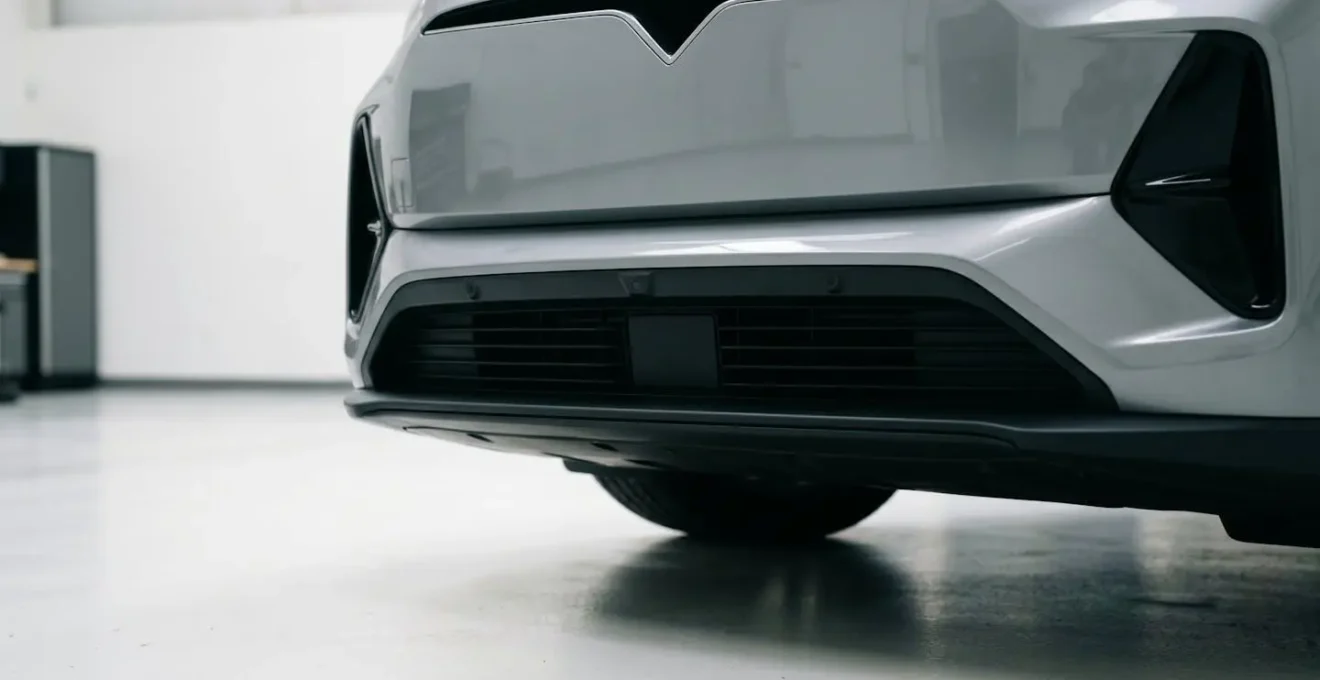
The forward-facing radar sensor is typically located in the lower grille or behind the manufacturer’s emblem. It emits a cone-shaped beam that needs a clear, unobstructed path. A metal bull bar, no matter how stylish, acts as a blindfold. It can block the signal entirely or, worse, create bizarre reflections and « ghost » signals that confuse the system into thinking an obstacle is present when there is none. Even non-metal objects can cause issues. A thick plastic bumper that isn’t designed to OEM specifications for material density and curvature can distort the radar waves, rendering the sensor inaccurate.
This image shows the critical front fascia area where radar and camera sensors are integrated, a zone that must remain unobstructed for ADAS to function correctly.
To avoid these self-inflicted problems, it is crucial to only use ADAS-compatible aftermarket parts. Reputable manufacturers test their products to ensure they don’t interfere with sensor operation. According to guidelines from organizations like SEMA, any modification within the radar’s projection area must be carefully vetted. This includes ensuring bull bars have precise cutouts for both radar and camera fields of view and that any plastic components match OE specifications. After any such installation, or even a windshield replacement that involves the camera mount, a professional ADAS recalibration is mandatory to ensure the system’s « vision » is correctly aligned.
When to Brake: Does Intervening Cancel the Emergency System?
When your car brakes unexpectedly, your first instinct is to fight it. But can you? And should you? Understanding your ability to override the system is critical. In most phantom braking scenarios, you absolutely can and should intervene. A firm press on the accelerator is typically enough to tell the system it’s a false alarm, causing it to disengage the brakes and return control to you. A slight steering input can also signal to the car that you are alert and in command.
However, there is a crucial concept to understand: the decision threshold, or the point of no return. AEB systems are designed to save you from a collision when you are not reacting. If the system calculates that a crash is milliseconds away, it will commit to maximum braking power, and at that point, it may ignore your inputs. This is by design, as a last-ditch effort to mitigate or avoid an impact. As experts from the AAA Automotive Research Center note:
Most AEB systems have a temporal or proximity threshold beyond which driver input is ignored, making immediate action critical when detecting a false positive to override the system before reaching the point of no return.
– AAA Automotive Research Center, Progression of Automatic Emergency Braking Technology
This highlights why situational awareness is paramount. By recognizing the early signs of a false positive—the visual alert, the initial beep—you can intervene long before the system reaches that critical decision threshold. This knowledge is empowering. It confirms that in the vast majority of false alarm cases, you remain the ultimate authority. The system is an assistant, not a dictator, and your prompt, decisive input will almost always be respected. This intervention ability is a core part of a safety net that is, overall, highly effective; a comprehensive analysis published in PMC demonstrates that low-speed AEB systems reduced front-to-rear crash rates by 43%.
The Sun Glare Angle That Blinds LiDAR and Causes Sudden Stops
While sensor disagreements are a primary cause of phantom braking, certain environmental conditions can effectively « blind » a single sensor, leading to the same result. One of the most common and unnerving environmental triggers is low-angle sun glare. This occurs most often when driving directly into a rising or setting sun. The intense, direct light can overwhelm the car’s forward-facing camera, causing it to momentarily « white out. » In this state, the camera cannot reliably detect lane lines or objects.
If your car relies heavily on its camera system (as in some « vision-only » ADAS suites), this temporary blindness can be enough to trigger a braking event. The system, suddenly unable to see the road ahead, may default to a « safe state » by decelerating sharply. In sensor fusion systems that also use radar or LiDAR, sun glare can still cause conflicts. The camera reports « I see nothing, » while the radar might report a clear path. This disagreement can be enough to make the central processor hesitate or brake as a precaution.
This vulnerability isn’t limited to cameras or sun glare. As research on AEB technical limitations reveals that camera and radar are less effective in adverse weather. Heavy rain, dense fog, or snow can affect all sensor types differently. Rain can distort what a camera sees, heavy precipitation can interfere with LiDAR beams, and dense fog can limit radar range. Each sensor has its own unique Achilles’ heel. The challenge for automotive engineers is to create fusion algorithms that can intelligently weigh the inputs from each sensor based on the current environmental conditions, a task that is still being perfected.
The Sensor Glitch That Can Disable Your Car on the Highway
Perhaps more frightening than a single phantom braking event is a systemic cascade failure. This occurs when one sensor’s glitch triggers a domino effect, causing multiple, seemingly unrelated warning lights to illuminate on your dashboard. You might suddenly see alerts for « AEB Unavailable, » « Cruise Control Disabled, » and « Traction Control Fault » all at once. In some vehicles, this can even put the car into a « limp mode, » drastically reducing power and forcing you to the side of the road.
This cascade happens because modern vehicles are incredibly interconnected. The radar sensor doesn’t just talk to the AEB module; its data is also used by the adaptive cruise control. The wheel speed sensors, crucial for the ABS and traction control, also provide speed data to the ADAS. If one of these key sensors provides erratic data—or fails completely—the central computer can’t trust the information from any of the systems that rely on it. As a safety measure, it disables them all, leading to the cascade of warnings.
The driver’s experience during this event is one of pure anxiety, feeling as though the entire car is shutting down at highway speeds.

Experiencing this can feel catastrophic, but having a clear protocol can restore a sense of control. The most important thing is to document everything for the technician who will diagnose the problem. A single, transient glitch can be nearly impossible to find after the fact unless you provide a detailed account of exactly what happened.
Your Action Plan: Emergency Protocol for ADAS Failures
- Safely Pull Over: When multiple warning lights appear, immediately activate your hazard lights and move to a safe location off the roadway.
- Document the Sequence: Use your phone to photograph the dashboard, capturing all warning lights in the order they appeared. Note the time and current driving conditions.
- Record On-Screen Messages: Before turning off the vehicle, write down or photograph the exact text of any messages displayed on the instrument cluster or infotainment screen.
- Note Environmental Conditions: Document the weather (rain, sun glare), road surface, your speed, and any unusual structures (bridges, tunnels) you were near when the failure occurred.
- Provide Complete Documentation to Your Technician: Share all your photos, notes, and a timeline of the event. This information is invaluable for diagnosing complex electronic issues.
Key Takeaways
- Phantom braking is primarily caused by a « sensor fusion conflict, » where the car’s camera and radar disagree on whether an obstacle is present.
- Drivers can safely build trust in their AEB system by observing its behavior with Adaptive Cruise Control and learning its multi-stage warning alerts.
- Driver intervention, like pressing the accelerator, can override most false braking events, but only before the system reaches its « decision threshold » for an imminent crash.
Do Advanced Safety Systems Actually Lower Your Insurance Premiums?
After grappling with the complexities and potential failures of ADAS, a practical question emerges: do these safety systems, which are meant to prevent accidents, at least result in lower insurance costs? The answer is a frustrating « sometimes. » While insurance companies acknowledge the potential of ADAS, the reality of premium reductions has not kept pace with the technology’s adoption, partly due to the very issues discussed in this article.
On one hand, the data supporting AEB’s effectiveness is undeniable. For instance, a 2025 study analyzing thousands of collisions found that vehicles equipped with AEB for pedestrian and bicycle detection showed an overall crash risk reduction of around 20%. Insurers see this data and recognize that these systems prevent claims. As a result, many carriers do offer specific, albeit often small, discounts for vehicles equipped with AEB, lane-keeping assist, and blind-spot monitoring.
On the other hand, insurers are also keenly aware of the downsides. The sensors and cameras that enable these features are expensive to repair or replace after even a minor collision. A simple bumper replacement can now involve a costly radar recalibration, driving up repair costs. Furthermore, the issue of phantom braking creates a significant liability gray area.
Case Study: The Phantom Braking Liability Investigation
The uncertainty surrounding ADAS-induced accidents is a major concern for insurers. In a significant investigation, the National Highway Traffic Safety Administration (NHTSA) looked into more than 400,000 instances of phantom braking complaints across multiple manufacturers. High-profile cases include class-action lawsuits against Tesla for sudden braking in Model 3 and Y vehicles, and a recall of over 100,000 Nissan Rogues for similar AEB software errors. These events raise a difficult question: if an AEB system causes a phantom braking event and the car is rear-ended, who is at fault? This legal ambiguity makes insurers cautious about offering deep discounts until the technology becomes more reliable and the liability landscape is clearer.
Armed with this investigative knowledge, your next step is to actively observe your car’s behavior, noting how it responds in different situations. This transforms you from a passive rider into an informed supervisor, capable of managing the technology’s limits and driving with renewed confidence.