
You can achieve significant fuel savings by transforming driver behavior, not by investing in new hardware.
- Mastering momentum through strategic coasting and anticipation is the single most effective way to cut fuel waste.
- Operating within the engine’s « sweet spot » (typically 1250-1350 RPM) is more crucial than simply aiming for low RPMs.
- Eliminating unnecessary idling prevents both immediate fuel burn and expensive, long-term engine damage to modern diesel systems.
Recommendation: Focus on coaching the ‘why’ behind these techniques to empower your drivers and create lasting, cost-saving changes in your fleet.
As a fleet manager, you know the single biggest variable in your operational budget: fuel. The constant pressure to find savings can feel like you’re being asked to squeeze water from a stone. You’ve likely looked at upgrading to newer, more efficient trucks, but the capital expenditure is daunting, especially with a tight budget. You’ve probably told your drivers to slow down, check their tires, and reduce idling—the standard advice. But what if the real key to unlocking that elusive 15% saving isn’t in what they do, but in understanding *why* they do it?
This isn’t just another checklist. This is a coaching manual. We’re going to move beyond the generic tips and dive into the mechanics and physics of efficient driving. The goal is to transform your drivers from operators following rules into strategic partners who understand momentum management, thermal efficiency, and engine mechanics. By empowering them with this deeper knowledge, you’re not just hoping for better habits; you’re building a culture of efficiency from the ground up.
Together, we’ll explore how simple shifts in technique—backed by science—can have a massive impact on your bottom line. We’ll demystify engine behavior, quantify the real cost of speed, and identify the small, often-overlooked maintenance issues that secretly drain your fuel tanks. This is about working smarter, not just harder, and giving you the tools to coach your team to victory against rising fuel costs.
This guide provides a structured coaching framework to help your drivers master the art and science of eco-driving. Each section breaks down a core principle, explaining the mechanics behind it and providing actionable insights you can implement immediately.
Summary: A Fleet Manager’s Coaching Guide to Slashing Fuel Costs
- Why Coasting to a Stop Saves More Fuel Than Braking Late?
- Shifting at 1500 vs. 2500 RPM: The Sweet Spot for Diesel Economy?
- 55mph vs. 65mph: How Much Does Speed Really Cost You in Fuel?
- The « Warm Up » Myth That Wastes Fuel on Modern Engines
- When to Leave: How avoiding Rush Hour Decreases Wear and Tear?
- How to Use Regenerative Braking to Extend Your Range by 15 Miles?
- When to Remap Your ECU: Identifying the Sweet Spot Between Power and Ecology
- Which 3 Low-Cost Parts Are Secretly Ruining Your Gas Mileage?
Why Coasting to a Stop Saves More Fuel Than Braking Late?
The most powerful tool a driver has for saving fuel is momentum. The biggest mistake is treating the brake pedal as the primary way to slow down. Every time a driver hits the brakes, they are converting kinetic energy—energy you’ve already paid for in fuel—into waste heat. The key is to teach drivers to be « momentum managers » by looking far ahead and anticipating stops.
Here’s the science behind it: modern diesel engines are equipped with a feature called Deceleration Fuel Cut-Off (DFCO). When a driver takes their foot completely off the accelerator while the truck is in gear, the Engine Control Unit (ECU) completely shuts off the fuel supply to the injectors. The wheels and transmission keep the engine turning, so it uses zero fuel. This is far more efficient than idling at a stoplight or braking hard at the last second.
Coaching your team to lift their foot off the pedal and coast toward a red light or a slower vehicle ahead is the single most effective behavior change you can instill. It’s not about being slow; it’s about being smooth. A UK study on heavy goods vehicles confirmed that maximizing coasting can lead to a fuel consumption improvement of up to 10% in urban and suburban driving. This technique turns every predictable stop into a fuel-saving opportunity.
Shifting at 1500 vs. 2500 RPM: The Sweet Spot for Diesel Economy?
Many drivers, especially those who learned on older equipment, believe that higher RPMs equal more power and are necessary for acceleration. While that might feel true, it’s a major source of fuel waste in a modern diesel truck. The goal of eco-driving isn’t to rev the engine; it’s to keep it in its « sweet spot, » where it produces the most torque with the least amount of effort.
For most modern heavy-duty diesel engines, this sweet spot is surprisingly low. While it varies by engine manufacturer, research shows that the most fuel-efficient range is often between 1,250 and 1,350 RPM. Pushing the engine to 2,000 or 2,500 RPM during acceleration burns significantly more fuel for a negligible gain in performance. This practice is often called « progressive shifting » or « shifting on the rise. » It involves upshifting as soon as the engine has enough torque to handle the next gear without lugging.
Coach your drivers to listen to the engine, not just watch the tachometer. They should aim to use the minimum amount of throttle and engine speed necessary to get the job done. This gentle approach not only saves fuel but also reduces stress on the engine and drivetrain, leading to lower maintenance costs over time.
Your Action Plan for Auditing Driver Shifting Habits
- Points of contact: Identify key routes and segments (uphill, city, highway) where shifting behavior has the most impact.
- Collecte: Use telematics data or conduct ride-alongs to inventory current shifting patterns. Note average RPMs for upshifts and downshifts.
- Cohérence: Compare the collected data against the engine manufacturer’s recommended optimal RPM range (the « sweet spot »).
- Mémorabilité/émotion: During coaching, frame it as « working with the engine, not against it. » Contrast the sound of a strained engine with one in its efficient zone.
- Plan d’intégration: Set a clear, simple goal, such as « Keep shifts below 1,500 RPM when possible, » and track progress weekly.
55mph vs. 65mph: How Much Does Speed Really Cost You in Fuel?
When you’re trying to make a delivery on time, the temptation to push the speed limit is strong. But that extra 5 or 10 mph comes at a staggering cost. The primary enemy of fuel efficiency at highway speeds is aerodynamic drag. This force doesn’t increase linearly; it increases with the square of the speed. This means that the jump from 55 to 65 mph requires much more energy than the jump from 45 to 55 mph.
This paragraph introduces the concept of aerodynamic drag. To better understand this invisible force, the illustration below visualizes how air resistance intensifies on the truck’s surfaces at higher speeds.

As the image suggests, every surface of the truck is fighting against the air. The numbers are compelling. The American Trucking Associations’ research shows that for a Class 8 truck, increasing speed from 65 mph to 75 mph can increase fuel consumption by as much as 27%. Even a small reduction in average speed can yield significant savings across a fleet. For many routes, reducing speed from 65 mph to 60 mph might only add a few minutes to the trip but can save gallons of fuel.
The « Warm Up » Myth That Wastes Fuel on Modern Engines
It’s a habit ingrained in many veteran drivers: start the engine and let it idle for 10-15 minutes to « warm up, » especially on a cold day. While this was necessary for older, carbureted engines, it’s not only wasteful but also actively harmful to a modern, electronically controlled diesel engine. A modern engine is designed to warm up most efficiently under a light load.
The most effective way to warm up a truck is to start it, wait for the oil pressure to stabilize (typically 30-60 seconds), and then begin driving gently, keeping RPMs low until the temperature gauge starts to climb. Prolonged idling does more than just waste fuel. In fact, data from the U.S. Department of Energy shows a typical long-haul truck may idle for 1,800 hours per year, consuming nearly 1,500 gallons of diesel. This idling occurs at low exhaust temperatures, which is a major problem for the emissions system.
Modern diesels use a Diesel Particulate Filter (DPF) to capture soot. This filter cleans itself (« regenerates ») using high exhaust heat generated during normal highway driving. When a truck idles for long periods, the exhaust is too cool to allow this passive regeneration. Soot builds up, eventually forcing the engine to perform an « active » regeneration, which involves injecting raw fuel into the exhaust system simply to burn off the soot. This process wastes a significant amount of fuel and puts extra wear on expensive emission components. The message to drivers is clear: idling is the enemy of both your fuel budget and your engine’s health.
When to Leave: How avoiding Rush Hour Decreases Wear and Tear?
One of the most overlooked aspects of fuel efficiency is trip planning. A driver can have perfect technique, but if they’re stuck in stop-and-go traffic for an hour, their fuel economy will plummet. Every time a 40-ton vehicle has to accelerate from a complete stop, it consumes a massive amount of fuel. Avoiding rush hour isn’t just about saving time; it’s about minimizing the number of these inefficient acceleration events.
The constant braking and accelerating of heavy traffic also dramatically increases wear and tear on the brakes, tires, and transmission. A smooth, steady drive on an open road is far less demanding on the vehicle’s components than the jerky, stressful environment of a traffic jam. Furthermore, rush hour traffic is a major contributor to idling time, which we’ve already identified as a key source of waste.
Encouraging drivers to schedule departures and arrivals outside of peak traffic times can have a huge impact. This might mean leaving 30 minutes earlier or later, or planning routes that bypass known congestion hotspots. The scale of this issue is enormous; the Argonne National Laboratory estimates that truck idling in the U.S. consumes over 1 billion gallons of fuel annually, costing the industry billions of dollars. A small adjustment in scheduling can help your fleet avoid contributing to that statistic and keep those fuel dollars in your budget.
How to Use Regenerative Braking to Extend Your Range by 15 Miles?
The term « regenerative braking » is most often associated with electric or hybrid vehicles that capture kinetic energy to recharge a battery. While a standard diesel truck doesn’t have this capability in the same way, the underlying principle of recovering energy and controlling momentum is still incredibly relevant. For a heavy truck, the equivalent is the masterful use of the engine brake (often called a Jake brake) or retarder.
This concept is best visualized when a truck is managing a long descent on a mountain grade. The image below shows a truck using its own engine to control its speed, minimizing the use of service brakes.
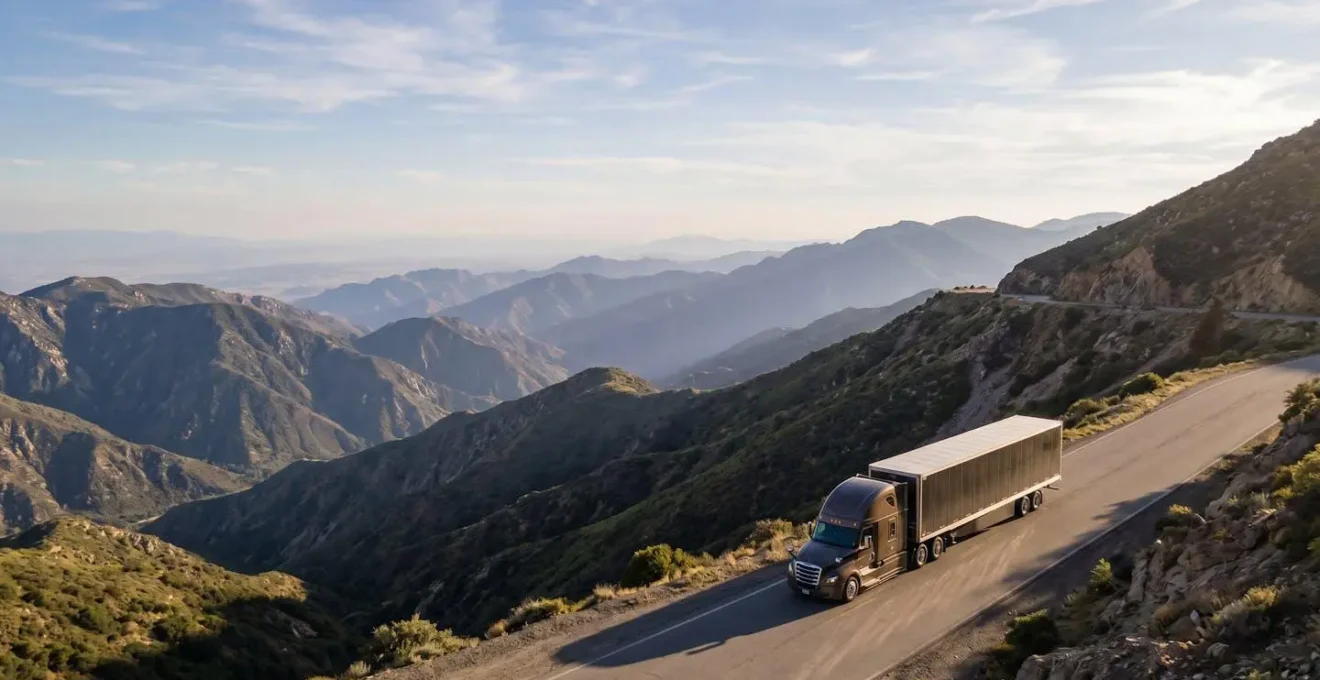
Instead of using the foot brake and turning that momentum into wasted heat, the driver uses the engine brake to hold a safe, steady speed. This has two major benefits. First, it dramatically saves wear and tear on the service brakes, preventing them from overheating and failing on long downgrades—a critical safety issue. Second, just like coasting, using the engine brake means the driver’s foot is off the accelerator, activating the DFCO and cutting fuel flow to zero. This is « regenerating » safety and control, not electricity, but it’s a core skill of an efficient, professional driver.
When to Remap Your ECU: Identifying the Sweet Spot Between Power and Ecology
ECU (Engine Control Unit) remapping, or « tuning, » is a hot topic among drivers and fleet owners. The idea of unlocking more horsepower and torque from the existing engine is tempting. Many tuning companies even promise improved fuel economy. However, this is a double-edged sword that requires careful consideration. A remap can indeed optimize fuel injection and turbo boost parameters, potentially leading to better efficiency when the truck is driven correctly.
The danger lies in how that newfound power is used. If a driver uses the extra horsepower to accelerate faster and drive at higher speeds, any potential fuel savings will be instantly erased and then some. It’s a classic case of power versus responsibility. As experts from Rush Truck Centers highlight, the relationship between speed and fuel consumption is unforgiving.
Did you know that every 1 mph increase in speed over 65 mph equals a 0.14 mpg decrease in fuel economy?
– Rush Truck Centers, 8 Ways to Improve Your Truck’s Fuel Efficiency
Therefore, an ECU remap should only be considered if your driver coaching program is already mature and your team has demonstrated a commitment to eco-driving principles. A remap on an undisciplined fleet is an invitation to burn more fuel, not less. The true « sweet spot » is a mild tune focused on low-end torque, combined with a driver who understands how to use that torque efficiently within the optimal RPM range, not for winning drag races between stoplights.
Key Takeaways
- Momentum is your most valuable asset; teach drivers to preserve it by anticipating stops and coasting instead of braking.
- Every modern diesel engine has an efficiency « sweet spot » (often 1250-1350 RPM). Operating in this zone is more important than simply keeping RPMs low.
- Prolonged idling is a dual threat: it wastes fuel directly and causes expensive, long-term damage to modern DPF emission systems.
Which 3 Low-Cost Parts Are Secretly Ruining Your Gas Mileage?
While driver behavior is the single biggest factor in fuel consumption, you can’t overlook the impact of vehicle maintenance. A perfectly driven truck can still waste fuel if simple, low-cost components are failing. These « parasitic losses » force the engine to work harder than necessary, silently draining your fuel budget. Before investing in major upgrades, ensure you’re not falling victim to these hidden fuel thieves.
Tire pressure is perhaps the most common and easiest to fix. A tire is a structural part of the vehicle, and if it’s underinflated, the engine has to expend extra energy to overcome the increased rolling resistance. According to diesel technology experts, a truck can suffer a 1% loss in fuel economy for every 10 psi it is under the recommended pressure. Across a full 18-wheel rig, that adds up fast.
Beyond tires, several small sensors can cause big problems. A failing oxygen sensor can send incorrect data to the ECU, causing it to run a rich fuel mixture. A clogged air filter restricts airflow, making the engine work harder, especially under load. This table breaks down the impact of these and other common culprits.
| Component | Condition | Impact on Fuel Economy | Additional Consequences |
|---|---|---|---|
| Oxygen (O2) Sensor | Failing/Lazy | Causes rich fuel mixture | Increased fuel consumption, higher emissions |
| Air Filter | Clogged | Significant reduction under load | Engine works harder, reduced power output |
| Coolant Temperature Sensor | Malfunctioning | Maintains warm-up fuel mixture | Drastically reduced MPG on long hauls |
| Tire Pressure | 10 psi under recommended | 1% fuel economy loss | Diminished tread life, tire failure risk |
Start today by integrating these coaching points into your driver meetings and ride-alongs. Shifting the focus from simply following rules to understanding the reasons behind them will empower your team, reduce your fuel costs, and build a more professional, efficient, and safer fleet for the long haul.