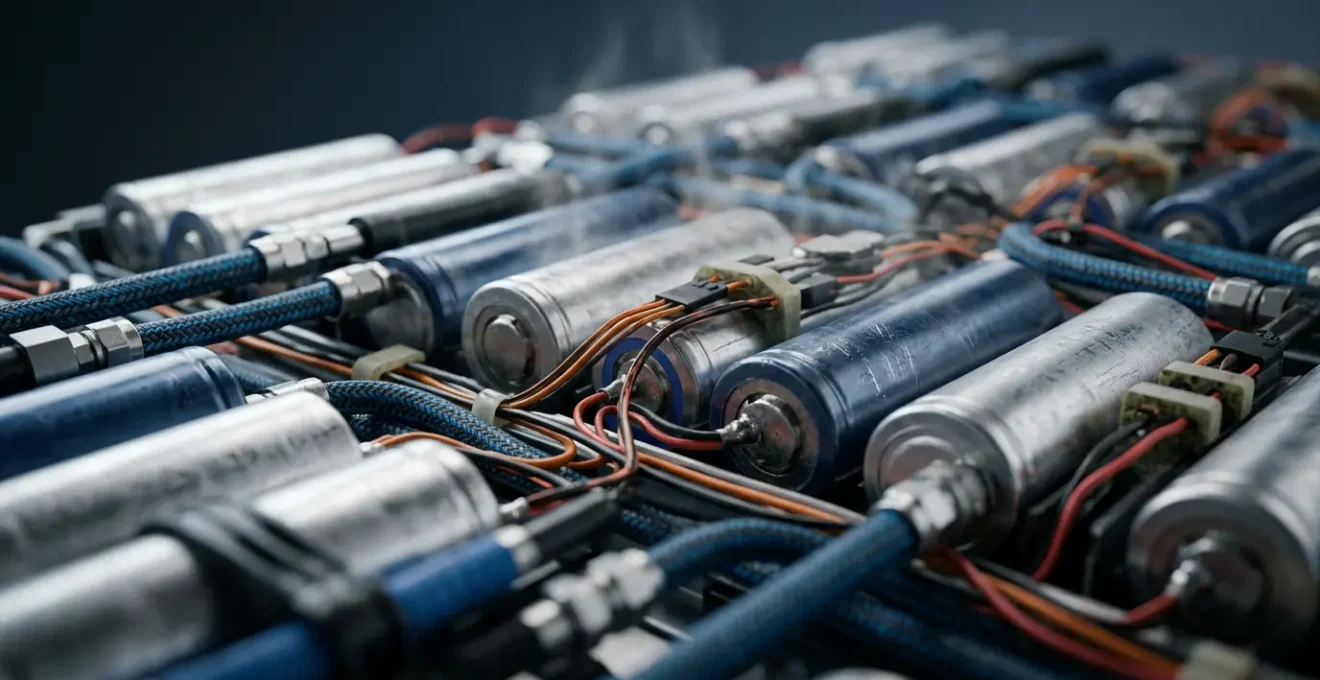
The real threat to your EV’s battery isn’t DC fast charging itself, but how you use it; mastering a few key strategies has a far greater impact on long-term health than avoiding fast chargers altogether.
- Battery degradation is primarily caused by thermal stress and charging at very high or low states of charge, not just the charging speed.
- Your vehicle’s Battery Management System (BMS) is designed to protect against damage, but you can significantly help it by understanding the charging curve and preconditioning.
Recommendation: Shift your mindset from « filling up » to 100% towards strategic, shorter charging stops that keep your battery in its 10-60% fast-charging sweet spot, especially on road trips.
For any electric vehicle owner, especially one who relies on the convenience of Superchargers and other DC fast-charging networks, a persistent worry hums in the background: « Am I killing my battery? » The conventional wisdom is clear: slow and steady AC charging at home is gentle, while high-power DC fast charging is a necessary but stressful evil that slowly chips away at your vehicle’s range. This leads to a constant, low-grade anxiety with every plug-in at a public station.
While there is a kernel of truth in this—high-power charging does introduce more thermal and chemical stress than Level 2 charging—this black-and-white view is dangerously simplistic. It overlooks the sophisticated engineering working to protect your investment and, more importantly, the immense power you have as a driver to influence your battery’s destiny. The real conversation isn’t about whether to use DC fast chargers, but how and when to use them intelligently.
The key to minimizing degradation while maximizing convenience lies not in avoiding fast chargers, but in mastering your vehicle’s own systems. By understanding the science behind the charging curve, the critical role of thermal management, and the logic of strategic charging, you can transform fast charging from a source of anxiety into your greatest asset for long-distance travel. This guide will demystify the processes at work inside your battery pack and provide you with the knowledge to charge smarter, not harder, preserving your range for years to come.
To navigate this complex topic, we will explore the essential strategies and uncover the truths behind common charging myths. The following sections break down everything you need to know to become an expert on your own vehicle’s battery health.
Summary: The Definitive Guide to EV and Hybrid Battery Health
- Why Your EV Charge Speed Drops Dramatically After 80%?
- How to Precondition Your Battery to Maximize Winter Charging Speed?
- CCS vs. NACS: Which Plug Standard Offers Better Reliability?
- The Cooling Mistake That Slows Down Your Charge on Hot Days
- When to Unplug: Why Stopping at 60% gets You to Your Destination Faster?
- The Charging Mistake That Shortens Your Hybrid Battery Life by 3 Years
- When to Install an Auxiliary Cooler on Your CVT Equipped SUV?
- Why Your Hybrid Vehicle Might Not Be Saving You Money on Highways?
Why Your EV Charge Speed Drops Dramatically After 80%?
Every EV owner who uses DC fast chargers has experienced this frustrating phenomenon: the charging speed is blazing fast up to around 80%, and then it suddenly plummets. Watching the kilowatt (kW) rate drop while the estimated time to 100% balloons can feel like a waste of time. This slowdown, known as « tapering, » isn’t a flaw; it’s a crucial, non-negotiable safety feature engineered by the Battery Management System (BMS) to protect the long-term health of your lithium-ion battery.
Think of your battery as a nearly-full parking garage. When it’s mostly empty (low state of charge), it’s easy for cars (lithium ions) to find empty spots quickly. As the garage fills up, it becomes harder and slower to find the remaining few spaces. The BMS dramatically reduces the charging power to carefully place the last ions without causing a « traffic jam. » This prevents a damaging phenomenon called lithium plating, where lithium ions build up on the anode’s surface instead of intercalating (soaking in) properly. This plating is irreversible and permanently reduces the battery’s capacity.
The time difference is staggering. As a common industry benchmark, analysis shows that charging from 80% to 100% can take nearly as long as charging from a much lower state, like 10%, all the way to 80%. For example, a Tesla Model 3 Long Range at a V3 Supercharger can gain about 70% of its charge (10% to 80%) in just 25 minutes. However, charging that last 20% can take another 20-25 minutes. This steep drop-off in efficiency is a universal principle of lithium-ion chemistry, designed to extend the battery’s service life by hundreds of cycles.
How to Precondition Your Battery to Maximize Winter Charging Speed?
Charging an EV in freezing temperatures can be a painfully slow process. If you’ve ever plugged into a DC fast charger on a cold day and seen disappointingly low charging speeds, you’ve witnessed a battery’s protest against the cold. A cold lithium-ion battery is chemically and physically resistant to accepting a fast charge. The electrolyte inside becomes more viscous, and the chemical reactions that store energy slow down, increasing internal resistance. Forcing high power into a cold battery is both inefficient and potentially damaging.
This is where preconditioning becomes your most powerful tool. Preconditioning is an active thermal management process where the vehicle uses a small amount of energy to heat the battery pack to its optimal temperature range (typically 70-90°F or 20-32°C) *before* you arrive at the charger. The single most common way to trigger this is by using the car’s built-in navigation system to route to a known DC fast-charging station. This signals the BMS to begin the warming process, ensuring the battery is ready to accept the highest possible power output the moment you plug in.
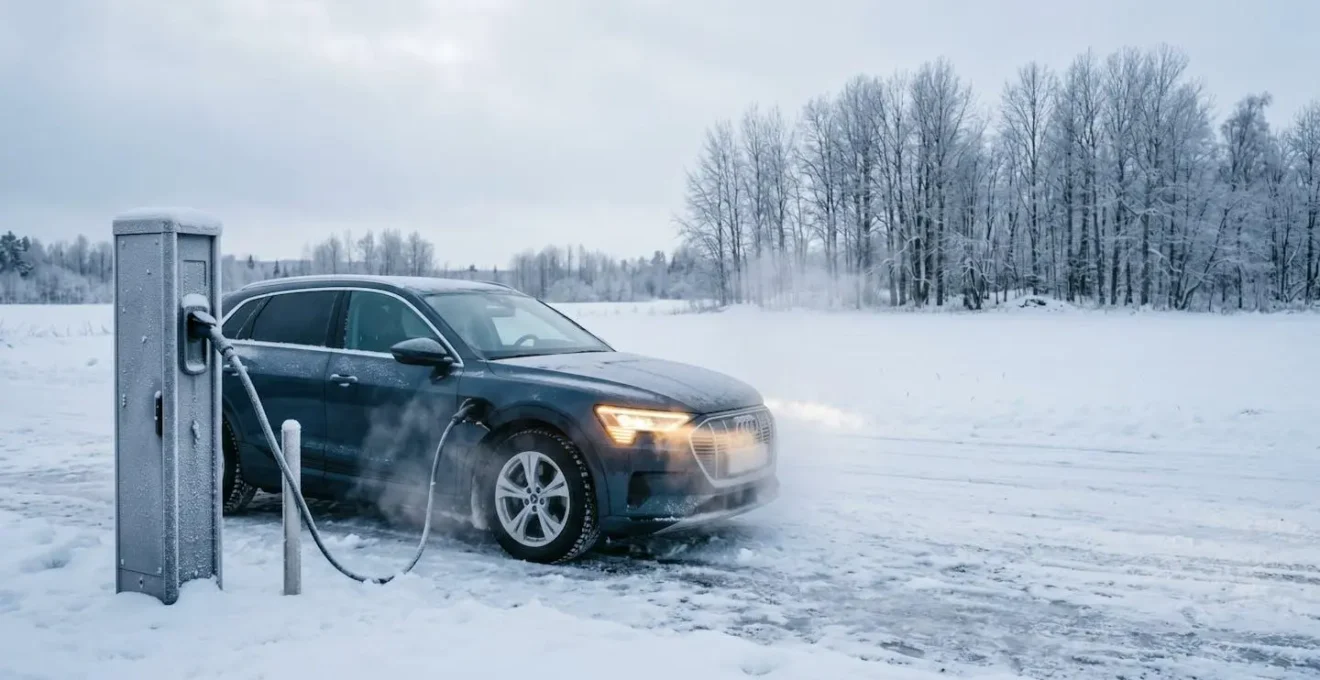
The impact is not trivial. Research into EV thermal management shows that at 20°F, an EV can lose 40% or more of its rated range, but preconditioning can recover a large part of the charging performance that would otherwise be lost. While it does use some energy from the battery to generate this heat, the time saved at the charger is almost always a net gain. As the Midtronics Battery Research Team highlights:
A preconditioned battery arriving at a DC fast charger can accept much higher charging rates, turning a 45-minute charging stop into a 20-minute stop.
– Midtronics Battery Research Team, Battery Preconditioning’s Role in Cold Climate EV Performance
CCS vs. NACS: Which Plug Standard Offers Better Reliability?
In the evolving world of EVs, the « plug war » between the Combined Charging System (CCS) and the North American Charging Standard (NACS), pioneered by Tesla, is a major topic of discussion. For a driver who relies on fast charging, the most important metric isn’t just the plug’s shape, but its reliability. A charging station is useless if it’s broken, and this is where the two standards have historically shown a significant divergence in user experience.
The core difference lies in the network philosophy. NACS has been developed within a tightly controlled, vertically integrated ecosystem. Tesla designs the cars, the chargers, and the software that connects them. This closed-loop system allows for exceptional quality control, remote diagnostics, and streamlined maintenance. The result is a network renowned for its consistency and uptime. According to charging infrastructure reliability data, Tesla’s NACS network consistently maintains an uptime of approximately 99%.
Conversely, the CCS network is an open ecosystem involving multiple hardware manufacturers (like Electrify America, EVgo, ChargePoint), various software providers, and dozens of different vehicle brands. While this fosters competition and wider availability in terms of locations, it also introduces countless variables that can lead to failure. Communication errors between the car and the charger, broken payment systems, and slower maintenance responses have historically plagued many CCS stations, creating frustration for drivers. As of early 2024, Tesla’s network comprised about 62% of all DC fast charging ports in the U.S., and its superior reliability record is the primary reason why major automakers like Ford, GM, Rivian, and others have announced plans to adopt the NACS standard, effectively ending the format war in North America.
The Cooling Mistake That Slows Down Your Charge on Hot Days
While much of the focus on battery temperature is on cold weather, extreme heat is an even greater enemy to battery health and charging speed. A battery that is too hot will be deliberately slowed down by the BMS to prevent thermal runaway and permanent cell damage. The most common and easily avoidable mistake drivers make is initiating a fast-charge session on a « heat-soaked » battery—a battery that is already hot from sitting in the sun or from hard driving.
Parking your EV in direct sunlight on a hot day can dramatically increase the battery’s core temperature even before you start driving. Thermal management studies have shown that a car’s internal temperature can be 30-40°F higher than the ambient air temperature. If you then drive and immediately plug into a DC fast charger, you’re asking the BMS to perform two difficult tasks simultaneously: cool the already-hot battery and manage the immense heat being generated by the fast charge itself. This is a recipe for a heavily throttled, or « derated, » charging session.
The BMS will prioritize safety above all else. It will aggressively limit the incoming power (kW) to give the vehicle’s cooling system—which consists of pumps, radiators, and coolant—a chance to catch up and bring the cell temperatures back into a safe operating window. The solution is simple but requires foresight. Whenever possible on hot days, park in a shaded or covered area before a planned fast-charging stop. Even 30 minutes in the shade can help reduce the battery’s initial temperature, giving the cooling system a crucial head start. This allows the BMS to permit a much faster and more sustained charging rate, getting you back on the road sooner while protecting your battery from unnecessary thermal stress.
When to Unplug: Why Stopping at 60% gets You to Your Destination Faster?
The traditional « fill-up » mentality inherited from gasoline cars is one of the hardest habits for new EV owners to break. The instinct is to charge to the highest possible percentage at every stop, but on a long-distance road trip, this is often the slowest way to travel. The key to minimizing travel time is to maximize your average speed, and that includes time spent charging. By leveraging the fastest part of the charging curve, multiple short stops can get you to your destination faster than one long one.
As we’ve established, your EV charges fastest when the battery is at a low state of charge (SoC). Based on charging curve analysis, the absolute peak speeds are typically delivered between 10% and 60% SoC. From 60% to 80%, the speed begins to taper noticeably, and after 80%, it slows to a crawl. The strategic play, therefore, is to operate almost exclusively within that high-speed 10-60% window. This means arriving at a charger with a low SoC and charging just enough to comfortably and safely reach the next charger on your route, where you will repeat the process.
Imagine you need 150 miles of range to reach the next charger. At a low SoC, you might add those miles in just 15 minutes. However, if you were to stay plugged in and charge from 80% to 95%, adding the *next* 50 miles might take an additional 20 minutes. In that extra time, you could have already been halfway to the next stop, where you’d once again be charging at peak speed. This « leapfrogging » strategy keeps you on the steepest, most efficient part of the charging curve, turning charging stops into quick, 15-20 minute breaks rather than long, 45-minute-plus ordeals.
Your Action Plan: Strategic Road Trip Charging
- Plan multiple shorter charging stops rather than one long session to stay within the 10-60% peak charging window.
- Check the distance to the next charger and your car’s realistic range; if 70-80% is enough to get there with a safe buffer, unplug and go.
- While DC fast charging, monitor the « miles added per minute » on your screen. If the rate drops to just 1-2 miles per minute, you are deep in the taper and wasting time.
- Reserve charging to 90-100% only for situations where the next charger is unusually far, such as in rural areas with sparse infrastructure.
- Use your vehicle’s navigation system to identify an optimal chain of charging stops that allows you to « leapfrog » efficiently.
The Charging Mistake That Shortens Your Hybrid Battery Life by 3 Years
While EV owners worry about fast charging, hybrid vehicle (HV) owners face a completely different, almost opposite, threat to their battery’s health: inactivity. The fundamental mistake is applying EV logic to a hybrid system. A hybrid’s small high-voltage battery (often 1-2 kWh) is not designed for range; it’s a dynamic power buffer designed for thousands of rapid, shallow charge and discharge cycles during normal driving. Its greatest enemy is sitting idle for long periods.
Unlike an EV battery that can happily sit for weeks at a moderate state of charge, a hybrid battery degrades most when it’s left at 0% or 100% SoC for extended durations. This is precisely what happens when a hybrid is not driven. The battery may self-discharge to zero, or it might be left fully charged after a short trip and then sit for days. Both scenarios accelerate capacity loss, especially in older Nickel-Metal Hydride (NiMH) packs but also in modern lithium-ion ones.
Case Study: The Pandemic’s Toll on Hybrid Batteries
The COVID-19 lockdowns provided a stark, real-world experiment demonstrating the danger of inactivity for hybrids. As explained by Hybrid Battery Management Specialists, many hybrid owners who left their cars unused for extended periods discovered premature failure of both their 12V and high-voltage batteries upon returning to normal use. The small battery packs, not designed for long-term static storage, suffered significant degradation from sitting in a state of deep discharge or being perpetually « topped off » without the regular cycling they depend on. This proved that for a hybrid battery, consistent use is not just beneficial—it’s essential for its survival.
The primary takeaway for a hybrid owner is that the best thing you can do for your battery is to simply drive the car regularly. A few drives a week are enough to keep the battery system operating as intended, cycling through its designed state-of-charge window and preventing the damaging effects of prolonged idleness. The worst thing you can do is let it become a « garage queen. »
When to Install an Auxiliary Cooler on Your CVT Equipped SUV?
Just as an EV’s battery health is dictated by thermal management, the longevity of a Continuously Variable Transmission (CVT) in an SUV is critically dependent on keeping its fluid cool. CVTs generate significant heat, especially under heavy loads like towing, climbing steep grades, or navigating stop-and-go traffic in hot weather. When the CVT fluid overheats, it begins to break down chemically, losing its viscosity and lubricating properties. This leads to increased wear on the belt and pulley system, eventually causing slipping, shuddering, and premature transmission failure.
While factory cooling systems are adequate for « normal » use, they are often pushed to their limits when an SUV is used for more demanding tasks. An auxiliary transmission cooler is an aftermarket radiator that works in tandem with the factory system to provide extra cooling capacity, keeping the fluid temperature in its optimal range (typically below 200°F or 93°C). Installing one is a proactive measure that can significantly extend the life of your CVT.
You should strongly consider an auxiliary cooler if you experience any of these warning signs or usage patterns:
- Frequent Towing: If you regularly tow a trailer that is near your vehicle’s maximum rated capacity, especially in a warm climate.
- Hot Climate Driving: If you live in an area where summer temperatures consistently exceed 85°F (29°C) and you frequently drive in heavy traffic or mountainous terrain.
- Warning Signs: If you notice a « burning toast » smell (from burnt fluid), hear a whining or humming noise that changes with engine speed, or feel a slipping sensation during acceleration.
- Temperature Monitoring: Using an OBD-II scanner to monitor your transmission fluid temperature is the most definitive method. If you see sustained temperatures above 200°F, additional cooling is warranted.
Key Takeaways
- Your charging strategy (preconditioning, avoiding 100% on DC, targeting the 10-60% window) has a bigger impact on battery health than the simple act of using a fast charger.
- Thermal management is the most critical factor for both battery and transmission longevity. Keeping components within their optimal temperature range, whether through preconditioning or auxiliary cooling, prevents premature failure.
- Vehicle systems are specialized. EV, hybrid, and CVT drivetrains have fundamentally different needs; applying the wrong maintenance or usage logic (e.g., letting a hybrid sit idle) can cause significant damage.
Why Your Hybrid Vehicle Might Not Be Saving You Money on Highways?
Hybrid vehicles are marketed on the promise of superior fuel economy, a promise they overwhelmingly deliver on in city and suburban driving. However, many hybrid owners are disappointed to find that on long highway road trips, their fuel economy is often not dramatically better—and sometimes is even worse—than an equivalent non-hybrid gasoline car. This isn’t a defect; it’s a fundamental consequence of hybrid design and physics.
A hybrid’s magic happens in its « efficiency island »—the realm of low-speed, stop-and-go driving. In these conditions, the electric motor does much of the work, and every time the driver brakes, the regenerative braking system captures kinetic energy to recharge the small battery. This constant, cyclical flow of energy is what produces stellar city MPG figures. On the highway, however, this entire advantage disappears. At a sustained high speed, braking is infrequent, so regenerative braking opportunities vanish. The primary force to overcome is aerodynamic drag, which increases exponentially with speed and affects all cars, hybrid or not.
Furthermore, at highway speeds, the small, efficient gasoline engine becomes the primary mover. It must now not only push the car through the air but also carry the « dead weight » of the electric motor and battery pack, components that are offering little assistance. As hybrid efficiency research indicates, for many models, fuel-saving benefits diminish significantly above 60-65 mph. The car is essentially operating as a slightly underpowered, slightly heavier gasoline car, which is not a recipe for optimal fuel efficiency. Understanding this helps set realistic expectations: a hybrid is a master of urban efficiency, not a highway fuel-sipping champion.
Whether managing an EV’s charge, a hybrid’s activity level, or a CVT’s temperature, the principle remains the same: knowledge transforms you from a passive operator into a proactive owner. By understanding the core design principles of your vehicle, you can align your habits with its engineering, ensuring maximum efficiency, longevity, and satisfaction for years to come. The ultimate control over your vehicle’s health and performance is in your hands.