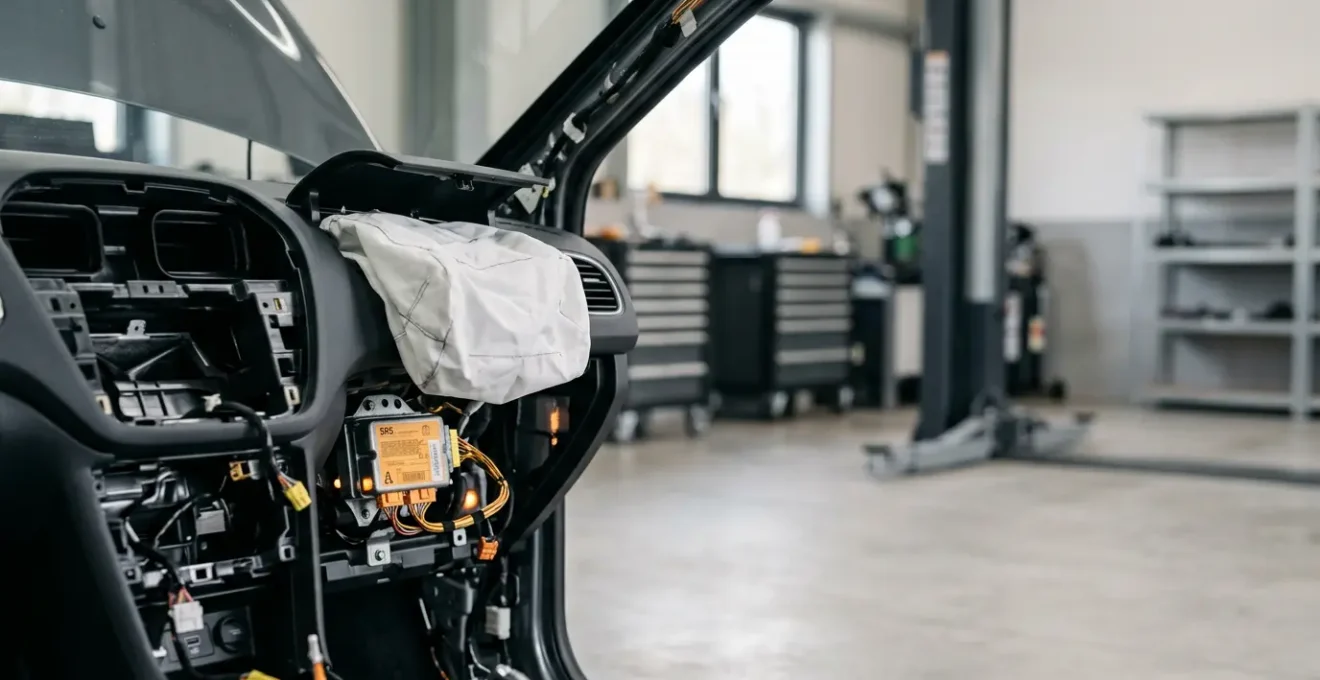
A replaced airbag does not automatically make a vehicle safe; true safety depends on the complete and expert restoration of the entire, interconnected crash management system.
- An airbag is just one component of a complex « Safety Chain » that includes sensors, modules, seat belt pretensioners, and even structural parts.
- Counterfeit airbags and improper electronic resets are common, dangerous shortcuts that can cause the system to fail catastrophically in a subsequent crash.
Recommendation: Never trust a cosmetic repair alone. Always demand a full diagnostic scan with a professional tool and an independent inspection of all safety-related components before driving a post-crash vehicle.
An airbag light on the dashboard switches off. The new steering wheel cover looks pristine. The body shop assures you the car is « good as new. » For many owners and prospective buyers of repaired vehicles, this is enough to assume safety has been restored. However, from a collision engineering perspective, this assumption is dangerously incomplete. The deployment of an airbag is not an isolated event; it’s the violent culmination of a precisely timed sequence involving sensors, electronic modules, and pyrotechnic charges. Simply replacing the bag itself without restoring the entire system is like replacing a fuse without fixing the electrical short that caused it to blow.
The common advice to « use a professional » and « check for OEM parts » is a starting point, but it fails to address the invisible yet critical risks. These include improperly reset control modules that still contain crash data, the use of counterfeit components that can fail to deploy or even explode, and ignoring the role that structural parts like bumpers play in triggering the airbag at the correct millisecond. A vehicle’s crashworthiness is not a collection of independent parts, but a holistic system. Any weak link in this Safety Chain renders the entire system unreliable.
This article will move beyond surface-level checks to provide an engineer’s perspective on what true post-deployment safety entails. We will dissect the interconnected systems, expose the common but deadly shortcuts taken in subpar repairs, and equip you with the knowledge to question, inspect, and verify that a vehicle’s most critical safety feature is genuinely ready to protect you. We are not just replacing a part; we are rebuilding a promise of safety, and every detail matters.
To navigate this complex topic, this guide examines the critical questions you must ask. We will break down everything from the hidden costs and counterfeit dangers to the essential diagnostic tools and the non-negotiable role of OEM components in preserving both your safety and your vehicle’s value.
Table of Contents: A Guide to Post-Crash Airbag Safety
- Why a $1,000 Airbag Can Total a $10,000 Car?
- How to Spot a Fake Airbag Installed by a Shady Body Shop?
- Module Reset vs. Replacement: Is Reusing Crash Data Safe?
- The Seating Position Mistake That Makes Airbags Dangerous
- Do Airbags Expire? The Truth About 15-Year-Old SRS Systems
- The Crash Test Difference Between Generic Bumpers and OEM Reinforcements
- Bluetooth vs. Handheld Scanners: Which Is Better for ABS and Airbag Codes?
- Why Paying 30% More for OEM Body Panels Protects Your Resale Value?
Why a $1,000 Airbag Can Total a $10,000 Car?
The idea that a single component could render an otherwise functional car worthless seems illogical, but it’s a common reality in collision repair. The sticker shock comes not from the airbag itself, but from the cascade of replacements it triggers. A single airbag unit might cost $1,000, but a deployment event is a signal that the entire Supplemental Restraint System (SRS) has done its job. Restoring it requires much more than just a new bag. The full replacement of the Safety Chain often includes new seat belt pretensioners (which fire to tighten belts), new impact sensors, and a new clock spring in the steering column. Crucially, it also requires a brand-new, non-negotiable Airbag Control Unit (ACU) or module.
The cumulative cost of these parts and the specialized labor required to install and calibrate them can easily reach several thousand dollars. Insurance companies operate on cold, hard math. They determine a vehicle’s Actual Cash Value (ACV) before the crash. If the estimated cost of repairs meets or exceeds a certain percentage of that ACV, the vehicle is declared a « total loss. » For example, some state laws mandate a vehicle is totaled if repair costs exceed 75% of its value. For a $10,000 car, a repair bill of $7,500—easily reached after a frontal deployment—means the insurance company will write a check for the car’s value rather than pay for the repair.
This economic threshold is a primary driver behind the unsafe practices seen in the rebuilt vehicle market. When an insurer totals a car, it’s often sold at auction to rebuilders who face immense pressure to cut costs. This is where the temptation to skip replacing a $1,000 module or use a $200 counterfeit airbag instead of a $1,200 OEM unit originates. The financial logic of the « total loss » system inadvertently creates a market for cars repaired with compromised safety systems.
How to Spot a Fake Airbag Installed by a Shady Body Shop?
A counterfeit airbag is one of the most insidious dangers in a repaired vehicle. It looks correct from the outside, and it may even turn off the SRS warning light, but it is a ticking time bomb. These fraudulent parts are not just substandard; they are often completely non-functional shells or, worse, packed with materials that can turn into deadly projectiles upon deployment. The consequences are not theoretical; federal regulators report at least nine deaths in otherwise survivable crashes directly linked to counterfeit airbag inflators. This is not a minor issue; it’s a growing threat, with U.S. Customs seizing more than ten times as many fake airbags in early 2024 as in all of 2023.
Spotting a fake requires a skeptical eye, as the forgeries are designed to deceive. However, there are several red flags. The most obvious is an SRS warning light that stays on, flickers, or fails to illuminate briefly when the car is started. But a switched-off light is no guarantee of safety, as the system can be easily tricked with a simple resistor.
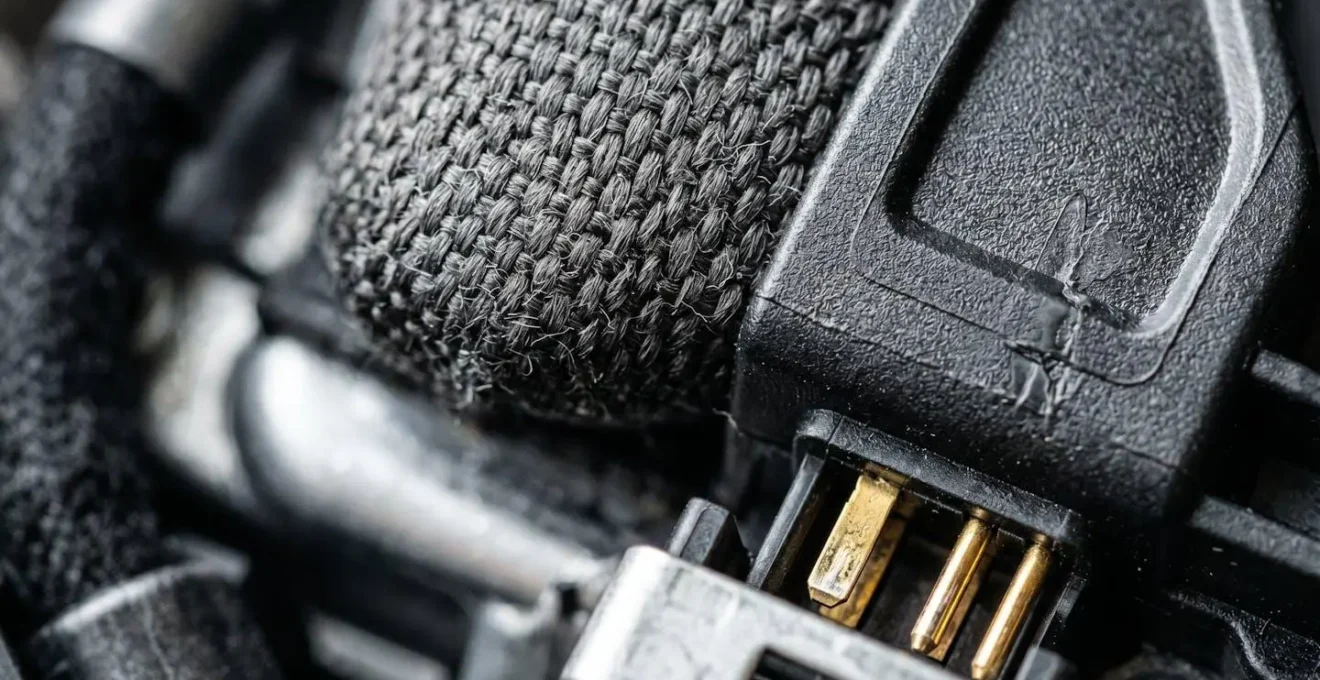
A more thorough physical inspection is necessary. Look closely at the airbag cover on the steering wheel or dashboard. Do the color and texture match the surrounding trim perfectly? Is the vehicle’s logo embossed correctly, or does it look cheap and poorly defined? Any sign of a cover that has been pried open, glued back on, or has a poor fit is a major warning. Ultimately, the only way to be certain is to see the repair documentation and verify that an Original Equipment Manufacturer (OEM) part was used. Any hesitation from the seller to provide this paperwork is a signal to walk away.
Action Plan: Verifying a Post-Repair Airbag System
- Visual Inspection: Check for mismatched panel colors, uneven gaps, and warning lights on the dash. Inspect the airbag cover for signs of tampering, incorrect logos, or poor fitment.
- Component Authentication: Request repair documentation. Verify part numbers for the airbag modules, sensors, and seat belt pretensioners are OEM. Be wary of invoices that list « rebuilt » or « used » safety components.
- Electronic Diagnostics: Perform a full system scan with a professional, manufacturer-specific scanner (not a generic Bluetooth dongle). Look for « hard codes » that couldn’t be cleared or communication errors with the SRS module.
- System Integrity Check: Confirm that related parts of the Safety Chain were replaced, including clock springs, seat belt pretensioners, and any impact sensors that were part of the deployment loop.
- Professional Validation: If any doubt exists, have the vehicle inspected by a dealership or a certified collision repair specialist who was not involved in the original repair. Their assessment is the final word on safety.
Module Reset vs. Replacement: Is Reusing Crash Data Safe?
Deep within your vehicle lies the Airbag Control Unit (ACU), the system’s black box. When a crash occurs, this module records « crash data »—irrevocable information about the impact. After a deployment, official manufacturer procedure and basic safety engineering dictate that this module must be replaced with a new one. However, a thriving and dangerous industry has emerged around « resetting » these modules. This process involves electronically wiping the crash data, making the old module appear new to the vehicle’s diagnostic system and turning off the SRS light.
The financial temptation is immense. A new ACU from a dealer can cost over $1,000, while reset services are advertised for as little as $50. Rebuilders looking to flip a salvaged car for profit often choose the reset. The problem is that this practice creates a massive, unknown safety risk. There is no guarantee that a module with wiped data will function correctly in a subsequent crash. The original crash could have caused unseen micro-damage to the module’s circuitry. More importantly, simply clearing a code does not restore the full Safety Chain. As the technical team at LND Solutions warns:
Resetting an airbag module without repairing pretensioners will not restore the system.
– LND Solutions Technical Team, Airbag Module Reset Guide
This highlights a critical point: a reset module can give a « green light » to the system even when other vital components, like the explosive seat belt pretensioners, have not been replaced. This creates a false sense of security. The car believes its safety systems are armed and ready, but key components will fail to activate in the next collision. From an engineering standpoint, there is no such thing as a « safely reset » module. The only safe module is a new, OEM module installed as part of a complete system restoration.
The Seating Position Mistake That Makes Airbags Dangerous
Even a perfectly installed, top-of-the-line airbag system can cause serious injury or death if the driver is positioned incorrectly. Airbags are not soft pillows; they are explosive devices that inflate at speeds up to 200 mph. They are designed to cushion an occupant who is correctly restrained by their seatbelt and positioned at a proper distance from the bag’s deployment zone. The fundamental purpose of an airbag is to work in concert with the seatbelt as a *supplemental* restraint.
The most critical positioning guideline comes from the Insurance Institute for Highway Safety (IIHS), which advises that every driver position themselves with at least 10 inches between their breastbone and the center of the steering wheel. Sitting closer than this puts you in the direct path of the airbag’s most violent inflation phase. This was a particularly severe problem in early airbag systems. Historical data from the National Highway Traffic Safety Administration (NHTSA) showed that during the 1990s, many airbag-induced fatalities occurred in low-speed crashes where the occupant was too close to the deploying module. While modern « depowered » and advanced multi-stage airbags have reduced this risk, the laws of physics remain unchanged: distance is safety.

Proper posture is also part of the equation. Drivers should sit upright, not with the seat excessively reclined, and hold the steering wheel at the « 9 and 3 » or « 8 and 4 » positions. This keeps arms and hands out of the direct deployment path. For a car that has undergone airbag replacement, verifying your own seating position is a critical—and free—safety check. You can have the best-repaired car in the world, but if you’re sitting on top of the steering wheel, you have inadvertently made a safe system dangerous.
Do Airbags Expire? The Truth About 15-Year-Old SRS Systems
For years, a common myth suggested that airbags had a finite lifespan, often cited as 10 to 15 years, after which they should be proactively replaced. For most modern vehicles, this is not true. Automakers design SRS components to last the life of the vehicle, and there is no scheduled maintenance or replacement interval for airbags. They are intended to be a « fit and forget » component, ready to deploy at a moment’s notice, whether the car is one day or 20 years old. In theory, the chemical propellant (sodium azide) and the electronic components are sealed and stable.
However, theory and reality can diverge, as proven by the largest automotive recall in history. The Takata airbag crisis demonstrated that material degradation over time is a real and deadly threat. The issue was that the ammonium nitrate propellant used by Takata could become unstable after long-term exposure to heat and humidity. This instability could cause the inflator to rupture during deployment, spraying metal shrapnel into the cabin. As of 2022, this defect led to the recall of 67 million vehicles in the U.S. alone, linked to at least 23 deaths and hundreds of injuries.
The Takata crisis serves as a powerful lesson: while airbags don’t have a universal « expiration date, » their long-term reliability is not infallible. It depends entirely on the quality of their components and design. For someone buying an older, repaired vehicle, this adds another layer of risk. Was the replacement airbag a new OEM part, or was it a used part salvaged from another 15-year-old car in a junkyard? A salvaged airbag carries not only its own unknown history but also the potential for age-related degradation. When evaluating a repaired car, especially an older one, insisting on a new OEM replacement airbag is the only way to mitigate the risk of installing an already-aged and potentially compromised component.
The Crash Test Difference Between Generic Bumpers and OEM Reinforcements
The concept of the Safety Chain extends beyond the airbags and sensors to the very structure of the car. Many people assume that a bumper or a fender is just a cosmetic part, but from a safety engineering standpoint, they are critical to crash management. The front bumper reinforcement bar, the foam absorbers behind it, and the front frame rails are designed as a system to do one thing: control the dissipation of energy in a crash. They are engineered to crumple at a specific rate to absorb impact forces and, just as importantly, to transmit the correct « crash pulse » signal to the airbag sensors.
The timing of an airbag deployment is measured in milliseconds. It must deploy after the initial impact but before the occupant’s body has moved too far forward. This timing is calibrated based on how a vehicle with OEM structural parts behaves in a collision. When a repair shop uses a cheaper, non-OEM (or « aftermarket ») bumper reinforcement, that calibration is compromised. These generic parts may look identical, but they often use different steel alloys or manufacturing processes. They may be stiffer or weaker than the original part.
If a generic part is too stiff, it can transfer too much force to the cabin and transmit a crash signal that is too sharp, potentially causing airbags to deploy in a minor impact where they aren’t needed. If it’s too weak, it can collapse too quickly, failing to absorb enough energy and causing the airbag to deploy too late. As the Insurance Institute for Highway Safety (IIHS) states clearly when discussing post-crash repairs:
Airbags don’t typically require maintenance unless they deploy in a crash. In that case, they must be replaced at a repair shop that uses original equipment manufacturer (OEM) replacement parts to ensure that the new airbag is not counterfeit.
– Insurance Institute for Highway Safety, Airbags Topic Overview
This principle extends to all system components. Using a non-OEM bumper is a form of systemic compromise. You are altering the vehicle’s engineered crash response, making the behavior of the entire SRS unpredictable.
Bluetooth vs. Handheld Scanners: Which Is Better for ABS and Airbag Codes?
After a repair, how can you verify the health of the SRS? The answer lies in electronic diagnostics, but not all tools are created equal. The market is flooded with cheap Bluetooth OBD2 (On-Board Diagnostics) dongles that pair with a smartphone app, promising to read your car’s codes. While these devices are fine for basic engine trouble codes (like a loose gas cap), they are dangerously inadequate for diagnosing safety systems like ABS and SRS.
These basic scanners can typically only read generic « P » (powertrain) codes. They often lack the software to access the manufacturer-specific modules that control the airbag system. A cheap scanner might tell you the car is « code-free » when, in reality, it’s simply not capable of communicating with the ACU to see the « hard codes » stored there from a previous crash. It gives a false negative, the most dangerous result possible.
A professional handheld scanner is a completely different class of tool. These devices, which can cost hundreds or thousands of dollars, are loaded with software specific to different manufacturers. They can perform a « deep scan » of every module in the vehicle, including the ACU. They can read manufacturer-specific diagnostic codes, access live data streams from occupant weight sensors, and even perform bi-directional controls to test individual components of the system. This is the level of diagnostic power needed to truly vet a post-crash repair.
The following table illustrates the vast capability gap between these two types of tools when it comes to airbag diagnostics.
| Feature | Bluetooth OBD2 Dongle | Professional Handheld Scanner |
|---|---|---|
| Read Airbag Codes | Basic code reading | Advanced diagnostic codes |
| Access Live Data | Limited to generic parameters | Manufacturer-specific live data from occupant sensors |
| Bi-Directional Control | Not available | Can test individual SRS components without deployment |
| Clear Hard Crash Codes | Cannot clear hard codes | Limited; professional reset equipment required |
| Reset & Calibration | No reset capability | Can reset and calibrate after component replacement |
| Cost | $20-$100 | $200-$15,000 |
Key Takeaways
- System, Not a Part: An airbag is one piece of a complex « Safety Chain. » True safety requires restoring the entire system, including sensors, modules, and seat belts.
- OEM is Non-Negotiable: Aftermarket structural parts and counterfeit airbags compromise the system’s engineered timing and reliability, creating unpredictable outcomes.
- Diagnostics are Deceptive: An extinguished SRS light is not proof of a safe repair. Only a deep scan with a professional, manufacturer-specific tool can reveal hidden issues like uncleared crash data.
Why Paying 30% More for OEM Body Panels Protects Your Resale Value?
The decision to use OEM parts versus cheaper aftermarket alternatives is often framed as a simple cost-benefit analysis. While the immediate savings of using generic parts are tempting, it’s a shortsighted choice that damages a vehicle’s long-term value and, as we’ve discussed, its safety integrity. When it comes time to sell, savvy buyers and trained inspectors can easily spot the hallmarks of a cheap repair, which directly impacts the car’s resale value.
OEM body panels, for instance, are manufactured to precise specifications, ensuring perfect fitment, panel gaps, and body lines. Aftermarket panels often require bending, drilling, or the use of excessive body filler to fit, signs that a professional appraiser will spot immediately. This signals that the repair was done on a budget, leading a prospective buyer to wonder what other, more critical corners were cut—like those in the SRS. A car with documented OEM collision repairs holds its value significantly better than one with a history of cheap fixes.
This isn’t a niche concern. CARFAX data reveals that nearly 2 million cars were put back on the road in the last two years after a crash that deployed their airbags. This vast market of rebuilt vehicles means that diminished value from improper repairs is a widespread financial risk. Paying more for OEM parts is not an expense; it is an investment in your car’s structural integrity, its safety performance, and its future marketability. It’s a clear statement that the repair was done right, a message that pays dividends in both peace of mind and resale price.
Ultimately, the safety of a vehicle after an airbag deployment is not a matter of chance, but of deliberate, uncompromising choices. The only path to restoring a vehicle’s crashworthiness is through a meticulous, fully documented repair using only OEM parts for every single component in the Safety Chain. For anyone considering purchasing or continuing to drive a repaired vehicle, an independent, expert inspection is not a recommendation—it is an absolute necessity.