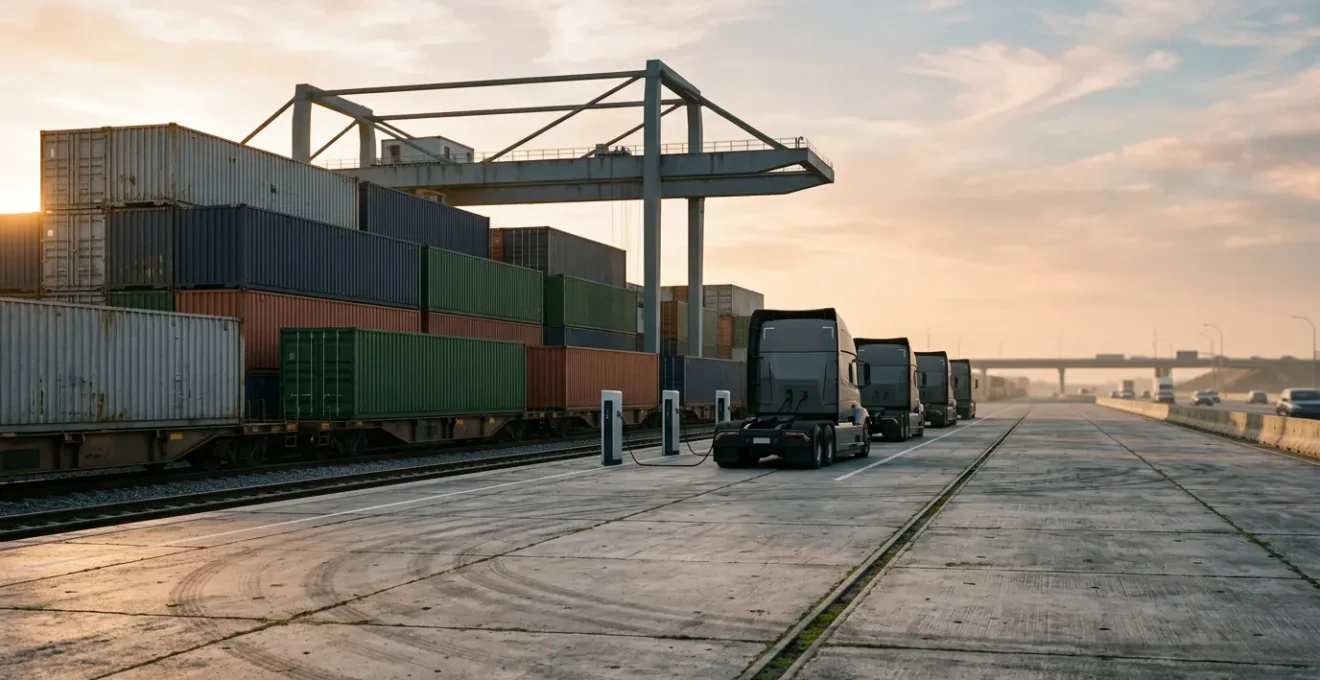
Achieving a 20% reduction in supply chain emissions is not a budgetary burden; it’s a direct result of eliminating costly operational inefficiencies that are already impacting your bottom line.
- Wasted fuel from empty « deadhead » miles represents a massive, untapped source of both cost and carbon savings.
- Moving beyond superficial « green » claims to data-driven carrier verification using frameworks like GLEC is critical to making real, measurable progress.
Recommendation: Begin by auditing your network for operational drag—specifically empty miles and supplier-induced delays—to identify the most immediate opportunities for simultaneous cost and emissions reduction.
As a logistics director, you operate under constant, dual pressures: meet ambitious corporate ESG targets and protect your operating budget. The conventional wisdom suggests these two goals are at odds, forcing a choice between profitability and sustainability. Many proposed solutions, such as fleet-wide electrification, demand significant capital expenditure, while others, like basic route optimization, offer only marginal gains. This creates a strategic impasse, leaving many leaders feeling that significant emissions reduction is financially out of reach.
The common advice to simply « consolidate shipments » or « buy carbon offsets » often misses the core of the issue. These are superficial fixes to deep-seated structural inefficiencies. But what if the path to a 20% carbon footprint reduction wasn’t an additional expense, but a discipline of rooting out the waste that is already costing you money? The true opportunity lies not in spending more, but in operating smarter. It’s about identifying the financial leaks in your supply chain that also happen to be major sources of emissions.
This guide reframes the challenge. We will demonstrate that by focusing on eliminating operational drag—from the hidden inefficiencies of LTL shipping to the financial drain of deadhead miles—you can achieve substantial environmental goals while directly improving your P&L. This article will provide a strategic roadmap to transform your supply chain from a cost center under environmental scrutiny into a model of financial and ecological efficiency, proving that sustainability is a byproduct of operational excellence.
This article provides a comprehensive framework for turning your sustainability goals into a profitable strategy. We will explore the hidden carbon costs in your daily operations, provide tools to verify your partners’ green credentials, and lay out a financial plan to de-risk your business from future carbon taxes. The following sections break down this value-driven approach.
Summary: A Strategic Guide to Cost-Effective Emissions Reduction in Logistics
- Why Less-Than-Truckload (LTL) Shipping Increases Your Carbon Footprint?
- How to Verify a Carrier’s « Green » Claims to Avoid Greenwashing?
- Offsets vs. Reduction: Which Strategy Actually Impresses Investors?
- The « Deadhead » Mistake That Wastes 30% of Your Fuel Budget
- When Carbon Taxes Hit: How to Prepare Your Logistics Budget for 2030?
- Why Cheap Suppliers Are Actually Costing You $5,000 a Month in Delays?
- Why Your Tariff Classification Could Be Costing You 6% Extra per Shipment?
- Rail vs. Truck: When Does Intermodal Transport Become Cheaper and Faster?
Why Less-Than-Truckload (LTL) Shipping Increases Your Carbon Footprint?
On the surface, Less-Than-Truckload (LTL) shipping appears to be a model of efficiency. It allows multiple shippers to share space on a single truck, avoiding the cost of a dedicated Full-Truckload (FTL) for smaller shipments. However, this model introduces significant « operational drag » that inflates your carbon footprint. An LTL shipment rarely travels directly from origin to destination. Instead, it moves through a complex hub-and-spoke system, involving multiple stops, consolidations, and deconsolidations at various terminals. Each touchpoint adds miles, handling, and potential for idling, increasing total fuel consumption per item shipped.
Furthermore, the LTL network’s complexity inherently leads to routing inefficiencies. A truck may travel a circuitous path to accommodate various pickups and drop-offs, a stark contrast to the direct A-to-B route of an FTL shipment. This inefficiency is a hidden carbon-as-a-cost factor. While you may be paying for less space, the prorated carbon cost of your goods can be substantially higher due to the extended journey and energy used at sorting hubs. The model’s reliance on filling trucks with disparate freight also increases the likelihood of suboptimal loading and contributes to the broader problem of empty or partially empty repositioning trips across the network.
The core issue is a loss of control and visibility. When you hand over a shipment to an LTL carrier, you are ceding control over its exact path and the associated emissions. To truly understand this impact, you must look beyond the initial cost savings and quantify the total emissions per shipment. As we’ll explore, making operational choices based on complete data is the first step toward building a genuinely sustainable and cost-effective logistics network. The principle of measuring the full impact is key, as it can reveal that a seemingly cheap option carries a high environmental price.
How to Verify a Carrier’s « Green » Claims to Avoid Greenwashing?
In a market where « sustainability » is a powerful buzzword, distinguishing genuine commitment from « greenwashing » is a critical business function. Many carriers promote their eco-friendly initiatives, but without a standardized, auditable reporting method, these claims are often meaningless. As a logistics director, you cannot afford to base your ESG strategy on marketing materials. You need a rigorous verification process to ensure your partners’ efforts are real, measurable, and aligned with your corporate goals. The key is to shift the conversation from vague promises to data-driven verification.
The single most effective tool for this is demanding adherence to a global standard. The Global Logistics Emissions Council (GLEC) Framework, which is now aligned with ISO 14083, provides a universal methodology for calculating and reporting logistics emissions. Insisting that a carrier is GLEC-compliant is the first and most important step. This moves the discussion away from proprietary, often opaque, calculation methods to a transparent, comparable standard. A carrier serious about sustainability will not only be familiar with the GLEC Framework but will also be able to provide reports based on its principles, detailing emissions per shipment or transport chain element.
This verification process is not about confrontation; it’s about setting clear expectations for partnership. A truly sustainable carrier will welcome the scrutiny and be prepared to provide primary data, such as actual fuel consumption for your shipments, rather than relying on less accurate industry averages. This level of transparency is the hallmark of a genuine partner in your decarbonization journey. The following checklist provides a concrete action plan for auditing potential or existing carriers.

As the image suggests, this process is about professional diligence. It requires a close examination of documentation and methodologies, not just accepting a glossy brochure at face value. By institutionalizing this level of scrutiny, you de-risk your supply chain from reputational damage and ensure that your sustainability efforts are built on a foundation of truth. It transforms your procurement process into a strategic tool for achieving real emissions reductions.
Your Action Plan: Verifying Carrier Green Credentials
- Verify carrier uses GLEC Framework v3.2 aligned with ISO 14083 for emissions calculation and reporting across all transport modes.
- Request auditable CO2 reporting clauses based on Transport Chain Elements (TCEs) showing emissions per shipment segment.
- Confirm carrier provides primary fuel consumption data rather than industry averages for higher accuracy.
- Cross-reference the carrier’s emissions methodology with GHG Protocol Corporate Standard compliance.
- Validate that the carrier reports Well-to-Wheel (WTW) emissions, including upstream fuel production impacts.
Offsets vs. Reduction: Which Strategy Actually Impresses Investors?
The carbon offset market presents a tempting solution to the emissions problem: continue operations as usual and pay someone else to capture or avoid an equivalent amount of CO2. While offsets can play a role in a comprehensive climate strategy—particularly for emissions that are truly unavoidable—relying on them as a primary strategy is increasingly viewed with skepticism by sophisticated investors. The central question they ask is: are you fixing the problem at its source, or are you simply paying to obscure it? The answer has significant implications for your company’s valuation and long-term risk profile.
Direct emissions reduction is, without question, the more impressive and strategically sound approach. A strategy focused on operational efficiency, network optimization, and technological upgrades demonstrates strong management and a proactive stance on risk. It shows investors that you are building a more resilient, efficient, and future-proof business. Reduction addresses the root cause of emissions, often leading to simultaneous cost savings in fuel, energy, and materials. This is a narrative of operational excellence that resonates powerfully on an earnings call.
In contrast, an offset-heavy strategy can be perceived as a financial maneuver rather than a fundamental operational improvement. As academic research on investor behavior highlights:
Investors place greater emphasis on the quality of carbon offsets rather than their quantity, particularly during periods of heightened climate concerns.
– Academic research on investor behavior, Do Investors Care about Carbon Offsets?
This focus on « quality » opens a Pandora’s box of concerns about the validity, permanence, and additionality of offset projects. The voluntary market is poorly regulated, and stories of low-quality or fraudulent projects have damaged its reputation. While the market is projected to grow significantly, with voluntary offset market projections suggesting a rise from $2 billion in 2020 to $250 billion by 2050, this growth is accompanied by intense scrutiny. For a logistics director, this means an investment in offsets may not deliver the expected reputational or financial ROI. The capital might be better spent on projects that deliver guaranteed, measurable reductions within your own operations.
The « Deadhead » Mistake That Wastes 30% of Your Fuel Budget
The single most glaring inefficiency in the trucking industry—and the most significant opportunity for simultaneous cost and carbon reduction—is the « deadhead » mile. A deadhead refers to any mile a truck travels completely empty, typically on a return trip after a one-way delivery or while repositioning to its next pickup location. This is not a minor issue; it is a systemic financial drain and an environmental catastrophe. When a truck is deadheading, it is a pure cost center: consuming fuel, generating emissions, causing wear and tear, and paying a driver, all while producing zero revenue.
The scale of the problem is staggering. Industry data reveals the shocking extent of this waste, showing that approximately 35% of trucks on the road travel empty, which translates to 61 billion empty miles and 87 million metric tons of pointless CO2 emissions every year in the U.S. alone. For a logistics director, this macro-statistic should be a call to action to examine your own network. What percentage of your freight budget is being vaporized by paying carriers for these unproductive, high-emission miles? Even a 15-20% deadhead rate, which is common, represents a massive portion of your fuel budget being burned for no reason.
Addressing this « deadhead mistake » is the lowest-hanging fruit in logistics decarbonization. It requires no new technology, only better planning, network visibility, and strategic partnerships. Solutions include leveraging freight matching platforms to find backhauls, collaborating with other shippers in your area to create continuous loops, and optimizing network design to better balance inbound and outbound flows. Treating empty miles as a key performance indicator (KPI) to be relentlessly driven down is the first step. The table below breaks down the real-world costs of ignoring this fundamental operational flaw.
The financial impact of deadhead miles is a direct and measurable drain on your budget. The following breakdown illustrates how these empty miles translate into tangible costs across several categories.
| Cost Category | Impact per 100 Empty Miles | Annual Impact (20% Deadhead Rate) |
|---|---|---|
| Fuel expenses | $50-$75 at current diesel prices | Varies by mileage |
| Driver compensation | Paid by mile or hour with zero revenue offset | Significant labor cost |
| Equipment depreciation | Wear on tires, brakes, engine components | Accelerated maintenance cycles |
| Opportunity cost | Time not generating revenue | 15,000-25,000 unproductive miles/year |
| Industry average deadhead | 15-35% of total miles | Billions in annual industry losses |
When Carbon Taxes Hit: How to Prepare Your Logistics Budget for 2030?
The era of treating carbon emissions as an externality with no financial cost is rapidly coming to an end. Governments worldwide are implementing carbon pricing mechanisms, and the logistics sector is squarely in their sights. For logistics directors, this is no longer a distant threat; it is an impending line item on your budget. The key is not to react when these taxes are implemented, but to prepare for them now, transforming a potential liability into a competitive advantage. The most powerful tool for this is internal carbon shadow pricing.
Shadow pricing is the practice of assigning a hypothetical cost—a « shadow price »—to each ton of CO2 your operations emit. This price is then factored into internal business cases, investment decisions, and supplier selection. It makes the cost of carbon visible and tangible in your financial planning today, long before the government sends you a bill. This simple accounting shift forces a change in mindset. A high-emission shipping lane or supplier is no longer just « less green »; it is now « more expensive. » This immediately incentivizes your team to find lower-carbon, and therefore lower-cost, alternatives.
The timeline is accelerating. For instance, EU ETS2 will incorporate carbon pricing into road transport starting in 2027. Companies that have already integrated a shadow price into their budgeting will be years ahead of their competitors. They will have already optimized their networks, chosen more efficient partners, and shifted volume to lower-emission modes where feasible. When the actual taxes hit, their budget will have already absorbed the impact, while unprepared competitors will face sudden, disruptive cost increases. Implementing a shadow pricing strategy is a definitive act of strategic de-risking.

As this visual metaphor suggests, preparation involves balancing the weight of future carbon costs with smart, sustainable investments today. It is a strategic exercise in financial foresight. The following steps provide a practical guide to implementing a carbon shadow pricing model in your organization, turning regulatory risk into a catalyst for innovation and efficiency.
- Establish a Baseline: Set an internal carbon price (e.g., $30-100/ton CO2e by 2030) aligned with IEA Net Zero projections.
- Apply the Price: Integrate this shadow price into all internal accounting for shipment modes to make low-emission choices economically attractive.
- Measure and Analyze: Use your carbon footprint data to identify emission hotspots across your logistics network.
- Prioritize and Act: Define action plans to tackle the highest-impact sectors first, based on your footprint analysis.
- Budget for Change: Create a dedicated « Decarbonization CAPEX » budget line, justified by the ROI from future tax avoidance and operational savings.
Why Cheap Suppliers Are Actually Costing You $5,000 a Month in Delays?
Selecting suppliers based primarily on the lowest unit price is a classic procurement trap that creates significant hidden costs and operational drag. A « cheap » supplier is often one that has underinvested in quality control, production planning, and their own supply chain resilience. This inevitably manifests as inconsistent lead times, poor quality products, and unexpected delays. For a logistics director, these delays are not just an inconvenience; they are a direct hit to your budget and your carbon footprint. A delayed shipment can cause a domino effect of costly disruptions: trucks idling at docks, missed connections for onward journeys, and the need for expensive expedited freight to meet deadlines.
These disruptions carry a steep price tag. Consider a single delayed shipment that causes a truck and driver to wait for an extra day. You incur costs for driver time, equipment underutilization, and potentially demurrage fees. If that delay causes you to miss a slot on an ocean freighter, the consequences multiply. Now, extrapolate that across dozens of shipments a month from an unreliable, low-cost supplier. The « savings » on unit price are quickly erased by thousands of dollars in reactive, unplanned logistics costs. This is before even considering the carbon cost of idling vehicles and the potential for inefficient, last-minute transport solutions.
The strategic shift required is to move toward a Total Cost of Ownership (TCO) model for supplier evaluation. This means assessing partners on reliability, quality, and their own commitment to sustainability, not just their price list. A slightly more expensive supplier who delivers on time, every time, is almost always more profitable in the long run. Furthermore, partnering with suppliers who are actively working to reduce their own emissions is crucial, as their footprint is your Scope 3 footprint. The good news is that this shift does not have to break the bank. In fact, research shows the modest cost of comprehensive emission reduction, indicating that full supply chain decarbonization often increases end consumer prices by only 1-4%. This demonstrates that building a sustainable and reliable supplier network is an affordable, high-ROI investment.
Case Study: Unilever’s Proactive Supplier Engagement
Unilever identified that raw materials and packaging from its suppliers accounted for over 60% of its value chain emissions. Instead of simply switching suppliers, the company launched its « Clean Future » strategy. A key part of this involves actively working with 300 of its suppliers to help them measure, report, and reduce their own emissions. Unilever uses advanced tools like satellite imaging and blockchain to improve transparency and traceability. This collaborative approach aims to reduce product emissions by up to 20% by 2030, proving that engaging suppliers as partners is more effective than simply chasing the lowest price.
Why Your Tariff Classification Could Be Costing You 6% Extra per Shipment?
While logistics leaders are laser-focused on transport costs and fuel efficiency, a significant source of financial leakage and operational drag often lies hidden in administrative processes: customs tariff classification. The Harmonized System (HS) code you assign to a product determines the duty and tax rate it will incur upon import. A small error in classification—choosing a code that is technically incorrect but seems close enough—can result in overpaying duties by several percentage points on every single shipment. For a company importing significant volumes, this amounts to a substantial and entirely avoidable cost.
The problem goes beyond direct financial loss. Incorrect classification is a leading cause of customs delays. When customs authorities flag a shipment for a classification review, your cargo sits idle. This creates the exact kind of « operational drag » we’ve identified as a source of both cost and carbon. A truck may be waiting at the port, a production line may be halted, and you may ultimately need to arrange expedited shipping for the delayed goods once they are released. The administrative oversight of a tariff code directly leads to wasted time, wasted money, and wasted fuel.
This issue is a microcosm of a larger strategic risk. A poorly managed data process in one area of the supply chain often indicates weaknesses elsewhere. In an era where climate-related disruptions are becoming more common, this lack of administrative rigor is a major vulnerability. The Carbon Disclosure Project’s analysis underscores this, finding that $1.26 trillion of revenue is at risk over the next five years due to impacts from climate change on supply chains. While a tariff code is not a climate event, the mindset of precision, data accuracy, and proactive risk management required to get it right is the same mindset needed to build a resilient, low-carbon supply chain. Ensuring you have the expertise—either in-house or through a trusted customs broker—to manage tariff classifications correctly is not just about compliance; it’s a high-return investment in operational efficiency.
Key Takeaways
- Significant emissions reduction (20%+) is primarily achieved by eliminating existing operational and financial waste, not through massive new spending.
- Focusing on measurable data, such as GLEC Framework compliance and primary fuel consumption, is the only way to combat greenwashing and make real progress.
- Proactive measures like internal carbon shadow pricing and eradicating deadhead miles are strategic actions that deliver both financial ROI and environmental benefits.
Rail vs. Truck: When Does Intermodal Transport Become Cheaper and Faster?
For decades, trucking has been the default mode for domestic freight due to its flexibility and perceived speed. However, with road transport responsible for the lion’s share of transport emissions, the strategic case for intermodal transport—specifically, shifting long-haul routes from truck to rail—has never been stronger. Rail is fundamentally more fuel-efficient for moving heavy freight over long distances. A single train can carry the load of hundreds of trucks, resulting in a dramatic reduction in fuel consumption and CO2 emissions per ton-mile, often by as much as 75%.
The decision to use intermodal is a calculation of trade-offs. The common perception is that rail is slower and less flexible than trucking. While there is a time cost associated with moving containers between truck and train (drayage), this is often overestimated. The « break-even » point, where intermodal becomes both cheaper and time-competitive, is typically on routes of 750 miles (approx. 1200 km) or more. On these long-haul corridors, a train’s ability to travel consistently 24/7, without driver hours-of-service limitations, can often make up for the time spent in terminals. The train may be slower in mph, but it doesn’t stop, making the total transit time surprisingly competitive.
The cost savings are driven by fuel and labor efficiency. While you still have the « first mile » and « last mile » costs of trucking to and from the rail terminals, the long-haul portion of the journey is significantly cheaper by rail. For a logistics director, the key is to perform a lane-by-lane analysis of your network. Identify your high-volume, long-distance routes and conduct a TCO analysis comparing your current trucking costs to an intermodal alternative. In many cases, you will find that a switch not only slashes your carbon footprint but also delivers a material reduction in your overall freight spend. It is a powerful lever for achieving both ESG and budgetary goals.
Achieving a 20% emissions reduction is not a single, grand project but the cumulative result of a dozen smaller, smarter decisions. It is about instilling a culture of efficiency where every deadhead mile, every supplier delay, and every incorrectly classified shipment is seen not just as an operational problem, but as a direct financial and environmental cost. By adopting the mindset of a strategist who hunts for and eliminates this « operational drag, » you can systematically lower your carbon footprint while strengthening your bottom line, turning your logistics function into a source of competitive advantage.