A rejected load is not a failure of refrigeration; it is a failure of process. The common belief that a reefer unit’s setpoint guarantees cargo safety is a critical misunderstanding that leads to millions in losses.
- Temperature readings are often misleading, measuring return air, not the core temperature of cargo at the far end of the container.
- Improper pallet stacking is the primary cause of spoilage, as it destroys the « airflow integrity » required to maintain a consistent temperature envelope.
- Choosing the wrong operational mode (e.g., Cycle Sentry for sensitive goods) actively creates the temperature volatility you are trying to prevent.
Recommendation: Shift your focus from simply monitoring temperature to rigorously controlling the physics of airflow and enforcing strict, non-negotiable loading and operational protocols.
The phone call every logistics manager dreads: a receiver has rejected an entire shipment. The temperature logger shows a spike, the cargo is compromised, and now you face not only financial loss but also a breach of trust with your client. You followed the standard procedures—the reefer was pre-cooled, the driver checked the setpoint—so what went wrong? The answer is rarely a catastrophic equipment failure. More often, the cause is a systemic vulnerability hidden within your standard operating procedures, rooted in a misunderstanding of cold chain physics.
Most cold chain guides focus on surface-level advice like « use data loggers » or « maintain your equipment. » While necessary, these are merely table stakes. They monitor for failure; they do not prevent it. True resilience in the cold chain comes from a deeper, process-oriented understanding of how temperature excursions actually happen. It’s about mastering the science of airflow, recognizing the critical difference between maintaining and reducing temperature, and enforcing a level of procedural discipline that leaves no room for error. The problem isn’t the technology; it’s the gaps in the process where thermodynamics and human error converge.
This guide moves beyond the checklist. We will dissect the precise, often-overlooked points of failure that lead to spoiled cargo. We will analyze the critical mistakes in pallet stacking, the nuances of reefer operational modes, and the emergency protocols that can mean the difference between a minor delay and a total loss. This is not a list of tips; it is a foundational shift in how you must approach cold chain quality assurance. By understanding these core principles, you can build a system that is robust by design, not by chance.
The following sections will provide a detailed breakdown of the most critical vulnerabilities in the cold chain and the exact protocols required to mitigate them. This structured approach will equip you to diagnose and eliminate the root causes of temperature excursions within your operations.
Summary: A Zero-Tolerance Protocol for Temperature Excursions
- Why Your Reefer Display Says -4°F but the Cargo is Thawing?
- The Pallet Stacking Mistake That Blocks Airflow and Spoils Food
- Continuous Run vs. Cycle Sentry: Which Mode Protects Ice Cream Better?
- The Cleaning Error That Makes Your Next Load Smell Like Fish
- When the Reefer Fails: The Emergency Protocol to Save the Load?
- How to Load a Container for Rail to Prevent Damage from Shunting?
- Bubble Foil vs. Polystyrene: Which Liner Keeps Heat Out Longer?
- Passive Insulation vs. Active Cooling: Which is Cost-Effective for Under 24 Hours?
Why Your Reefer Display Says -4°F but the Cargo is Thawing?
The setpoint on your reefer unit’s display is one of the most dangerously misleading metrics in the cold chain. It does not represent the temperature of your cargo. Instead, it typically measures the return air temperature—the air that has already circulated through the container, absorbed heat from the cargo and the walls, and is returning to the refrigeration unit to be cooled again. This creates a critical information gap and a false sense of security.
The core of the problem lies in airflow physics. Cold air is pushed from the refrigeration unit, ideally circulates around and through the cargo in a uniform pattern, and returns. However, in a loaded container, this flow is never uniform. Obstructions, tight packing, and simple distance cause the air’s velocity to plummet. In fact, numerical simulation research on refrigerated container airflow shows a staggering 95-97% decrease in average air velocity between the pallet stack near the reefer and the stack near the doors. This dramatic slowdown means the air spends more time absorbing heat at the back of the container, creating warmer microclimates that the front-mounted sensor cannot detect.
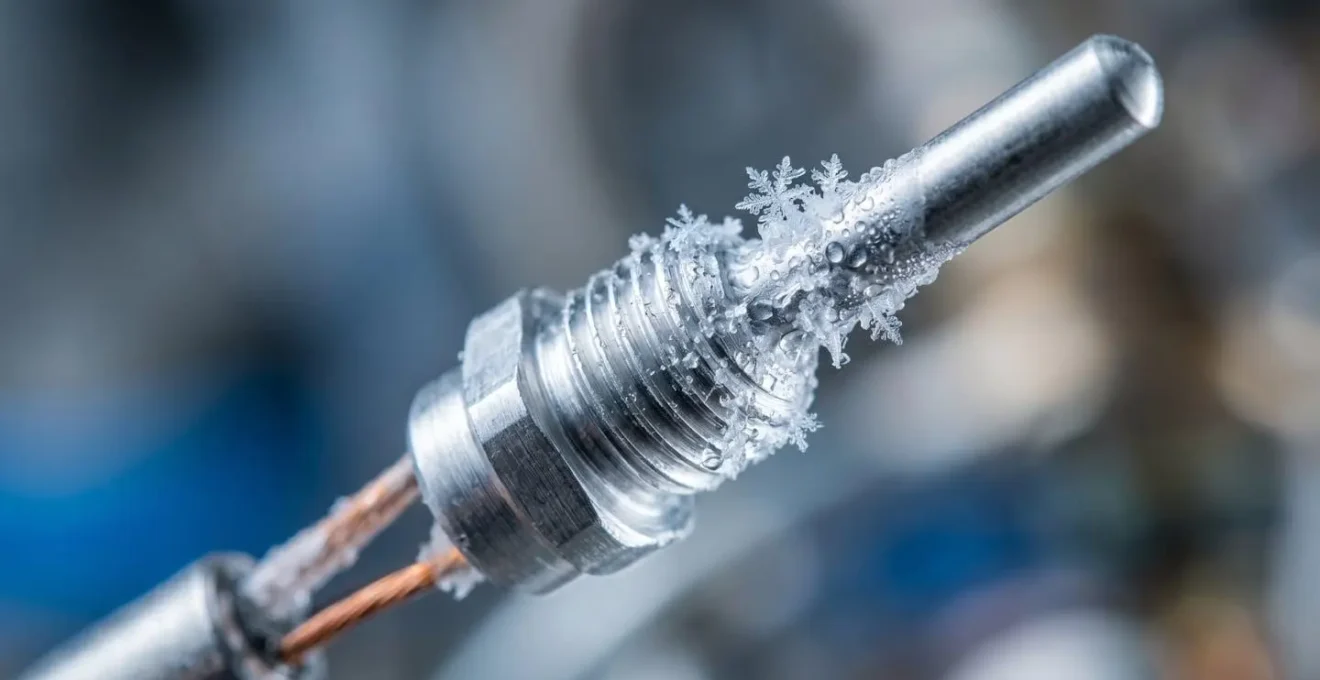
As the illustration of a frosted sensor suggests, the point of measurement is a highly localized and controlled environment. Your cargo, particularly at the rear and in the center of pallets, exists in a much harsher, more variable thermal world. Believing the -4°F on the display is a guarantee of safety for the entire load is a fundamental error. True temperature assurance requires understanding that the reefer display is only one data point in a complex thermal system. You must operate under the assumption that the warmest point in the load is significantly higher than what the unit’s display indicates.
The Pallet Stacking Mistake That Blocks Airflow and Spoils Food
The single greatest cause of in-transit spoilage is not equipment failure; it is improper loading that destroys airflow integrity. A reefer unit does not magically make a container cold. It relies on a continuous, unimpeded circulation of air to remove heat. When pallets are stacked incorrectly, this circulation is blocked, creating hot spots that lead directly to product degradation, even while the reefer unit itself functions perfectly.
Think of the space within the container as a circulatory system. The T-bar floor, the gaps between pallets, and the space above the load are the arteries that deliver cold air. Any obstruction acts like a clot, starving a section of the cargo of the temperature control it needs. Common errors include stacking pallets too tightly against the walls, blocking the return air path at the rear doors, or stacking product above the designated red load line near the ceiling. These mistakes force air to take the path of least resistance, often bypassing entire sections of the load. Research has shown that in a standard load, as many as 11 out of 21 pallets can receive inadequate airflow due to bypass and obstruction.
To prevent this, loading must be treated as a technical, process-driven discipline, not just a matter of fitting boxes into a container. Every pallet must be placed with the explicit goal of preserving these critical airflow channels. This requires strict adherence to established protocols that ensure air can circulate from floor to ceiling and from front to back without restriction.
Your Action Plan: Critical Airflow Loading Protocol
- Pallet Selection: Mandate the use of pallets with open bases. This allows cold air to circulate from the T-bar floor, which can increase overall airflow by approximately 26%.
- Air Gap Discipline: Enforce mandatory air gaps between pallet rows and between pallets and the container walls. This prevents the creation of a solid block of cargo that air cannot penetrate.
- Floor and Ceiling Boundaries: Prohibit placing items directly on the container floor and ensure all cargo remains below the red load line. The entire floor area must be covered with product or dunnage to prevent air from short-circuiting beneath the load.
- Stacking Height and Stability: Limit pallet stacking height to approximately 7 feet (2.1 meters) to maintain efficient top-down air distribution. Ensure cartons are not over-stacked to the point of compression, which can block internal vents within the product packaging itself.
- Rear Door Clearance: Maintain a clear, designated space between the last row of pallets and the container doors. This is a non-negotiable requirement for the return air flue.
Continuous Run vs. Cycle Sentry: Which Mode Protects Ice Cream Better?
The choice between « Continuous Run » and « Cycle Sentry » (also known as Start/Stop) is a critical control point that is frequently misunderstood. Selecting the wrong mode for your cargo type is not a minor error; it is a decision that actively introduces temperature volatility into your shipment. For highly sensitive products like ice cream, pharmaceuticals, or fresh produce, this choice can be the direct cause of a rejected load.
Continuous Run mode operates exactly as the name implies: the reefer engine runs constantly to maintain a precise temperature at the designated setpoint. It is the only acceptable mode for products requiring tight temperature tolerances. The downside is higher fuel consumption and increased wear on engine components.
Cycle Sentry is a fuel-saving mode designed for robustly frozen goods that can tolerate temperature fluctuations. In this mode, the unit turns off when the temperature reaches a certain point below the setpoint and only turns back on after the temperature rises several degrees above it. This creates a temperature band, not a stable point. As experts from United World Transportation’s operational guidelines explain, a load on cycle-sentry can experience significant temperature swings, which can cause issues like condensation in packaging or thermal shock.
| Feature | Continuous Mode | Cycle Sentry (Start/Stop) |
|---|---|---|
| Temperature Stability | Maintains constant temperature at exact setpoint | Temperature varies 5-6°F around setpoint (cycles on when +5°F above, off when 0.5-1°F below) |
| Recommended For | Fresh produce, temperature-sensitive products, loads requiring tight tolerances (above 24°F) | Frozen loads only (below 24°F) that can handle temperature variance |
| Fuel Consumption | Higher – engine runs constantly | Lower – significant fuel savings from intermittent operation |
| Risk Factors | Higher fuel cost, more wear on continuously running components | Potential for freezing on top boxes, condensation in packaging, thermal shock to sensitive products |
| Equipment Wear | Continuous operation wear | Greater wear on starter motor and electrical components from repeated on/off cycles |
| Typical Use Cases | Vegetables, fruits, dairy, ice cream, pharmaceuticals | Frozen meat, frozen vegetables, frozen bakery products |
The answer to which mode protects ice cream better is unequivocally Continuous Run. Subjecting a product like ice cream to the 5-6°F temperature swings inherent in Cycle Sentry mode can lead to thawing and refreezing, destroying its texture and quality. The fuel savings offered by Cycle Sentry are an unacceptable risk for any temperature-sensitive cargo. Your operational protocol must be explicit: Continuous Run for sensitive products, Cycle Sentry only for specific, pre-approved frozen goods where the risk is formally accepted.
The Cleaning Error That Makes Your Next Load Smell Like Fish
A temperature-controlled container is not just a cold box; it is a food-grade environment. A failure in sanitation protocols is a failure in quality control, with consequences that extend beyond simple hygiene. Cross-contamination from odors and microbial residue is a frequent and entirely preventable cause of rejected loads, turning a high-value shipment of baked goods or produce into unsalable waste that smells like the previous cargo of fish or onions.
The root cause is often an inadequate washout process that fails to eliminate biofilms. These are resilient, invisible layers of microorganisms that adhere to container walls and floors. Simple rinsing is not enough to remove them. When a container carries a strongly odorous product like fresh seafood, odor molecules and bacteria become trapped in these biofilms. If the container is not then properly sanitized with appropriate detergents and disinfectants, these residues persist. When the next, more delicate cargo is loaded, it absorbs these lingering odors, rendering it unacceptable to the receiver.
This is not a minor inconvenience; it is a direct contributor to the staggering cost of food loss. With research indicating that one-third of all food produced globally is lost or wasted, totaling over $35 billion annually, errors like improper cleaning represent a significant and needless financial drain. A load of premium cheese ruined by the lingering smell of garlic is a 100% preventable loss, directly attributable to a breakdown in process discipline between shipments.
The protocol must be absolute: every container must undergo a full, documented washout and sanitation procedure after carrying odor-producing or high-risk microbial cargo. This includes using approved cleaning agents, ensuring adequate contact time, and a thorough final rinse. A simple « sweep out » is unacceptable. The cost of a proper cleaning is negligible compared to the cost of a rejected load and the damage to your company’s reputation.
When the Reefer Fails: The Emergency Protocol to Save the Load?
A reefer unit alarm mid-transit is a high-stakes emergency. The actions taken in the first 30-60 minutes determine whether the cargo can be saved or becomes a total loss. Without a clear, pre-defined emergency protocol, panic and poor decisions can compound the initial failure. The stakes are not just financial; they are a matter of public health. Temperature control failures are a leading cause of foodborne illness, and as the Centers for Disease Control estimates show, each year in the U.S., this results in tens of millions of illnesses and 128,000 hospitalizations.
The driver is the first responder in this crisis, and they must be equipped with more than just a phone number for dispatch. They must be trained to execute a rapid, logical assessment and mitigation sequence. This protocol is not about performing complex mechanical repairs; it is about diagnosing the situation, protecting the remaining thermal integrity of the load, and communicating effectively to enable a rapid, informed response from the support team.
The immediate protocol should follow a clear sequence:
- Assess and Document: The driver’s first action is to safely pull over and inspect the reefer unit. They must record the exact alarm code, the current temperature reading, the setpoint, and any visible signs of malfunction (e.g., unusual noises, leaks, smoke). This information is non-negotiable and must be relayed accurately.
- Attempt a Simple Reset: Many alarms are triggered by transient faults that can be cleared by turning the unit off and on again. This should be the first and only troubleshooting step a driver attempts unless specifically trained for more.
- Communicate Immediately: The driver must contact dispatch or the dedicated quality assurance manager immediately with the documented information. Time is the most critical factor.
- Do Not Open the Doors: Unless explicitly instructed by a qualified manager, the driver must never open the container doors. Opening the doors will destroy the remaining cold air envelope and accelerate the warming of the cargo. The insulated container is the best defense against temperature rise, but only if it remains sealed.
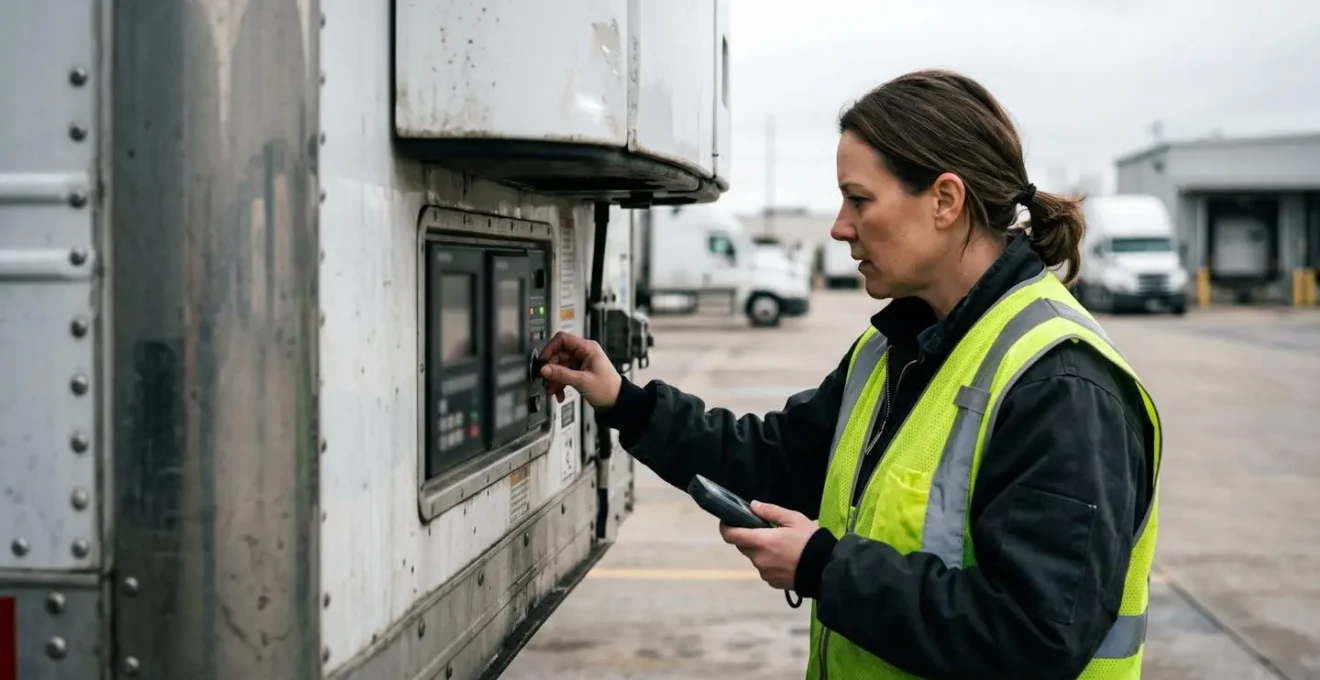
This situation demands calm, professional execution of a pre-planned procedure. The driver’s role, as depicted here, is one of focused crisis management. They are not a mechanic; they are the eyes and ears on the ground, and their ability to follow a strict protocol is paramount to salvaging the load. Every logistics operation must have this emergency plan drilled into every driver.
How to Load a Container for Rail to Prevent Damage from Shunting?
Transporting a reefer container by rail introduces a set of physical forces that are far more violent than those experienced on the road. The process of rail shunting—where rail cars are coupled together—creates powerful longitudinal shocks that can cause improperly secured cargo to shift dramatically. This movement is not just a risk to the product from impact; it’s a critical threat to the cold chain itself. When pallets shift, they can collapse the carefully planned airflow channels, leading to temperature excursions and spoilage.
The fundamental error is assuming that a load secured for road transport is also secure for rail. During shunting, acceleration and deceleration forces are abrupt and severe. If cargo is not properly braced, pallets can slide forward or backward, blocking the return air vent at the back or crashing into the reefer unit at the front. This not only damages product and equipment but also destroys the container’s ability to circulate cold air effectively. The result is the same as with poor stacking: the creation of hot spots and the eventual spoilage of the cargo.
Case Study: Load Securement Failure in Reefer Rail Transport
An analysis of cold chain failures in intermodal transport found that poor lashing and void space management were primary causes of in-transit temperature problems. The study demonstrated that during rail shunting events, unsecured pallets would shift, obstructing critical airflow paths. The solution identified was a two-part system: using purpose-built reefer lashing points to secure pallets without damaging container walls, and deploying inflatable dunnage bags in any void spaces between pallets. The dunnage bags act as cushions, absorbing shock and preventing any movement during the violent coupling events characteristic of rail yard operations, thus preserving the integrity of the airflow channels.
Therefore, a specific and more robust securement protocol is required for any container destined for rail transport. This must go beyond standard shrink-wrapping and corner boards. The protocol should mandate:
- Void Filling: All significant empty spaces between pallets and between the last pallet and the doors must be filled with appropriate dunnage, such as heavy-duty inflatable bags or other certified void-fill materials.
- Bracing and Lashing: Cargo must be braced against longitudinal movement. This can involve using specialized lashing straps anchored to the container’s designated securing points or building a wooden bulkhead to hold the load in place.
- Weight Distribution: The load must be balanced evenly throughout the container to maintain stability during transit and shunting events.
Ignoring the unique physics of rail transport is a recipe for failure. Your loading protocol must have a distinct and more rigorous standard for intermodal shipments.
Bubble Foil vs. Polystyrene: Which Liner Keeps Heat Out Longer?
When protecting cargo from short-term temperature spikes, such as during tarmac delays or cross-docking, passive insulation in the form of thermal liners is a critical line of defense. However, not all liners are created equal. The choice between a bubble foil liner and a molded polystyrene (like Styrofoam) liner depends on understanding the primary type of heat transfer you are trying to block.
Bubble foil liners are primarily effective at blocking radiant heat. The reflective surfaces bounce thermal radiation away from the cargo. This makes them highly effective in situations where the cargo is exposed to direct sunlight, such as waiting on an airport tarmac. They are lightweight and flexible, but offer less protection against conductive heat transfer (heat moving through direct contact).
Polystyrene liners and panels, on the other hand, excel at blocking conductive and convective heat. The trapped air within the foam structure is a poor conductor of heat, slowing the rate at which ambient warmth can penetrate the cargo area. They provide a more robust thermal barrier in a hot container that isn’t in direct sunlight but is simply sitting in high ambient temperatures. They are bulkier and more rigid than foil liners.
The choice is not about which is « better » overall, but which is correct for the specific risk. For a short journey in a closed truck, polystyrene may offer superior protection against general ambient heat. For a pallet sitting on a sunny loading dock before being loaded, bubble foil provides a crucial shield against solar radiation. In many high-risk scenarios, a hybrid approach combining both can be optimal. What is most important, however, is to remember the fundamental role of this insulation. As experts at X-Pak Global state:
Reefer units are engineered to maintain temperature, not to cool warm cargo. So the product must be pre-cooled. Warm warehouse staging areas and delays before container sealing further expose goods to temperature rise before transit even begins.
– X-Pak Global, Cold Chain Reality: Where Temperature Control Breaks in Transit
This principle is paramount. Liners, whether foil or foam, are there to protect the pre-cooled temperature of the product. They slow down heat ingress; they do not generate cold. Their effectiveness is entirely dependent on the cargo being at the correct temperature before the insulation is applied.
Key Takeaways
- Airflow is Non-Negotiable: The primary function of a reefer is to circulate air. Any obstruction to airflow—caused by improper stacking, blocked vents, or shifted loads—is the number one cause of spoilage. Process must enforce airflow integrity.
- Maintain, Don’t Reduce: A reefer unit is designed to maintain the temperature of pre-cooled cargo, not to cool down a warm load. Any failure in pre-cooling or protection against heat gain cannot be corrected in-transit.
- Procedural Discipline Over Technology: The most advanced data logger is useless if loading protocols are ignored. Strict, enforced, and audited procedures are more critical to preventing excursions than technology alone.
Passive Insulation vs. Active Cooling: Which is Cost-Effective for Under 24 Hours?
The final strategic choice in temperature-controlled logistics is deciding between a passive or an active system. This decision hinges on a calculated balance of risk, duration, and cost. For short-duration shipments, typically under 24 hours, this choice is particularly critical, as over-engineering the solution can be needlessly expensive, while under-engineering it can lead to a total loss.
Passive Insulation refers to systems that rely on insulation materials (like thermal blankets, liners, or insulated containers) and phase-change materials (like gel packs or dry ice) to maintain temperature. There is no external power source. Its effectiveness is finite; it simply slows the rate of temperature change. For a sub-24-hour journey where the cargo is properly pre-cooled and the external conditions are predictable, a well-designed passive system is often the most cost-effective solution. It eliminates the cost, complexity, and potential failure points of an active mechanical system.
Active Cooling, in contrast, refers to a powered refrigeration system, such as a reefer trailer or an active ULD (Unit Load Device). This system can actively remove heat and maintain a precise setpoint indefinitely, as long as it has power. While providing the highest level of security, it also comes with the highest cost, both in terms of equipment and fuel. For shipments under 24 hours, a full active system might be overkill unless the cargo is extremely high-value or the risk of an unforeseen delay (e.g., customs hold, traffic) is high. Any potential for the journey to extend beyond the calculated limit of a passive system pushes the balance in favor of an active solution.
The cost-effectiveness calculation must therefore include a risk assessment. If a 20-hour journey has a 10% chance of a 5-hour delay, the passive system designed for 24 hours is no longer adequate. The rise of IoT-enabled refrigeration units and real-time monitoring has further blurred the lines, allowing for more dynamic management, but the fundamental choice remains. For short, predictable routes, a robust passive system is superior in cost. For any route with significant uncertainty or duration, the security of an active system becomes the only viable option.
The next temperature excursion is not a matter of ‘if’ but ‘when’ if these systemic vulnerabilities are not addressed. The principles outlined here are not suggestions; they are the foundation of a resilient cold chain. Begin by auditing your loading, sanitation, and reefer operation protocols today to move from a reactive to a preventative quality assurance model.