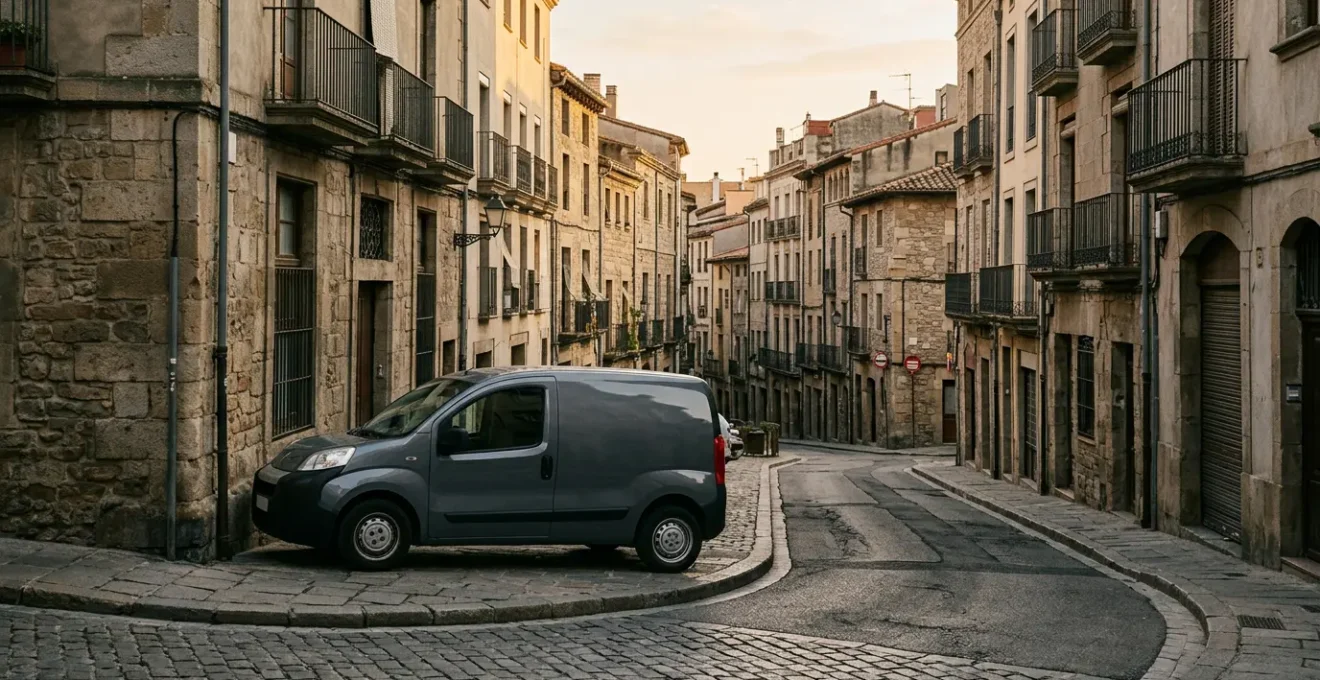
Parking fines aren’t a cost of doing business; they are a data point proving your delivery system is inefficient and misaligned with urban reality.
- Rethinking your vehicle mix by integrating cargo bikes can more than double hourly delivery rates in dense areas.
- Strategic use of parcel lockers can slash drop-off costs and eliminate the need for residential parking altogether.
Recommendation: Focus on redesigning your network to reduce vehicle ‘dwell time’ and operational friction instead of just trying to find better parking spots.
For any courier company manager, the daily pile of parking tickets feels like a painful, inevitable cost of doing business in the city. Each fine represents a dent in your already-thin profit margins, a source of frustration for your drivers, and a symptom of a system under pressure. The conventional wisdom offers little comfort: negotiate with the city for special permits, try yet another routing app, or simply budget for the fines and hope for the best. But these are merely attempts to treat the symptoms, not cure the disease.
What if those parking fines aren’t the real problem? What if they are a clear, measurable signal that your entire urban delivery model—from vehicle selection to routing logic and drop-off strategy—is fundamentally misaligned with the operational reality of modern cities? The solution isn’t about finding a magical parking spot or arguing with a traffic warden. It’s about building a smarter, more resilient logistics network that makes parking fines an irrelevant relic of an inefficient past. This isn’t about working harder; it’s about working smarter by optimizing the entire flow of goods.
This guide will deconstruct the challenge, moving beyond the platitudes to offer practical, data-backed strategies. We will explore how rethinking your delivery model, optimizing vehicle choice, implementing intelligent routing, and perfecting proof of delivery can transform your operations. By focusing on systemic efficiency, you can not only eliminate fines but also significantly increase delivery speed and capacity.
To navigate this complex topic, we will break down the key strategic levers you can pull. This article explores everything from high-level model choices like lockers vs. home delivery to ground-level tactics like routing and vehicle selection, providing a complete framework for building a fine-free, high-speed urban delivery operation.
Summary: A Manager’s Playbook for Fine-Free Urban Logistics
- Home Delivery vs. Lockers: Which Reduces Cost Per Drop by 40%?
- Van vs. Box Truck: Which is Better for Narrow European Streets?
- Why Removing Left Turns Saves Fuel and Time in City Delivery?
- The « Proof of Delivery » Mistake That Leads to Chargebacks
- When to Deliver to Business Districts: The Window Before the Morning Rush?
- How to Combine Scooters and Trains for the Fastest Commute?
- Where Can You Park? Legal Pitfalls for Commercial Cargo Bikes
- Cargo Bikes vs. Vans: Which Is Faster for Downtown Deliveries?
Home Delivery vs. Lockers: Which Reduces Cost Per Drop by 40%?
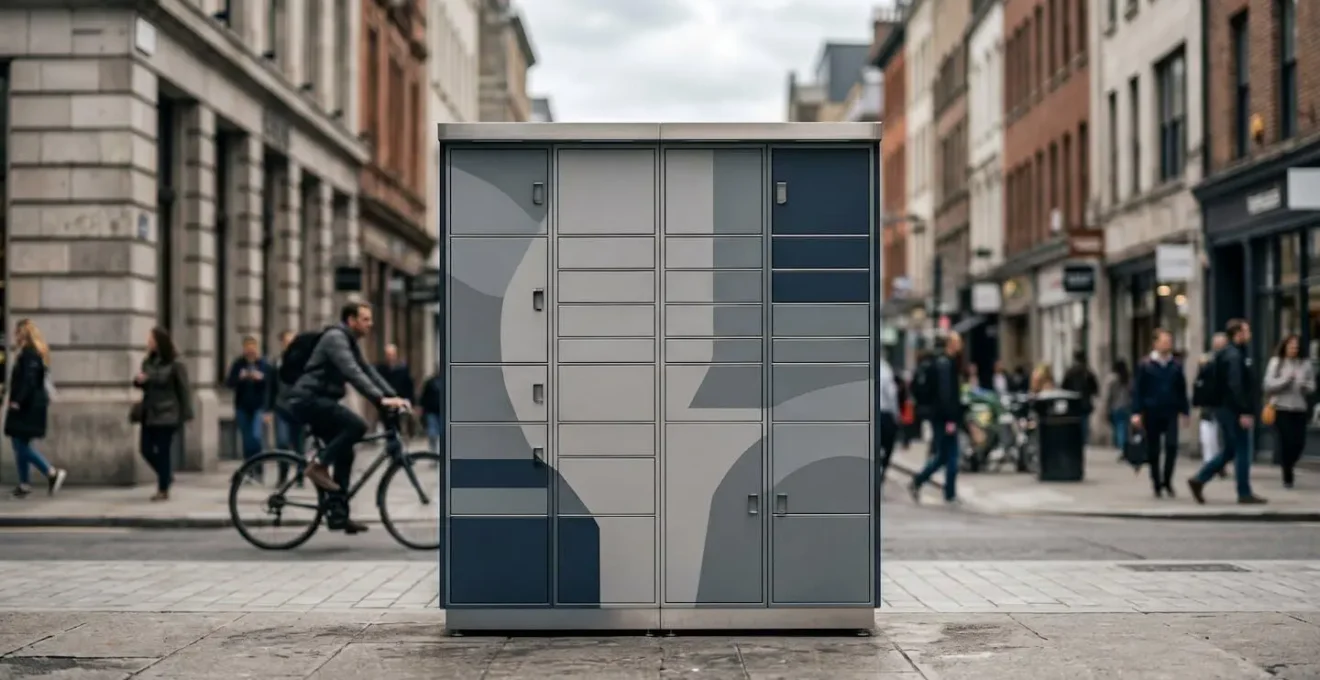
The traditional home delivery model is the primary source of urban logistics friction. It forces drivers to find parking for every single drop-off, often in residential areas with limited or no legal stopping zones. This hunt for parking is a major contributor to failed delivery attempts and, consequently, parking fines. Shifting a portion of your volume to a parcel locker network is a systemic change that attacks the root of the problem by consolidating dozens of individual stops into one. This drastically reduces the time a vehicle needs to be parked and the number of high-risk parking situations it encounters.
The economic case is compelling. By centralizing drop-offs, you eliminate the most time-consuming part of the delivery process. Instead of one driver making 100 individual stops, one driver can service a few high-density locker locations. This model can lead to a massive reduction in operational costs. In fact, a last-mile delivery economics analysis shows that smart lockers can result in a 50-55% cost reduction compared to traditional door-to-door delivery. This isn’t just an efficiency gain; it’s a fundamental change in your cost structure.
This strategy also builds incredible resilience into your network, especially during peak seasons when volume surges and parking becomes even more scarce. A robust locker network can absorb these peaks without a proportional increase in costs or risk.
Case Study: Croatian Operator Peak Season Performance
A Croatian operator with 95 parcel lockers tracked its performance during the December 2024 peak season. They found that while delivery volume increased by 52%, their delivery costs remained remarkably stable, rising only 4%. This stands in stark contrast to the traditional 35-50% cost increase seen in home-delivery models during the same period. The locker infrastructure absorbed the surge through higher utilization rates (climbing from 70% to 90%), extended customer pickup windows, and the crucial advantage of not needing to hire additional drivers or vehicles.
By shifting focus from individual doorsteps to strategic nodes, you transform the delivery equation. You are no longer solving a parking problem; you are designing a system where the problem rarely occurs.
Van vs. Box Truck: Which is Better for Narrow European Streets?
Vehicle selection is one of the most critical, yet often overlooked, factors in urban delivery efficiency. The temptation to maximize cargo capacity with a large box truck can be a strategic blunder in dense city centers. While it seems efficient on paper to carry more packages, the reality of narrow streets, tight corners, and non-existent parking makes larger vehicles a significant liability. They create operational friction at every turn, increasing the risk of accidents, blocking traffic, and, most importantly, spending an inordinate amount of time simply being stationary.
The « dwell time »—the period a vehicle is parked during a route—is a key metric that exposes the inefficiency of oversized vehicles. Research from the Urban Freight Lab at the University of Washington delivered a stunning finding: delivery trucks spend approximately 80% of their time on-route parked. This means the vehicle is not a mode of transport for the vast majority of its workday but rather a mobile, and often illegally placed, warehouse. This single insight reframes the vehicle choice debate: optimizing for maneuverability and minimal dwell time is far more important than maximizing cubic capacity.
This is especially true when considering that the last mile is the most expensive part of the entire shipping journey. With recent logistics industry data confirming that last-mile delivery accounts for up to 53% of total shipping costs, every second saved by avoiding a 15-minute search for a parking spot for a large truck has a direct and significant impact on your bottom line. The right vehicle isn’t the one that holds the most; it’s the one that gets in, gets the delivery done, and gets out with the least amount of friction and risk.
Why Removing Left Turns Saves Fuel and Time in City Delivery?
One of the most powerful examples of systemic efficiency comes from a simple, counter-intuitive routing rule made famous by UPS: eliminate left turns. On the surface, this seems inefficient. Why drive three right turns in a loop instead of making one left? The answer lies in understanding urban traffic flow and risk. A left turn against oncoming traffic is one of the most dangerous and time-consuming maneuvers a driver can make. It involves idling while waiting for a gap, which wastes fuel, increases emissions, and exposes the vehicle to a higher risk of accidents. For a delivery van, this idling time is pure inefficiency.
By implementing a « right-turn preferred » routing algorithm, logistics companies can create a smoother, more predictable, and safer delivery flow. This isn’t just a theoretical benefit; the results are significant and measurable. UPS, the pioneer of this strategy, has built its entire routing system, ORION (On-Road Integrated Optimization and Navigation), around this principle. The documented savings are staggering, with the company saving more than 10 million gallons of fuel annually through this policy alone. This translates into massive cost savings and a significant reduction in carbon footprint.
This approach directly attacks the problem of parking fines by reducing unnecessary stops and vehicle idling. A driver who is constantly moving is a driver who isn’t looking for a place to park illegally while waiting for traffic. It’s a prime example of how focusing on « flow optimization » rather than just the shortest path can yield outsized returns in cost, efficiency, and safety. This strategy proves that the smartest route is not always the shortest one.
Action Plan: Implementing a Right-Turn Routing Strategy
- Fuel Savings: Analyze current routes to identify and minimize left turns, which can save millions of gallons of fuel annually across a large fleet.
- Improved Safety: Prioritize right turns in routing software, as vehicles turning left are significantly more likely to be involved in accidents, especially with pedestrians.
- Reduced Emissions: Track carbon dioxide emissions to measure the environmental benefit, which can amount to tens of thousands of tonnes per year for a major operator.
- Increased Delivery Capacity: Measure packages delivered per route to quantify the efficiency gains; the same fleet can often handle significantly more volume.
- Reduced Idling Time: Equip vehicles with telematics to monitor and minimize time spent waiting at traffic lights for oncoming traffic to clear before making left turns.
The « Proof of Delivery » Mistake That Leads to Chargebacks
A robust Proof of Delivery (PoD) process is more than just administrative paperwork; it’s a critical defense against both friendly fraud and the operational costs of failed deliveries. The most common mistake is treating PoD as an afterthought, with a simple signature or a hasty photo. A weak PoD process invites « Item Not Received » (INR) claims, a common form of chargeback fraud. When a customer claims a package never arrived and you cannot provide clear, irrefutable evidence to the contrary, you not only lose the value of the goods but also incur chargeback fees and damage your reputation with payment processors.
The scale of this problem is significant. In the world of e-commerce fraud, the « order not received » claim is a popular tactic, with industry data revealing that 32% of fraudsters use this claim. Furthermore, a poor PoD process contributes to the cycle of redeliveries. If a delivery is disputed, it may trigger a second delivery attempt, sending another driver into a high-risk urban environment, doubling the potential for a parking fine. A strong PoD, conversely, ensures the first delivery is the only delivery. It solidifies the transaction and closes the loop, preventing the costly and risky process of redelivery.

The solution is to arm your drivers with the tools and training to capture high-quality, comprehensive PoD. This includes a clear, well-lit photo showing the package in its specific location (e.g., next to the door, under the porch bench), GPS coordinates, and a timestamp. As one expert in e-commerce fraud and chargeback research at Host Merchant Services notes, the simple act of providing clear information can have a significant impact. They point out that « one study found that giving clear tracking information and delivery alerts reduced ‘item not received’ disputes by about 25%. » This demonstrates that a proactive, data-rich PoD process is a powerful tool for reducing both financial and operational risk.
When to Deliver to Business Districts: The Window Before the Morning Rush?
Timing is a critical, yet often underestimated, lever in urban logistics. Delivering to a dense business district at 10 AM is a radically different challenge than delivering at 6 AM. The « when » of delivery dictates the « how » and « where » of parking. A delivery made during peak business hours faces a gauntlet of double-parked cars, heavy pedestrian traffic, and aggressive parking enforcement. The same delivery made during the pre-rush hour window (e.g., 5 AM to 7 AM) often finds empty streets, available loading zones, and a far more permissive environment.
The core issue is failed delivery attempts, which create a vicious cycle of inefficiency. A failed first attempt necessitates a redelivery, which often takes place during more constrained hours, increasing the likelihood of a parking violation. The scale of this problem is significant; as one study on urban freight highlights, stakeholders estimate that up to 10% of first delivery attempts fail. This is frequently because the recipient isn’t available, a problem compounded in residential areas but also relevant for businesses with specific receiving hours. Each failed attempt adds cost, fuel consumption, and another high-risk parking event to your operations.
Therefore, a key strategy for courier managers is to work with clients, especially B2B clients, to establish off-peak delivery windows. This may involve negotiating for 24/7 access to a mailroom, using secure drop-boxes, or simply educating clients on the mutual benefits of early morning deliveries. By shifting deliveries out of the 9-to-5 congestion window, you aren’t just avoiding traffic; you’re fundamentally changing the risk profile of your routes. You replace a high-stress, high-risk parking search with a smooth, efficient drop-off, directly boosting your speed and eliminating a major cause of fines.
How to Combine Scooters and Trains for the Fastest Commute?
The future of urban logistics is not about a single perfect vehicle but about a flexible, multi-modal system that uses the right tool for each segment of the journey. Relying solely on vans for every delivery, from the central depot to the final doorstep, is a recipe for inefficiency in a congested city. A truly smart system leverages the strengths of different transport modes, combining the long-haul efficiency of trains or large trucks with the last-mile agility of smaller vehicles like cargo bikes or even foot couriers.
This « intermodal » approach is being pioneered by logistics giants like Amazon. The strategy involves creating a network of micro-fulfillment hubs strategically located within dense urban areas. Large trucks or trains transport goods to these hubs during low-traffic, off-peak hours. From there, the final delivery is completed using a fleet of low-emission, highly maneuverable options. This system design completely sidesteps the problem of bringing large, hard-to-park vans into the most congested parts of the city during the busiest times of the day.
The results of this systemic shift are transformative. By replacing traditional van deliveries, this model dramatically reduces road congestion, lowers emissions, and boosts delivery speed. In a city as dense as Paris, this is not a futuristic concept but a current reality. Amazon’s implementation of this strategy has led to a situation where, in Paris, two thirds of orders are now completed with zero-emission last-mile deliveries. This proves that by breaking down the « last mile » into distinct stages and optimizing each one, you can build a system that is not only faster and cheaper but also inherently immune to the parking challenges that plague van-centric models.
Where Can You Park? Legal Pitfalls for Commercial Cargo Bikes
As courier companies increasingly turn to cargo bikes to navigate congested cities, a new set of legal and practical questions emerges. The primary advantage of a cargo bike is its ability to bypass the parking challenges that plague vans, but where can they legally stop to make a delivery? The answer is complex and varies by municipality, creating potential pitfalls for uninformed operators. While they are often treated as bicycles, their commercial use and larger size can place them in a legal gray area. Can they use a bike lane to stop? Can they park on a wide sidewalk if it doesn’t obstruct pedestrian flow? Knowing the local regulations is crucial to avoiding a new category of fines.
Despite these ambiguities, the strategic advantage remains immense. The probability of a conventional delivery vehicle parking illegally is alarmingly high, with recent studies estimating a 25% probability for any given stop. Cargo bikes, by their very nature, offer alternatives that vans simply don’t have. They can access service alleys, utilize dedicated bicycle parking, and often get much closer to the final delivery point. This drastically reduces the « walk time » for the courier, a major component of a van’s inefficient dwell time. The key is to proactively train riders on local rules and best practices.
Furthermore, research validates the inherent advantage of the cargo bike’s form factor. According to a simulation-based study published in the European Transport Research Review, the design of the cargo bike itself provides a competitive edge in urban traffic. The study notes: « The extended cargo bike outperforms conventional delivery vans when stopping on the bicycle lane which is possible because of its smaller width. » This highlights that the cargo bike’s ability to use infrastructure unavailable to vans is not a bug, but a key feature that enables greater efficiency and circumvents the entire problem of finding a legal parking space.
Key takeaways
- Parking fines are a symptom of system inefficiency, not an unavoidable cost.
- Right-sizing vehicles and using models like parcel lockers fundamentally reduces parking risk.
- Intelligent routing, such as minimizing left turns, improves flow and reduces idle time, a major contributor to parking issues.
Cargo Bikes vs. Vans: Which Is Faster for Downtown Deliveries?
Beyond navigating legal gray areas, the core question for any logistics manager is performance. So, how do cargo bikes actually stack up against traditional vans in a head-to-head comparison of downtown delivery speed? The data is conclusive and may be surprising: in dense urban environments, cargo e-bikes are not just a sustainable alternative; they are a significantly faster one. While a van has a higher top speed on an open road, that metric is irrelevant in a congested city center where average speed is dictated by traffic, red lights, and the single biggest time sink: parking.
A cargo bike’s advantage lies in its ability to circumvent these bottlenecks. It can use bike lanes, cut through parks or plazas, and get much closer to the delivery destination, dramatically cutting down the time spent walking from the vehicle to the door. This agility translates into a staggering increase in productivity. For instance, a 2023 Brussels study found that cargo e-bikes deliver an average of 10.1 packages per hour vs 4.9 for vans. This means a single cargo bike rider can be more than twice as productive as a van driver in the same environment. When you factor in the lower vehicle cost, zero fuel cost, and minimal maintenance, the business case becomes undeniable.
The table below, based on the Brussels study, lays out the performance metrics in stark detail. From average speed to cost per delivery, the cargo e-bike consistently outperforms both diesel and electric vans in the scenarios that matter most for a last-mile courier company. It’s a clear demonstration that to increase speed and eliminate fines, you sometimes need to think smaller, not bigger.
| Metric | Cargo E-Bike | Diesel Van | Electric Van |
|---|---|---|---|
| Average Speed (Brussels) | 16 km/h | 11.3 km/h | 11.3 km/h |
| Delivery Time (8.5km route) | 48 minutes | 99 minutes | 99 minutes |
| Packages Per Hour | 10.1 | 4.9 | 4.9 |
| Cost Per Delivery | €0.10 | €1.10 | €1.05 |
| Average Parking Distance | 30 meters | Up to 25 min search time | Up to 25 min search time |
| CO2 Emissions Reduction | 96-98% vs vans | Baseline | 90% less than diesel |
This data proves that embracing cargo bikes is not a compromise on performance but a strategic investment in superior efficiency and profitability for urban routes.
By implementing these systemic strategies—from adopting new delivery models and right-sizing your fleet to optimizing routes and embracing multi-modal solutions—you can move from a reactive position of paying fines to a proactive one of designing an efficient, resilient, and profitable urban logistics network. Start today by analyzing your highest-fine routes and identifying which of these strategies can be deployed to turn a cost center into a competitive advantage.