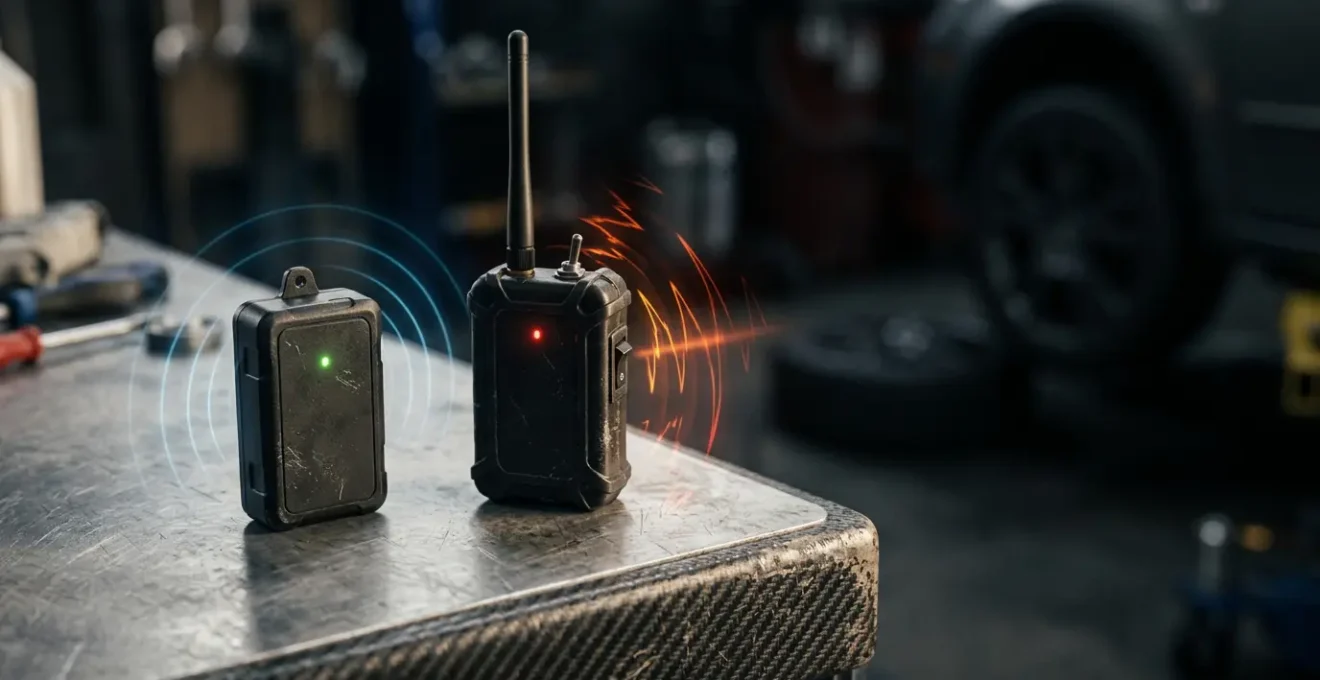
Effective vehicle recovery is not a choice between GPS and RF; it’s the result of a layered security strategy that defeats a professional thief’s predictable attack sequence.
- Professional thieves anticipate and disable standard GPS trackers using jammers in over 80% of organized thefts.
- A robust defense relies on signal redundancy (GPS + RF), covert installation that avoids common search patterns, and long-life battery power independent of the vehicle’s electrical system.
Recommendation: Audit your vehicle’s vulnerabilities through the lens of a thief’s « kill chain »—from keyless entry to their in-car search for tracking devices—and deploy a multi-technology solution accordingly.
The moment you realize your valuable vehicle is gone is a moment of pure, cold dread. For a classic car owner, it’s the loss of a passion project. For a fleet manager, it’s a critical asset vanished, disrupting operations and impacting the bottom line. The common response is to invest in a GPS tracker, believing technology will be the silver bullet. This is the first, and often most critical, mistake. Professional thieves don’t just steal cars; they execute a planned operation, a « theft kill chain, » and your simple GPS tracker is their first expected target.
The market is flooded with devices, creating a confusing landscape of GPS, LBS, RF, and Bluetooth technologies. Most advice centers on a simplistic « GPS vs. RF » debate, failing to address the tactical reality of modern vehicle theft. Professionals arrive prepared. They utilize relay attacks to bypass keyless entry and deploy signal jammers the moment they gain access, rendering most standard GPS trackers instantly blind. Relying on a single technology is like putting a standard lock on a bank vault door; it ignores the sophisticated threats arrayed against it.
But what if the entire premise of choosing one technology over another is flawed? The key to effective asset recovery is not finding the « best » tracker but building a layered security system with signal redundancy. This approach anticipates the thief’s methods, creating a series of obstacles and fail-safes that ensure you maintain a tracking signal even when one layer is compromised. It’s about moving from a reactive mindset— »How do I find my car? »—to a strategic one: « How do I make my asset un-stealable, or at the very least, immediately recoverable? »
This guide deconstructs the professional thief’s playbook. We will analyze each stage of the theft kill chain, from exploiting vulnerabilities like the OBD port and keyless entry systems to the use of jammers. By understanding their tactics, you can deploy a counter-strategy that hardens your vehicle, ensures signal integrity, and provides law enforcement with the actionable intelligence needed for a swift recovery.
To navigate these critical security layers, this article breaks down the essential components of a robust anti-theft strategy. The following sections provide a tactical roadmap for protecting your assets against sophisticated threats.
Summary: GPS vs. Radio Frequency Trackers: Which Is Best for Recovering Stolen Cars?
- Why the OBD Port is the Worst Place to Hide a GPS Tracker?
- How to Track a Parked Trailer for 3 Months Without External Power?
- How Thieves Jam GPS Signals and What You Can Do About It?
- The Difference Between Anti-Theft Tracking and Illegal Stalking
- When to Activate « Recovery Mode »: The Critical First Hour After Theft?
- How to Integrate IoT Tracking in Your Fleet Without Triggering Privacy Issues?
- The Key Fob Vulnerability That Allows Relay Attacks on Connected Cars
- Who Actually Owns the Data Your Connected Car Generates?
Why the OBD Port is the Worst Place to Hide a GPS Tracker?
The On-Board Diagnostics (OBD-II) port is the single most common and strategically flawed location for installing a GPS tracker. Its appeal is obvious: plug-and-play installation and a constant power source. However, this convenience is precisely what makes it a thief’s primary target. Professionals know that many owners and even fleet managers opt for this simple solution. Consequently, the OBD port is the very first place they check upon entering a vehicle. Leaving a tracker there is akin to leaving your house key under the doormat.
The vulnerability of this location cannot be overstated. Because the port is standardized and easily accessible under the dashboard of any modern vehicle, a thief requires no special tools or knowledge to locate and unplug your device in seconds. This single action instantly severs your connection to the asset. Furthermore, security experts warn that the exposed nature of the port means OBD trackers are highly susceptible to theft or tampering. A professional won’t just unplug it; they will take it with them, removing any evidence and preventing you from ever knowing when or where the signal was lost.
The only viable use for an OBD-style device is with an extension y-cable, which allows the device to be hidden deeper within the dashboard while keeping the port itself clear. However, the core principle remains: effective tracking relies on covert installation. The device must be placed where it will survive a thief’s initial, predictable search pattern. Thinking like a thief is paramount. They work against the clock and follow a script. Your goal is to place the tracker outside the boundaries of that script.
Action Plan: Auditing Your Vehicle Against a Thief’s Search Pattern
- OBD-II Port and Fuse Box: The first locations inspected. Check for any non-factory devices or wiring. Is your tracker plugged directly into the port? If so, it offers zero security against a professional.
- Under-Dashboard and Steering Column: Scan the areas directly under the driver and passenger side dashboards. Thieves will quickly run their hands along these surfaces looking for magnetically attached or zip-tied boxes.
- Under Seats and Seat Rails: This is another common hiding spot for amateur installations. A quick visual and physical check by a thief will uncover any devices placed here.
- Behind Dashboard Trim Panels: More sophisticated thieves will bring trim removal tools. However, they will only check the most obvious panels initially. Deep, complex installation is your ally.
- Counter-Surveillance Integration: Assess your installation. Does it use factory-style wiring looms? Is it indistinguishable from the vehicle’s own electronics? The goal is to make the tracker invisible not just to the eye, but to a trained inspection.
How to Track a Parked Trailer for 3 Months Without External Power?
Tracking unpowered assets like trailers, containers, or classic cars in long-term storage presents a unique challenge: battery life. A standard, hardwired GPS tracker that reports its location every few minutes will drain its own internal backup battery in a matter of hours or days once disconnected from a vehicle’s alternator. This makes them useless for assets that sit dormant for weeks or months. The solution lies in specialized, battery-powered trackers designed for extreme longevity and strategic power management.
These devices operate on a fundamentally different principle. Instead of constant « live » tracking, they spend most of their time in a deep-sleep mode, consuming virtually no power. They are programmed to wake up at set intervals—once a day, for example—to acquire a GPS fix, transmit their location to the server, and then immediately return to sleep. This « low-and-slow » approach is the key to multi-month or even multi-year battery performance. In fact, some advanced battery-powered trackers can achieve up to 8 years on a single set of user-replaceable batteries when configured for one daily update.
This functionality is a critical component of a layered security system for stationary assets. While a hardwired tracker might provide primary tracking for a truck cab, a separate, battery-powered unit hidden on the trailer ensures you maintain visibility even when they are separated. The selection of such a device should prioritize a rugged, weatherproof enclosure (IP67 rating or higher) and a form factor that allows for discreet, creative installation. The goal is to make the device appear as an integral, non-electronic part of the asset it is protecting.

As the image suggests, the ideal placement for such a device is in an environment where it can be deployed for long durations without intervention. When theft occurs, the device’s configuration can be remotely switched to an aggressive « Recovery Mode, » providing frequent updates to law enforcement. This combination of extreme battery life for asset management and on-demand live tracking for recovery is what makes these units indispensable for protecting valuable, unpowered equipment.
How Thieves Jam GPS Signals and What You Can Do About It?
The most significant threat to a GPS-only tracking system is signal jamming. It is no longer a theoretical risk; it is a standard tool in the professional thief’s arsenal. Small, inexpensive, and easily obtainable online, a GPS jammer works by broadcasting a powerful radio signal on the same frequencies used by GPS satellites (primarily the L1 band). This « noise » overwhelms the faint satellite signals, preventing the tracker’s receiver from calculating its position. The tracker is effectively blinded, and to your tracking platform, it appears to have simply stopped moving at its last known location.
The prevalence of this tactic is alarming. According to law enforcement estimates, 80-85% of organized vehicle thefts now involve GPS jammers. Thieves often plug them into the vehicle’s cigarette lighter socket the moment they gain entry, creating an instant bubble of signal denial. This highlights the critical flaw in relying solely on GPS for security. Without a backup technology, your asset becomes invisible the moment a jammer is activated.
Case Study: The Sub-€30 Jammer That Neutralizes GPS and Cellular
For less than €30, criminals can acquire a simple cigarette-lighter-powered GPS jammer that creates a disruption bubble of 250-300 meters. This is more than enough to conceal a stolen vehicle as it’s driven away. More sophisticated professional crews use multi-band jammers that block not only GPS but also the GSM, 4G/LTE, and WiFi signals that trackers use to communicate their location data. This dual attack—blocking both positioning and communication—neutralizes even advanced trackers that use cellular or WiFi triangulation as a fallback. The critical takeaway, however, is that the jammer itself is a radio transmitter. It doesn’t make the vehicle invisible; it creates a detectable electronic signature that anti-jamming systems can identify.
The primary countermeasure is signal redundancy. This is where Radio Frequency (RF) or multi-constellation GNSS trackers become essential. * Radio Frequency (RF) Trackers: These devices do not rely on satellites. They emit their own proprietary, directional radio signal. While they don’t provide a precise map location like GPS, this signal can be detected by a dedicated handset, allowing law enforcement or a recovery team to home in on the vehicle, even if it’s hidden in an underground garage or a steel container where GPS cannot penetrate. RF is immune to GPS jammers. * Anti-Jamming GPS Technology: Some high-end GPS devices incorporate technology that can detect the noise from a jammer. While this may not restore the GPS position, it can trigger an immediate « jamming detected » alert on your platform, notifying you of the attack in real-time. * Multi-Constellation Receivers: Modern trackers often use receivers that can access multiple satellite systems (GPS, GLONASS, Galileo, BeiDou). While a simple jammer might target the primary GPS frequency, it may not block all constellations, offering a degree of resilience.

A layered system employing both GPS for pinpoint location and RF for jammer-proof homing offers the most robust solution. The GPS provides the « where » on a map, while the RF provides the « how » to find it when GPS is denied.
The Difference Between Anti-Theft Tracking and Illegal Stalking
The deployment of tracking technology operates within a strict legal framework. While using a GPS or RF device to protect your own property is a legitimate security measure, using the same technology to monitor a person without their consent crosses the line into illegal surveillance and stalking. As an owner or fleet manager, understanding this distinction is not just an ethical obligation; it is a legal imperative to avoid severe civil and criminal liability.
The core legal principle revolves around ownership and consent. You have the unequivocal right to install a tracking device on a vehicle or asset that you own. However, the moment that vehicle is primarily used by another person—be it an employee, a family member, or a long-term renter—the issue of consent becomes paramount. Tracking an individual’s movements without their explicit, informed knowledge and agreement is illegal in most jurisdictions. For fleet managers, this means implementing a clear, transparent, and written policy that is signed by every employee operating a company vehicle.
This policy must explicitly state that vehicles are equipped with tracking devices, the purpose of the tracking (e.g., safety, dispatch efficiency, theft recovery), what data is collected, and who has access to it. Conversely, the use of GPS jammers is also strictly regulated. While thieves use them for illicit purposes, their possession and operation by citizens are illegal in many countries. In the United States, for instance, federal law enforcement treats GPS jammer use as a serious violation, with the FCC having authority to impose fines in the hundreds of thousands of dollars, alongside potential criminal charges. The legal framework is designed to protect legitimate uses while penalizing malicious interference and privacy violations.
To ensure your anti-theft measures remain lawful, a clear set of rules must be followed:
- Verify Ownership: You must be the legal owner of the asset being tracked. You cannot track a vehicle you have sold or one that does not belong to you or your company.
- Secure Explicit Consent: If someone else is the primary driver, obtain their written consent. For fleets, this must be a formal part of the employment agreement or vehicle use policy.
- Define a Legitimate Purpose: The tracking must be for valid security or business reasons. Using tracking data to monitor an employee’s personal time or for any form of harassment is illegal.
- Maintain Transparency: Drivers must be clearly informed that tracking is active. Using « stealth » tracking on an employee without a clear policy is a significant legal risk.
When to Activate « Recovery Mode »: The Critical First Hour After Theft?
In the event of a theft, time is your most critical and perishable asset. The period immediately following the crime—often called the « golden hour »—is when the chances of a successful recovery are highest. Professional thieves aim to get the vehicle to a secure location, a « cool-down » spot, or a chop shop as quickly as possible to begin dismantling it or stripping it for valuable parts. Activating your tracker’s « Recovery Mode » and notifying law enforcement without delay is the single most important action you can take.
Data consistently shows the direct correlation between reporting speed and recovery success. In fact, law enforcement data shows that about 34% of recovered stolen vehicles are found on the same day the theft is reported. Waiting, even for a few hours, to « see if it turns up » dramatically decreases these odds. The moment you have confirmed a theft, your protocol must be immediate and precise. This involves activating Recovery Mode on your tracking platform, which forces the device to report its location at a much higher frequency (e.g., every 30 seconds), providing a live trail of the vehicle’s movement.
With live data in hand, your next call is to law enforcement. It is crucial to communicate effectively to ensure a priority response. Police departments are often inundated with reports, but a stolen vehicle with an active, live tracking signal is an actionable, in-progress crime that they can often respond to immediately. When you call, you must clearly state that you have live GPS data showing the vehicle’s current location. This elevates your report from a standard property crime to one with a high probability of immediate resolution and apprehension.
Follow this script when contacting law enforcement for a swift response:
- Immediately file a police report to get a case number. This is non-negotiable.
- Call the police dispatch line (not 911 unless instructed) and state, « I am reporting a stolen vehicle, case number [Your Case #], and I have active, live GPS tracking data showing its current location. »
- Provide the exact address or GPS coordinates from your tracking platform.
- Offer to provide the responding officers with a temporary, shareable tracking link from your platform so they can see the vehicle’s movement in real-time on their own devices.
- Relay any other alerts you have received, such as geofence breaches, ignition status changes, or if the vehicle is now stationary.
How to Integrate IoT Tracking in Your Fleet Without Triggering Privacy Issues?
For a fleet manager, IoT tracking is a powerful tool for optimization, safety, and security. It enables efficient dispatch, monitors driver behavior to reduce fuel costs and accidents, and is a cornerstone of asset recovery. However, this level of monitoring inherently creates tension with employee privacy. Implementing a successful and legally defensible tracking program requires a strategy built on transparency, clear boundaries, and demonstrable respect for employees’ rights.
The foundation of an ethical program is a comprehensive and transparent written policy. This document should leave no room for ambiguity. It must be provided to every employee, and their signature of acknowledgment should be obtained before they operate any tracked vehicle. This policy serves as a legal shield for the company and builds trust by showing that the goal is business management, not intrusive personal surveillance. A vague or non-existent policy is a direct invitation to legal challenges and a breakdown in employee morale.
Best Practice: The « Privacy Mode » Feature
Leading fleet management systems now offer a « Privacy Mode » or « Personal Use » button. This feature allows a driver to temporarily disable detailed location and behavior tracking when using a company vehicle for authorized personal time, such as a lunch break or approved after-hours use. When activated, the system might only record total mileage for expense purposes but will cease logging specific routes, speeds, and stops. The system logs the activation and deactivation of this mode, creating a transparent record that protects both the employee’s privacy and the company’s asset. This feature is a powerful tool for demonstrating trust and respecting the line between work and personal life.
A robust fleet tracking policy must clearly define several key elements to be effective and fair:
- What is Tracked: Be specific. List all data points, such as location, speed, route history, engine diagnostics, idle time, and harsh braking or acceleration events.
- When Tracking is Active: Clearly state the hours of operation for tracking. Is it strictly during work hours, or is it 24/7 for theft protection? If the latter, features like « Privacy Mode » become even more critical.
- The Purpose of Data Collection: Justify the tracking. Connect each data point to a legitimate business purpose like « improving dispatch efficiency, » « ensuring driver safety, » or « optimizing fuel consumption. »
- Who Has Access to the Data: Define access controls. Typically, only direct fleet managers and executive-level staff should have access to the data, not every supervisor, to prevent misuse for personal monitoring.
- Data Retention and Employee Rights: Specify how long the tracking data is stored and outline the process by which an employee can request and review their own data.
The Key Fob Vulnerability That Allows Relay Attacks on Connected Cars
While much focus is placed on tracking a vehicle after it’s stolen, a critical part of a layered security system is preventing the theft in the first place. One of the most widespread vulnerabilities in modern vehicles is the keyless entry system. Thieves exploit this with a technique called a relay attack, which requires no hacking, no code-breaking, and can be executed in seconds with relatively cheap electronic equipment.
A relay attack works by tricking your car into thinking your key fob is right next to it, even when it’s safely inside your house or pocket. The attack requires two thieves working together. The first thief stands near your home or office with a device that amplifies the search for your key fob’s signal. Once it detects your key’s passive signal, it relays it to a second device held by the other thief standing next to your car. This second device mimics your key, and the car, receiving the signal it expects, unlocks the doors and allows the engine to be started. The entire process is silent and leaves no signs of forced entry.
The scale of this vulnerability is staggering. A 2024 study by the German automobile club ADAC found that of 237 modern vehicles with keyless entry systems they tested, a shocking 230 were susceptible to being opened and driven away via a relay attack. The attack works because it doesn’t break the encryption; it simply extends the range of the legitimate signal. The car has no way of knowing the key isn’t physically present.

The most effective and affordable countermeasure is a simple physical barrier: a Faraday pouch or box. These signal-blocking containers are lined with a metallic mesh that creates a Faraday cage, preventing any radio signals from getting in or out. Storing your key fob in one of these pouches when you are not using it makes it completely invisible to a relay attack device. Some newer vehicles are also incorporating Ultra-Wideband (UWB) technology in their key fobs, which can measure the signal’s travel time to determine the key’s precise distance, making relay attacks far more difficult. However, for the vast majority of vehicles on the road, a Faraday pouch is an essential, non-negotiable layer of security.
Key Takeaways
- A layered security system combining GPS and RF is superior to any single technology, as it provides both mapping precision and jammer-proof homing capabilities.
- Professional thieves follow predictable search patterns, making covert, unconventional installation of tracking devices far more important than the device’s features alone.
- Immediate action is critical. Activating « Recovery Mode » and providing live tracking data to law enforcement within the first hour of a theft exponentially increases the chance of recovery.
Who Actually Owns the Data Your Connected Car Generates?
In the modern era of the connected car, the vehicle is no longer just a mechanical asset; it is a powerful data generation and transmission platform. Every trip, every turn, every hard brake, and every diagnostic code is logged, processed, and often transmitted back to the manufacturer, your insurance company, or third-party service providers. This raises a complex and increasingly important question: as the vehicle owner, what rights do you have, and who actually owns and controls this vast stream of data?
The answer is often buried deep within the terms and conditions you agreed to when you purchased the vehicle or activated its connected services. In most cases, while you own the physical car, you are granting the manufacturer a broad license to collect, use, and even sell the data it generates. This data is incredibly valuable, used for everything from R&D and predictive maintenance alerts to powering telematics-based insurance programs (pay-as-you-drive) and marketing partnerships. The challenge for owners is that this data collection is often a prerequisite for using features like remote start, live traffic updates, or concierge services.
Navigating this ecosystem requires a proactive approach to managing your vehicle’s privacy settings. Most modern infotainment systems provide a menu where you can review and, to some extent, control data sharing permissions. It is essential to conduct a personal audit of these settings to understand what you are sharing and with whom. Opting out of certain data streams may disable some convenience features, but it allows you to reclaim a degree of control over your personal information. Making an informed choice is key.
To take control of your vehicle’s data, follow these steps:
- Locate Privacy Settings: Find the « Connected Services, » « Data Sharing, » or « Privacy » menu within your car’s main infotainment system settings.
- Review Data Collection: Examine the list of data types being collected. This often includes precise location history, driving behaviors (speed, acceleration), vehicle health diagnostics, and even in-cabin voice commands.
- Manage Third-Party Sharing: Check which third parties are granted access. This can include the manufacturer, dealerships, insurance partners, and data brokers.
- Disable Non-Essentials: Make a conscious decision about what to disable. If you do not use telematics-based insurance, for example, ensure that detailed driving behavior data is not being shared with insurers.
- Request a Data Report: Under regulations like GDPR or CCPA, you may have the right to request a report from the manufacturer detailing exactly what data they have collected about you and your vehicle.
The most effective way to protect your automotive assets is to move beyond simply buying a device and instead adopt a strategic, layered security mindset. The next logical step is to conduct a thorough audit of your specific vulnerabilities—from keyless entry to potential tracker hiding spots—and build a comprehensive protection and recovery plan tailored to your vehicle and risk profile.