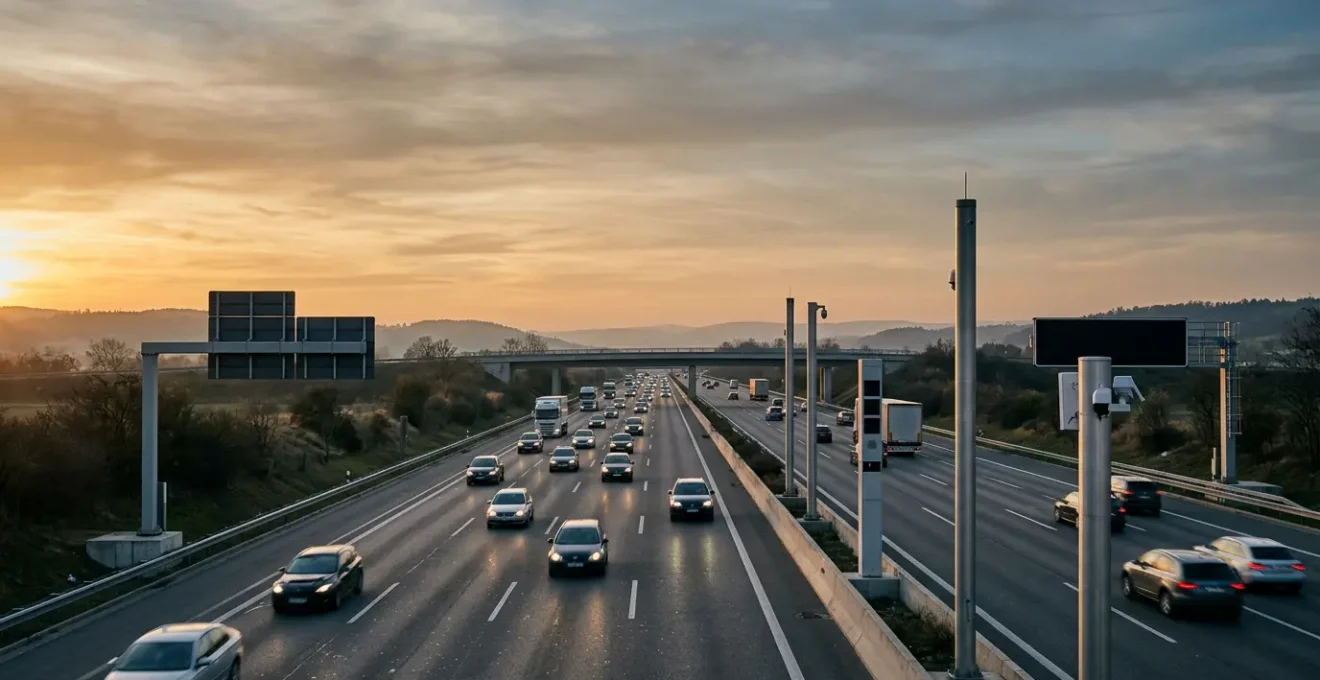
Smart infrastructure is no longer about just managing traffic; it’s about creating a predictive, collaborative ecosystem that actively prevents accidents and gridlock before they happen.
- Vehicle-to-Infrastructure (V2I) communication enables roads to use real-time data to create « green waves » and detect unseen hazards like black ice.
- The industry is undergoing a critical, federally-mandated shift from older DSRC to the more advanced C-V2X technology, but this transition introduces new cybersecurity vulnerabilities that must be addressed.
Recommendation: City planners and automotive engineers must prioritize system interoperability and robust cybersecurity protocols to unlock the full safety and efficiency potential of our future smart roads.
The daily commute is a universal ritual, often defined by frustration: the phantom traffic jam, the string of red lights, the sudden downpour that turns a familiar road into a hazard. We currently navigate this with a reactive mindset, responding to dangers and delays as they appear. For decades, the promise of « smart cities » has felt abstract, but a fundamental shift is already underway. By 2030, this reality will be transformed not by flying cars, but by a quieter, more profound revolution: the road itself is becoming sentient.
This isn’t about simply replacing metal signs with digital screens. We are building a predictive infrastructure, a city-wide nervous system where vehicles and roadways are in a constant state of dialogue. The common understanding is that this technology will make things faster, but its true purpose is far deeper. It’s about creating systemic resilience—an environment that anticipates danger, optimizes the flow of thousands of vehicles as a single collaborative entity, and shares critical information faster than human perception can process. This article moves beyond the headlines to explore the core mechanics of this transformation. We will dissect how this « ambient sensing » network functions, the critical security challenges it faces, and the tangible impact it will have on your safety and time.
This article explores the core technologies and timelines that will define our roadways by 2030. We will delve into how dynamic traffic management works, how sensors predict hazards, the communication protocols involved, and the crucial security measures needed to make this vision a reality.
Summary: How Smart Signs Will Revolutionize Your Commute Safety by 2030?
- Why Variable Speed Limits Reduce Traffic Jams Better Than Constant Ones?
- How Smart Signs Detect Black Ice Before You Can See It?
- V2I Communication: How Do Smart Signs « Talk » to Self-Driving Cars?
- The Security Flaw That Could Let Hackers Change Speed Limits Remotely
- When Will Your City Install Smart Traffic Lights: The Rollout Timeline?
- Why Your Dashboard is Telling You to Drive 35mph Between Lights?
- Why Your Car Knows Your Weight, Commute, and Driving Style?
- How V2I Technology Reduces Your Idle Time at Red Lights by 20%?
Why Variable Speed Limits Reduce Traffic Jams Better Than Constant Ones?
The concept feels counter-intuitive: to get traffic moving faster, you must first slow it down. Yet, this is the foundational principle behind Variable Speed Limit (VSL) systems, a cornerstone of smart road infrastructure. On a congested highway, a single driver tapping their brakes can trigger a shockwave that travels backward, creating a phantom traffic jam miles behind the initial event. Fixed speed limits are ineffective in these scenarios because they don’t adapt to changing road capacity. VSL systems use a network of sensors to monitor traffic density and flow in real-time. When congestion starts to build, the system preemptively lowers the speed limit in the upstream sections.
This controlled reduction does two critical things. First, it smooths out the flow of traffic, preventing the stop-and-go conditions that exacerbate delays. Second, it increases the overall throughput of the roadway. As the Texas A&M Transportation Institute’s research highlights:
Slowing traffic down in heavy traffic actually increases the number of cars that can travel on a road. The slower speeds make drivers more comfortable driving closer together and keep stop-and-go conditions to a minimum.
– Transportation Policy Research Center, Texas A&M Transportation Institute Policy Research
By harmonizing vehicle speeds, the system prevents the accordion-like effect of braking and acceleration, maintaining a denser but steadily moving column of traffic. The result is a more predictable and efficient commute. The data supports this, as research on intelligent traffic lights has shown an ability to achieve up to a 40% reduction in traffic delays. This isn’t just about changing a number on a sign; it’s about actively managing the physics of traffic flow for system-wide efficiency.
How Smart Signs Detect Black Ice Before You Can See It?
Black ice is one of the most treacherous conditions a driver can face precisely because it is invisible. By the time you feel the loss of traction, it’s often too late. Smart road infrastructure aims to eliminate this element of surprise by creating an « ambient sensing » network that detects the conditions for black ice formation long before it becomes a threat. This goes far beyond simple temperature readings. A specialized roadside unit is a sophisticated weather station and surface analyzer in one.
These systems employ sensor fusion, combining data from multiple sources to build a highly accurate picture of the road surface. This includes:
- Surface Temperature Sensors: Often using non-contact infrared technology to measure the exact temperature of the pavement itself, which can be significantly colder than the air.
- Atmospheric Sensors: These measure ambient air temperature, humidity, and dew point.
- Radar Technology: Advanced systems use 60GHz radar for non-contact measurement of the surface state, capable of distinguishing between dry, wet, or icy conditions.
This complex array of sensors allows for the proactive detection of invisible hazards. The illustration below shows the intricate technology embedded within these advanced sensors.

A real-world example is Prylada’s black ice detection solution, which uses deterministic machine learning models. The system is trained to recognize the specific pattern of sensor readings that precedes ice formation—for instance, when humidity exceeds 80% and the surface temperature drops below 4°C. When these conditions are met, the system triggers an alert. This alert can be broadcast to a central traffic management center, update digital warning signs for approaching drivers, and, most importantly, send a direct digital warning to connected vehicles, advising them to reduce speed or reroute long before they reach the hazardous patch.
V2I Communication: How Do Smart Signs « Talk » to Self-Driving Cars?
The « smart » in a smart sign isn’t just its display; it’s its ability to hold a high-speed, low-latency « data dialogue » with every connected vehicle around it. This is the essence of Vehicle-to-Infrastructure (V2I) communication, a system that allows cars and road infrastructure to constantly exchange vital information. This communication doesn’t rely on a driver seeing a sign; it’s a direct, machine-to-machine conversation. While often discussed alongside Vehicle-to-Vehicle (V2V) communication, V2I focuses specifically on the link between a car and fixed infrastructure like traffic lights, toll booths, and road signs.
Two primary technologies govern this space: DSRC (Dedicated Short-Range Communications) and C-V2X (Cellular Vehicle-to-Everything). Think of them as different languages for the same purpose. DSRC is an older, Wi-Fi-based standard, while C-V2X leverages modern cellular technology for greater range and performance. The technical differences are significant for planners; a recent comparative analysis of vehicular communication protocols shows that while DSRC offers latencies below 50 ms, C-V2X can achieve latencies as low as 20 ms with much higher data rates. This difference is critical for safety applications where every millisecond counts.
When a connected vehicle approaches a smart sign, the sign transmits a rich data packet. This isn’t just the speed limit; it includes its precise GPS location, the type of sign, the specific instruction (e.g., « 70 mph, » « Stop Ahead »), and, crucially, a digital signature to prove its authenticity. The vehicle’s onboard computer receives this data, verifies the signature to ensure it’s not a malicious signal, and can instantly act on it—displaying it on the dashboard for a human driver or feeding it directly into the decision-making algorithm of a self-driving system. This creates a layer of information redundancy and reliability that a camera-based system, which could be fooled by a dirty or vandalized sign, simply cannot match.
The Security Flaw That Could Let Hackers Change Speed Limits Remotely
As our road infrastructure becomes more connected, it also becomes a more attractive target for malicious actors. The prospect of a hacker remotely changing a speed limit sign from 70 mph to 15 mph on a busy highway is a terrifying but plausible scenario. The primary vulnerability in any V2I system stems from its reliance on wireless communication. Signals broadcast over the air can be intercepted, spoofed, or jammed, potentially compromising the integrity of the entire network. A compromised roadside unit could send false information, or a hacked vehicle could masquerade as a legitimate source, creating chaos.
A systematic review of academic literature on V2I security has identified the most common attack vectors that planners must defend against. These include:
- Man-in-the-Middle (MitM): An attacker intercepts and alters communication between a vehicle and a sign.
- Impersonation & Sybil Attacks: A single attacker creates thousands of « ghost » vehicles to trick the system into thinking there’s a traffic jam, triggering unnecessary speed reductions.
- Denial-of-Service (DoS): An attacker floods a roadside unit with junk data, preventing it from communicating legitimate information to vehicles.
- Tampering & Forgery: An attacker alters the data packet from a sign to broadcast false speed limits or warnings.
Defending against these threats requires a multi-layered security architecture built on principles of cryptography and trust. This includes robust encryption for all data transmissions, strong authentication using digital certificates to verify the identity of every car and sign, and continuous network monitoring to detect anomalous behavior. Security frameworks like CVGuard have shown promise, with an analysis of the CVGuard V2I security architecture demonstrating a 60% reduction in inter-vehicle conflicts caused by malicious data. Securing this data dialogue is not an afterthought; it is the absolute prerequisite for public trust and safe deployment.
Action Plan: Key Points to Verify for V2I Security Audits
- Communication Channels: Create a comprehensive inventory of all V2V, V2I, and V2N (Vehicle-to-Network) data exchange points in the system.
- Authentication & Encryption: Audit the existing security protocols, ensuring digital signatures and state-of-the-art encryption (e.g., TLS/DTLS) are implemented on all links.
- Attack Vector Simulation: Actively confront the system with simulated attacks, including Sybil, Man-in-the-Middle, and Denial-of-Service scenarios to identify weak points.
- Data Integrity & Provenance: Verify the mechanisms that confirm data origin and prevent tampering, ensuring every instruction can be traced to a trusted source.
- Incident Response Plan: Establish and test a clear protocol for detecting, isolating, and neutralizing a compromised unit to minimize its impact on the network.
When Will Your City Install Smart Traffic Lights: The Rollout Timeline?
The transition to a fully smart and connected road network won’t happen overnight. The rollout is a complex patchwork of state-level initiatives, federal mandates, and technological evolution. For city planners and drivers, the question is not *if* but *when* these systems will become standard. The process has been underway for years; an according to a Federal Highway Administration synthesis report, at least 13 U.S. states had deployed some form of Variable Speed Limit system as early as 2016. However, the pace is accelerating due to a critical regulatory shift.
The most significant factor driving the timeline is the federally mandated transition from DSRC to C-V2X technology. DSRC, the older standard, has been officially phased out for new deployments. As the Federal Communications Commission states in its ruling:
The FCC establishes a two-year sunset for DSRC operations in the 5.9 GHz band, with new licenses after the effective date authorizing only C-V2X operations, not DSRC operations.
– Federal Communications Commission, Second Report and Order on ITS Transition
This decision effectively sets the technological path forward. Any new smart infrastructure project, from traffic lights to road signs, must now use the more advanced C-V2X protocol. This creates a clear timeline: while existing DSRC systems may operate for a few more years, all future growth and investment will be in the C-V2X ecosystem. For most cities, this means the rollout will likely happen in phases: major arterial roads and highways will be upgraded first, with deployment gradually extending to collector and local streets over the next decade. Full national saturation is a long-term goal, but significant benefits will be realized in major urban corridors well before 2030.
Why Your Dashboard is Telling You to Drive 35mph Between Lights?
Seeing a specific speed recommendation like « 35 mph » appear on your dashboard is a direct and tangible benefit of V2I communication. This feature, known as Green Light Optimal Speed Advisory (GLOSA), is designed to help drivers avoid stopping at red lights, creating a smoother, more efficient, and less frustrating journey. It represents a shift from reactive driving (speeding up to « make » a light) to proactive, system-guided driving. The goal is to create a « green wave, » allowing a platoon of vehicles to pass through a series of intersections without stopping.
The technology works through a continuous data dialogue. As your vehicle approaches an intersection, the smart traffic light controller broadcasts its current status and timing information. This packet of data includes how long the current light will remain green (or red). Your vehicle’s onboard computer receives this information and combines it with its own position and speed. It then calculates the optimal speed you need to maintain to arrive at the intersection during a green phase. If you’re too far away to make the current green, it may advise a slower speed to ensure you arrive just as the next green cycle begins, thus avoiding braking, idling, and re-accelerating.
This approach, where vehicles collaboratively determine their optimal speeds based on infrastructure guidance, has been shown to produce significant gains. A research study on this V2I method demonstrated that by providing this real-time information, connected infrastructure can optimize traffic flow through coordinated vehicle speed management, leading to a substantial reduction in average travel time for commuters. It transforms each driver from an isolated agent into a cooperative participant in a city-wide traffic management ballet, orchestrated by data.
Why Your Car Knows Your Weight, Commute, and Driving Style?
Modern vehicles have become vast data-gathering platforms on wheels. While smart signs are broadcasting information to your car, your car is simultaneously generating an enormous amount of data about itself, its occupants, and its environment. This goes far beyond basic telematics. Your car knows your typical commute from GPS history, your driving style from accelerometer data (tracking acceleration and braking harshness), and can even estimate passenger weight using seat occupancy sensors originally designed for airbag deployment. This data is the lifeblood of the personalized and predictive services that define the future of mobility.
This data collection serves multiple purposes. For instance, knowing occupant weight allows for more efficient energy management in an electric vehicle. Understanding a driver’s braking habits can inform personalized coaching for safer or more fuel-efficient driving. In the context of V2I, this data becomes even more powerful. A vehicle can anonymously report its own speed and position, contributing to the real-time traffic map that VSL systems rely on. It can report a sudden traction control activation, providing a ground-truth data point that can help confirm a smart sign’s suspicion of icy roads.

This two-way data dialogue raises important questions about privacy and control, but it also enables a more intelligent and responsive system. The information broadcast by a smart sign is enriched by the collective, real-time data provided by the vehicles themselves. As described by industry analysis, a smart sign’s data packet includes a digital signature to prove it’s not a fake, but it’s the anonymous data from thousands of vehicles that validates the real-world conditions the sign is describing. It’s a symbiotic relationship: the infrastructure provides authoritative guidance, and the vehicles provide the distributed, real-time feedback to ensure that guidance is accurate and relevant.
Key takeaways
- Smart roads are not just about digital displays; they create a predictive ecosystem using sensor fusion to detect hazards like black ice before they are visible.
- V2I communication allows for collaborative traffic flow, with technologies like Variable Speed Limits and GLOSA reducing traffic jams and creating « green waves » at intersections.
- The entire industry is shifting to the C-V2X communication standard, but this connected future brings critical cybersecurity challenges (like MitM and Sybil attacks) that must be addressed with robust encryption and authentication.
How V2I Technology Reduces Your Idle Time at Red Lights by 20%?
The time spent idling at a red light is more than just an annoyance; it’s a measurable waste of fuel, a source of unnecessary emissions, and a key contributor to traffic congestion. V2I technology directly tackles this inefficiency by optimizing traffic signal timing based on the actual, real-time flow of vehicles. Instead of relying on fixed, pre-programmed cycles, smart traffic lights can adapt dynamically to demand, significantly reducing the time drivers spend waiting for a green light.
This optimization is a direct result of the « collaborative flow » enabled by V2I. As connected vehicles approach an intersection, they communicate their presence, speed, and trajectory to the traffic light controller. The controller can then analyze this data from all directions. If it detects a large platoon of vehicles approaching on a main thoroughfare and very little traffic on the cross street, it can extend the green light for the main road to allow the platoon to pass through uninterrupted. This prevents the lead car from stopping, which in turn prevents the entire line of cars behind it from stopping, idling, and then re-accelerating.
The impact of this dynamic management is substantial. While headlines often focus on one figure, the benefits are multi-faceted. The 20% figure frequently associated with V2I’s impact often refers to the reduction in harmful emissions from less idling. However, the direct benefit to the driver—the reduction in waiting time—can be even more dramatic. According to one study, simulation outcomes of smart traffic systems revealed reductions of up to 40% in waiting times and 25% in overall travel times. By transforming intersections from static bottlenecks into dynamic nodes of a larger, intelligent network, V2I technology turns wasted time into productive, safer, and cleaner movement.
The transition to a sentient street, where infrastructure and vehicles operate in a state of constant, collaborative dialogue, is the most significant leap in road safety and efficiency of our generation. To realize this future, city planners, engineers, and policymakers must now focus on building the secure, interoperable, and resilient digital foundation this revolution requires.