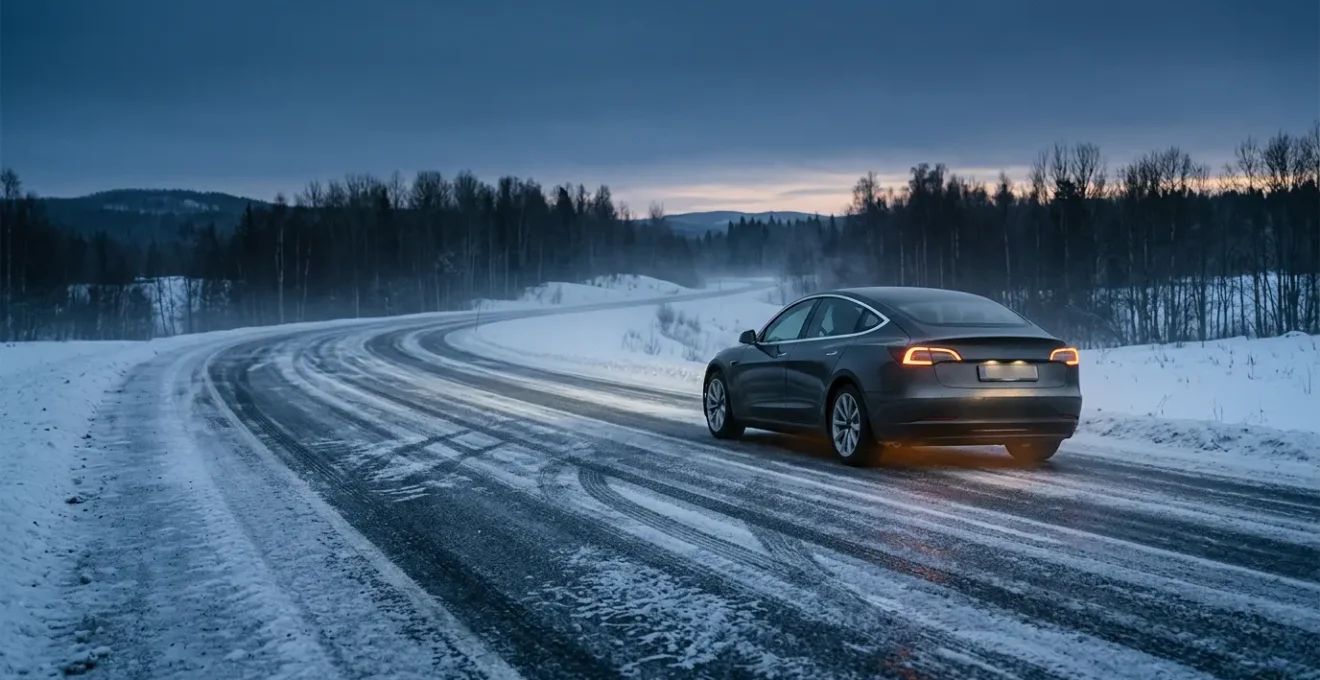
Your car’s Electronic Stability Program (ESP) isn’t a magical forcefield; it’s a predictive physics engine that can be outsmarted by physics, faulty parts, or a driver who misunderstands its purpose.
- ESP works by braking individual wheels to correct a skid, often before you even sense it. It’s about stability, not just traction.
- On loose surfaces like deep snow or gravel, both ESP and ABS can actually work against you, making it harder to get unstuck or stop effectively.
- AWD gets you going, but ESP keeps you from spinning out. For winter safety, a functioning ESP is arguably more critical than all-wheel drive.
Recommendation: Treat ESP as an expert co-pilot, not an autopilot. Learn its language, understand its limits, and know when to make an intentional override to maintain ultimate control.
The feeling is unmistakable: a sudden, unnerving lightness in the steering as your car glides over a patch of black ice. In that split second, every driver has the same thought: « Will the car save me? » For decades, the answer has increasingly been tied to a three-letter acronym: ESP, or Electronic Stability Program. Many drivers view it as an infallible guardian angel, a system that defies the laws of physics to keep them safe. They trust it implicitly, sometimes to a fault, believing that technology alone is the ultimate defense against winter’s treachery.
This common belief, however, overlooks a critical truth. While stability control is a monumental leap in automotive safety, it is not magic. It is a system bound by the same physical principles that govern every vehicle: tire grip and momentum. Simply having ESP is not enough; true mastery of winter driving comes from understanding *how* it thinks. It’s about knowing the difference between ESP and simple traction control, and recognizing the specific, rare scenarios where you, the driver, must make an intentional override to achieve a better outcome. Blind faith in the system can lead to overconfidence and dangerous situations.
But what if the key wasn’t just to trust ESP, but to understand its logic so deeply that you can work *with* it? This guide moves beyond the simplistic « what it does » and dives into the « why and how. » We will deconstruct the system, treating it not as a black box, but as a predictive physics engine. We will explore the precise mechanics it uses to correct understeer, identify the exact moments when disabling traction control is not just useful but necessary, and clarify the crucial-yet-misunderstood relationship between ESP and All-Wheel Drive.
By exploring the system’s logic, its potential failure points, and even its aerodynamic dependencies, you will shift from a passive passenger to an informed pilot. You will learn to interpret its signals, anticipate its actions, and ultimately, become a safer, more competent driver, whether you’re navigating a frozen highway or simply troubleshooting a mysterious warning light.
This article provides a deep dive into your vehicle’s stability control system. Discover the detailed mechanics, critical safety distinctions, and troubleshooting steps that will make you a more informed and capable driver in any condition.
Summary: Decoding Your Car’s Electronic Stability Program
- How ESP Fixes Understeer Before You Even Feel It?
- When to Turn OFF Traction Control to Get Unstuck?
- AWD vs. ESP: Which Is More Important for Winter Safety?
- The Wheel Speed Sensor Issue That Disables Your ESP
- Why is Your ESP Light Flashing on Dry Pavement?
- Why ABS Might Increase Your Stopping Distance on Gravel or Snow?
- Why Your Stock Spoiler Might Be Generating Dangerous Lift at 80 MPH?
- How to Troubleshoot ABS Activation at Low Speeds on Dry Pavement?
How ESP Fixes Understeer Before You Even Feel It?
Understeer, the condition where the front wheels lose grip and the car plows straight ahead despite your steering input, is a common and frightening loss of control. ESP combats this not by magic, but with lightning-fast calculations and precise mechanical intervention. The system acts as a predictive physics engine, constantly comparing your intended path (measured by the steering angle sensor) with the car’s actual rotation (measured by the yaw rate sensor). When a discrepancy is found, it intervenes before most drivers even realize a skid has begun. In fact, Bosch research shows that ESP’s control unit calculates vehicle movement 25 times per second, allowing for near-instantaneous reactions.
The system’s genius lies in its corrective action. To combat understeer, ESP doesn’t brake the front wheels; that would only worsen the skid. Instead, the system’s logic dictates a far more subtle approach. As detailed in engineering case studies, it applies a precise, sharp braking force to the inside rear wheel while simultaneously reducing engine power. This action creates a pivot point, a slight drag on one corner of the car that effectively « tucks » the vehicle’s nose back into the corner. This induced rotation realigns the car with the driver’s intended path, correcting the slide before it can fully develop. This entire process happens in milliseconds, often feeling like a momentary hesitation or a subtle tug on the chassis, rather than a dramatic event.
This pre-emptive correction is what makes ESP so effective. It doesn’t wait for a full-blown slide. It detects the very inception of instability—the moment the car’s actual yaw rate deviates from the predicted yaw rate based on your steering input and speed. By intervening at this micro-level, it maintains control with minimal drama, managing the tire’s limited traction budget without overwhelming the driver.
When to Turn OFF Traction Control to Get Unstuck?
The button on your dashboard, often showing a car with skid marks, is one of the most misunderstood controls in a modern vehicle. While ESP is the master system for stability, it works in concert with a subsystem: Traction Control (TC). TC’s primary job is to prevent wheelspin during acceleration. On a slippery but firm surface like ice, this is invaluable. However, in deep snow, mud, or sand, this function becomes a liability. To get unstuck from these loose materials, you often need a degree of controlled wheelspin to dig through the soft top layer and find a firmer surface below. Traction control, by design, will cut engine power precisely when you need it most, preventing you from generating the momentum needed to escape.
This is the critical scenario for an intentional override. Most vehicles offer a two-stage deactivation. A single, short press of the button typically disables only the traction control (TC) while leaving the overarching stability control (ESP) active. This is the ideal setting for getting unstuck, as it allows for wheelspin while still providing a safety net against a lateral skid if you start to slide sideways. A long press (usually 3-5 seconds) will often disable the entire ESP system, which should only be done in very specific circumstances, such as trying to « rock » the vehicle back and forth between drive and reverse—a technique that is impossible with TC active.
Understanding this distinction is key. You are not « turning off safety »; you are adapting the vehicle’s logic to a specific problem the engineers anticipated. The goal is to use the tire’s tread to evacuate the loose material and bite into something solid.

As the illustration shows, controlled spin allows the tread blocks to act like paddles, clearing away the low-friction powder to reach the more compressed, grippier layer underneath. Once you are free and moving on a more solid surface, it is crucial to immediately press the button again to re-engage the full suite of safety systems. Disabling these systems is a temporary tool, not a permanent driving mode.
AWD vs. ESP: Which Is More Important for Winter Safety?
The debate between All-Wheel Drive (AWD) and Electronic Stability Program (ESP) is a common one, but it’s based on a fundamental misunderstanding of their roles. AWD is an acceleration technology; ESP is a stability technology. AWD gives you a significant advantage in getting moving from a stop on a slippery surface by distributing power to all four wheels. However, it provides almost no benefit when it comes to turning or stopping. This reality creates a dangerous sense of overconfidence, as drivers of AWD vehicles can accelerate to speeds their braking and steering systems cannot safely handle on ice or snow. In fact, recent data reveals that AWD vehicles are involved in 10% more ice-related brake accidents, likely due to this exact « go-but-not-slow » capability.
ESP, on the other hand, is the critical system for maintaining control during directional changes on low-friction surfaces. Its function is to prevent a skid, whether it’s understeer or oversteer, by managing the vehicle’s yaw and keeping it pointed where the driver intends. Its value is highest precisely when a driver’s inputs (steering, braking) might otherwise overwhelm the available grip. A comprehensive study on the system’s life-saving potential highlighted this, showing that ESP’s effectiveness in reducing fatal single-vehicle accidents jumps significantly on wet and slippery roads. The study confirms that while AWD helps you start, ESP is what keeps you on the road once you’re moving.
Think of it this way: your tire has a finite « traction budget » that it can spend on accelerating, braking, or turning. AWD helps you spend that budget more effectively for acceleration. ESP acts as a budget manager, preventing you from overspending your grip on a turn and entering a slide. In an ideal winter vehicle, you would have both. But if forced to choose one for safety, the technology that prevents you from spinning out of control is far more critical than the one that helps you win a traffic light grand prix in a blizzard.
The Wheel Speed Sensor Issue That Disables Your ESP
Your vehicle’s ESP and ABS systems are entirely dependent on one critical piece of data: the rotational speed of each wheel. This information is provided by a wheel speed sensor (WSS) at each corner of the car. If even one of these sensors fails or provides erratic data, the ESP control module cannot make sense of the vehicle’s dynamics. It can’t tell if a wheel is slipping, locking up, or spinning normally. In this state of confusion, the system defaults to its safest mode: it shuts down completely, illuminating the ESP and ABS warning lights on your dashboard. According to automotive diagnostic data, a malfunctioning wheel speed sensor represents the most frequent cause for these specific warning lights to appear.
The failure isn’t always the sensor itself. The sensor works by reading the teeth of a tone ring (or reluctor ring) that rotates with the wheel hub. This entire assembly lives in a harsh environment behind the brake rotor, exposed to water, salt, road debris, and extreme temperatures. Common failure points include physical damage to the sensor’s wiring from debris, or an accumulation of metallic brake dust and corrosion on the sensor’s magnetic tip or the tone ring itself. This buildup can obscure the signal, leading the control module to believe a wheel has stopped turning, triggering a fault code.
For a mechanically inclined driver, a preliminary visual inspection can often identify the problem without expensive diagnostic tools. By safely jacking up the car and removing the wheel, you can gain access to the sensor and tone ring. Looking for obvious cracks in the ring, severed wires, or a heavy buildup of grime can quickly point to the source of the problem. A simple cleaning can sometimes restore function, though replacement of the sensor or the entire hub assembly (which often includes the tone ring) is a common repair.
DIY Checklist: Visual Inspection of Your Wheel Speed Sensor
- Access the Area: Safely jack up the vehicle, secure it with jack stands, and remove the wheel to get a clear view of the brake and hub assembly.
- Locate Components: Identify the ABS tone ring (a metal ring with teeth on the axle or hub) and the wheel speed sensor that points at it.
- Inspect the Tone Ring: Carefully examine the tone ring for any visible cracks, warping, or missing teeth. Even a hairline fracture can cause a bad signal.
- Check for Debris: Look for buildup of metallic brake dust, rust, or mud caked onto the tone ring’s teeth or the tip of the wheel speed sensor.
- Examine the Wiring: Trace the sensor’s wire back as far as you can, looking for any signs of cuts, pinching, or heat damage from contact with exhaust or brake components.
Why is Your ESP Light Flashing on Dry Pavement?
An ESP light flashing during a winter slide is reassuring; it means the system is working. But when it flashes during normal driving on a perfectly dry, high-grip road, it’s a sign of a systemic misinterpretation. The ESP system is not faulty; rather, it is receiving data that, according to its programming, indicates a loss of traction, even when none exists. One of the most common and overlooked causes for this is mismatched tire sizes or wear. The ESP module expects all four wheels to rotate at nearly identical speeds when driving straight. If one tire has a different diameter—due to being a different brand, having significantly more or less tread depth, or simply being the wrong size—it will rotate at a different speed. The ESP module interprets this speed differential as wheel slip and intervenes unnecessarily, often by cutting power or applying a brake, causing the light to flash.
This issue is surprisingly sensitive. Even a few millimeters of difference in tread depth between the front and rear tires on an all-wheel-drive car can be enough to trigger false activations, particularly during moderate cornering. Another critical input that can cause false activation is the steering angle sensor. This sensor tells the ESP module how far and in which direction you are turning the steering wheel. If it’s improperly calibrated after a wheel alignment or has an internal fault, it might tell the ESP module you are in a sharp turn when you are driving straight. The system, seeing a mismatch between the steering angle and the zero-rotation signal from the yaw rate sensor, will assume a skid is in progress and activate.
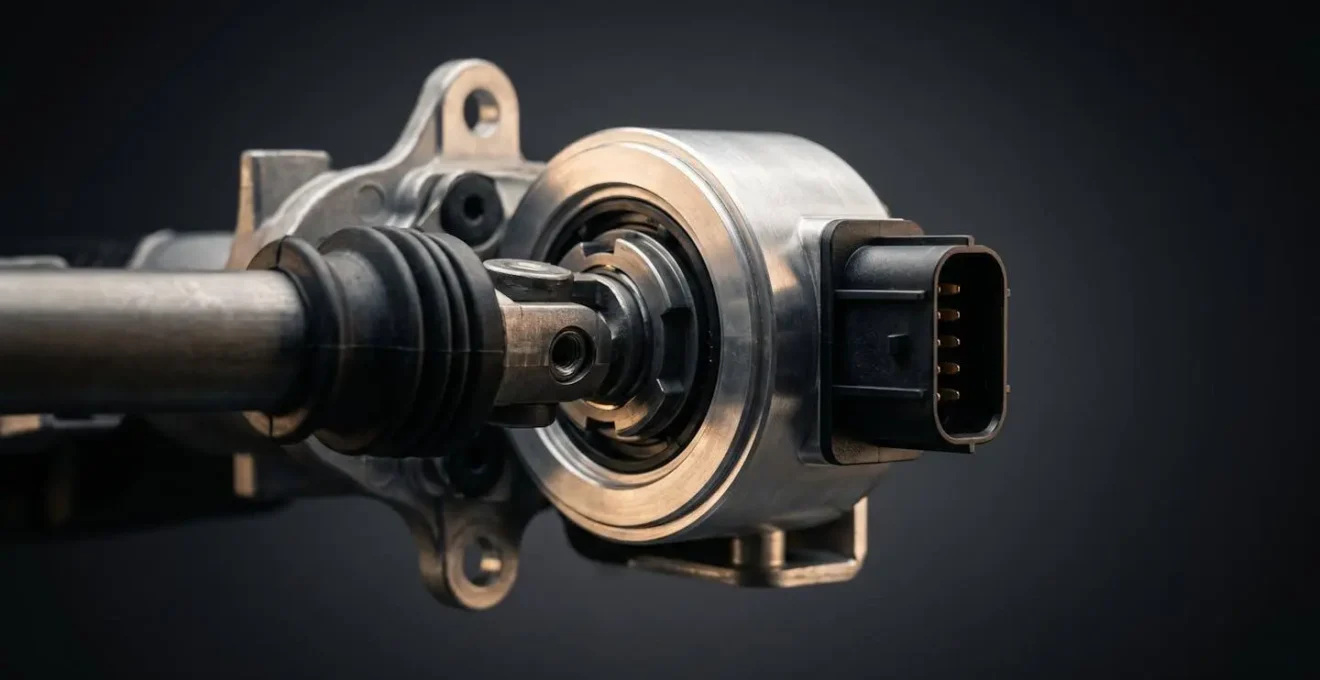
The steering angle sensor, a precision instrument often located on the steering column, is the system’s understanding of your intent. If this intent is misreported, the car’s reaction will be flawed. Troubleshooting these « dry pavement » activations, therefore, involves checking for these logical discrepancies: verifying all four tires are identical in size, brand, and wear, and ensuring the steering angle sensor has been correctly calibrated, especially after any suspension or alignment work.
Why ABS Might Increase Your Stopping Distance on Gravel or Snow?
The Anti-lock Braking System (ABS) is a cornerstone of modern vehicle safety, designed to prevent wheel lock-up during hard braking and allow the driver to maintain steering control. On paved surfaces, this is a massive benefit, leading to shorter, more controlled stops. However, on certain loose surfaces like deep snow, sand, or gravel, the very action of ABS can paradoxically increase your stopping distance. This is due to a phenomenon often called the « grip wedge. » When a non-ABS-equipped wheel locks up on a loose surface, it plows material in front of it, building up a wedge of snow or gravel. This wedge provides a significant amount of braking force, helping to slow the car down quickly.
ABS, by its nature, is designed to prevent this from happening. The system detects the impending wheel lock and rapidly pulses the brake pressure, keeping the wheel rotating just at the threshold of skidding. While this maintains steering control, it prevents the formation of that effective grip wedge. The tire is constantly rolling over the loose material instead of digging into it. The result is that the car may take longer to stop than it would have with locked wheels. This is not a system flaw, but a trade-off inherent in its design: ABS prioritizes steerability over the absolute shortest stopping distance in these specific conditions.
The effect is not trivial. A landmark June 1999 National Highway Traffic Safety Administration study found that ABS increased stopping distances on loose gravel by an average of 27.2%. For drivers in rural or heavy-snow areas, this is critical knowledge. It means you must leave a greater following distance and anticipate braking zones earlier when on unpaved or unplowed roads. While some modern off-road vehicles have specialized ABS modes that allow for more slip to build up a small wedge, the vast majority of passenger cars do not. Understanding this limitation is key to safely managing your vehicle’s braking performance across all types of terrain.
Why Your Stock Spoiler Might Be Generating Dangerous Lift at 80 MPH?
Your car’s ESP system is calibrated with an incredibly precise understanding of the vehicle’s physical characteristics, including its weight, wheelbase, and, crucially, its aerodynamic profile. The engineers program the system based on how the car behaves at speed, including the distribution of downforce (or lift) between the front and rear axles. A factory-designed spoiler is part of this equation, engineered to produce a specific amount of downforce at highway speeds to press the rear tires into the pavement, increasing their grip. However, a poorly designed aftermarket spoiler, or even a factory « styling » spoiler not meant for performance, can do the opposite: it can generate aerodynamic lift.
At speeds above 70-80 mph, this lift can dangerously reduce the load on the rear tires. Less load means less grip. This creates a vehicle that is far more prone to oversteer (where the rear end slides out) than the factory vehicle the ESP was programmed for. The ESP module is now operating with a flawed set of assumptions. It expects a certain level of rear grip that no longer exists. When the driver makes a quick lane change or enters a high-speed corner, the rear of the car can lose traction much more suddenly and violently than the system anticipates. As a result, the ESP’s intervention may be too little, too late. The system might be overwhelmed because the car’s actual behavior is now far outside its programmed parameters.
This is why modifying a car’s aerodynamics is not merely a cosmetic choice; it’s a change to its fundamental handling DNA. The ESP system is a stability aid, but as its core programming states, it does not inherently improve a vehicle’s cornering performance or add grip. It can only work with the grip that is physically available. If an aerodynamic modification actively removes grip from one end of the car, you are creating a condition that even the most advanced stability control system may not be able to manage, turning a safety feature into one that is chasing a problem it wasn’t designed to solve.
Key Takeaways
- ESP is a physics-based stability manager, not a magic grip creator. It works by braking individual wheels to correct skids.
- AWD provides acceleration traction, but ESP provides cornering stability. For avoiding a crash in winter, ESP is the more critical system.
- System failures are most often caused by faulty wheel speed sensors or bad data from mismatched tires, not a faulty ESP module itself.
How to Troubleshoot ABS Activation at Low Speeds on Dry Pavement?
One of the most perplexing and common brake issues is the sensation of the ABS pump activating—a grinding or pulsing feeling through the brake pedal—just before coming to a complete stop on dry pavement. This phantom activation is almost always a symptom of a problem in the wheel speed sensor system, specifically with the ABS tone ring. The tone ring, with its series of teeth, spins past the wheel speed sensor, creating a digital signal. The frequency of this signal tells the ABS module how fast the wheel is turning. At higher speeds, this frequency is very high. But as you slow to a crawl (under 5 mph), the frequency becomes very low, with teeth passing the sensor slowly.
The problem arises when the tone ring develops a small, hairline crack. This crack creates a slightly larger gap in the tooth pattern. At high speeds, this tiny gap is too brief for the sensor to register as an anomaly. However, at very low speeds, when the sensor is expecting a slow, steady stream of pulses, this crack gap is interpreted as the wheel having instantaneously stopped turning. The ABS module, believing a wheel has locked up, immediately activates the pump for that brake circuit to « release » the lock. This causes the pulsing sensation you feel in the pedal for the last few feet of stopping. Once the car stops, the system resets, and the issue only reappears during the final moments of your next stop.
Troubleshooting this issue involves a careful visual inspection of the tone rings on all four wheels. Because they are exposed to the elements, they are prone to corrosion, which can lead to stress cracks over time. The inspection requires raising the vehicle and slowly rotating each wheel hub while closely examining the entire circumference of the ring for any fractures or even missing teeth. In many modern cars, the tone ring is integrated into the wheel bearing hub assembly, meaning a cracked ring often necessitates replacing the entire hub, not just the ring itself.
Mastering your vehicle is a continuous journey of learning. By understanding the intricate logic of its safety systems, you are no longer just a driver, but an informed operator. This knowledge empowers you to work in concert with your car, anticipate its reactions, and maintain control when it matters most. The next logical step is to apply this understanding in a controlled environment. Find a safe, empty parking lot after a snowfall and feel how the car reacts with TC on and off. True confidence is built not from blind faith in technology, but from a deep, practical understanding of its capabilities and, more importantly, its limits.